

Gelatin-alginate compound slurry, gelatin-alginate compound scaffold and preparation method of gelatin-alginate compound scaffold
A technology of alginate and composite slurry, which is applied in medical science, prosthesis, additive processing, etc. It can solve the problems of complex operation, poor mechanical properties of pure sodium alginate, gelatin, and insufficient stability, and achieve technological operation Simple, solve the effect of weak mechanical strength, improve biological stability and physical and mechanical properties
- Summary
- Abstract
- Description
- Claims
- Application Information
AI Technical Summary
Problems solved by technology
Method used
Image



Examples
preparation example Construction
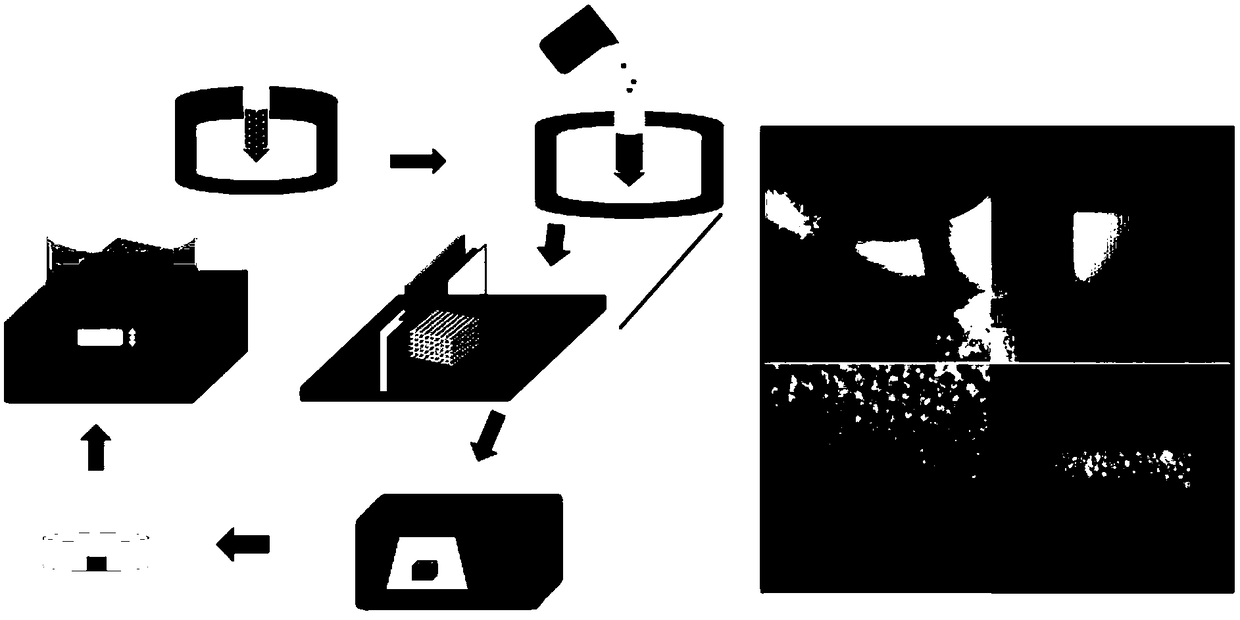
[0032] The preparation method of the gelatin-alginate composite scaffold of the present invention comprises the following steps:
[0033] (1) Preparation of gelatin-alginate composite slurry, which has been described above and is omitted here. Preferably, the composite slurry is prepared as follows: after heating the acrylated gelatin and the ultraviolet crosslinking initiator to dissolve in water, adding alginate or its derivative, stirring in the dark, and mixing uniformly. More specifically, an appropriate amount of acrylated gelatin is dissolved in distilled water (the concentration can be, for example, 15-25 wt %), and the water bath is heated to, for example, about 50° C.-60° C. to make it fully dissolved, and then an appropriate amount of ultraviolet cross-linking initiator is added, And add sodium alginate powder and mix with this solution (the concentration of sodium alginate relative to the solvent used, i.e. water, can be, for example, 5-15wt%), under the above cond...
Embodiment 1
[0040] Example 1: Preparation of gelatin-alginate composite scaffold-1
[0041] Dissolve 2.0 g of acrylated gelatin in 10 mL of distilled water with a concentration of 20 wt%, place it in a water bath at 55°C for 2 hours to fully dissolve it, and add 30 μl of UV cross-linking initiator 2-hydroxy-2-methylpropiophenone ;
[0042] Continue heating in a water bath, add 1.0 g of sodium alginate, and fully mix the sodium alginate and gelatin solution to obtain a gelatin-alginate composite slurry;
[0043] Put the evenly mixed composite slurry into the barrel of the 3D printing instrument (Bioscaffold 2.1 from GeSiM, Germany) and keep it at 55°C, while cooling the printing table (also called the printing stage) to -35°C to prepare the printing bracket;
[0044] Set the remaining 3D printing parameters, including air pressure 0.35MPa, fiber spacing 0.78mm, layer height 0.15mm, printing speed 10mm / s, rotation angle between fiber layers 60°, and the slurry is frozen and printed;
[00...
Embodiment 2
[0048] Example 2: Preparation of Gelatin-Alginate Composite Scaffold-2
[0049] Dissolve 2.0 g of acrylated gelatin in 10 mL of distilled water with a concentration of 20 wt%, place it in a water bath at 55°C for 2 hours to fully dissolve it, and add 30 μl of UV cross-linking initiator 2-hydroxy-2-methylpropiophenone ;
[0050] Continue heating in a water bath, add 1.0 g of sodium alginate, and fully mix the sodium alginate and gelatin solution to obtain a gelatin-alginate composite slurry;
[0051] Put the evenly mixed composite slurry into the barrel of the 3D printing instrument and keep it at 55°C, and at the same time cool the printing (object) stage to -35°C to prepare the printing bracket;
[0052] Set the remaining 3D printing parameters, among which the air pressure is 0.40MPa, the fiber spacing is 0.78mm, the layer height is 0.15mm, the printing speed is 10mm / s, and the rotation angle between the fiber layers is 60°, and the slurry is frozen and printed;
[0053] P...
PUM
| Property | Measurement | Unit |
|---|---|---|
| compressive modulus | aaaaa | aaaaa |
| compressive strength | aaaaa | aaaaa |
Abstract
Description
Claims
Application Information
 Login to View More