Application of metallide/palladium compound catalytic reduction system in debenzylation reaction and deuterization reaction
What is AI technical title?
AI technical title is built by PatSnap AI team. It summarizes the technical point description of the patent document.
A palladium compound and metallization technology, applied in the field of organic synthesis, to achieve the effects of wide substrate range, small molecular weight and easy availability
Active Publication Date: 2018-08-03
SUZHOU UNIV
View PDF0 Cites 6 Cited by
Summary
Abstract
Description
Claims
Application Information
AI Technical Summary
This helps you quickly interpret patents by identifying the three key elements:
Problems solved by technology
Method used
Benefits of technology
Problems solved by technology
Although it has been used for more than 100 years, sodium hydride is rarely used as a reducing agent, and there are few related reports
Method used
the structure of the environmentally friendly knitted fabric provided by the present invention; figure 2 Flow chart of the yarn wrapping machine for environmentally friendly knitted fabrics and storage devices; image 3 Is the parameter map of the yarn covering machine
View more
Image
Smart Image Click on the blue labels to locate them in the text.
Viewing Examples
Smart Image
Click on the blue label to locate the original text in one second.
Reading with bidirectional positioning of images and text.
Smart Image
Examples
Experimental program
Comparison scheme
Effect test
Embodiment 1
[0031]
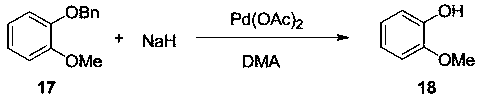
[0032] Under nitrogen protection, palladium acetate (3.4 mg, 0.015 mmol, 5 mol%) and sodium hydride (60% in oil, 18 mg, 0.45 mmol, 1.5 equiv) were suspended in DMA (1.0 mL), stirred at 25°C for 5 minutes, and the compound was added 1 (0.3mmol) in DMA (0.5 mL), react at 50°C for 5 hours, add ice water to stop the reaction, adjust the pH value to 3.5 with dilute hydrochloric acid, extract with ethyl acetate, combine the extracts, wash with sodium sulfateDrying, rotary evaporation to dryness, and purification by column chromatography gave product 2 with a yield of 98%. 1 H NMR (400 MHz, DMSO-d 6 ): δ 10.10 (br, 1H), 8.13 (d, J = 7.9 Hz,1H), 7.80 (d, J = 7.7 Hz, 1H), 7.51-7.37 (m, 2H), 7.31 (q, J = 8.0 Hz, 2H), 6.87 (d, J = 6.8 Hz, 1H); 13 C NMR (151 MHz, DMSO-d 6 ): δ 153.12, 134.38, 127.34, 126.39, 126.04, 124.53, 124.50, 121.94, 118.29, 108.00. LR-MS (ESI): m / z 145.1 [M+H] + .
Embodiment 2
[0034]
[0035]Under nitrogen protection, palladium chloride (2.7 mg, 0.015 mmol, 5 mol%) and lithium hydride (3.6 mg, 0.45 mmol, 1.5 equiv) were suspended in DMF (1.0 mL), stirred at 25°C for 5 minutes, and compound 1 (0.3 mmol) in DMF (0.5 mL), then reacted at 100°C for 1 hour, added ice water to stop the reaction, adjusted the pH value to 3.5 with dilute hydrochloric acid, extracted with ethyl acetate, combined the extracts, dried over sodium sulfate, and spun Evaporated to dryness and purified by column chromatography, the product 2 was obtained with a yield of 91%.
Embodiment 3
[0037]
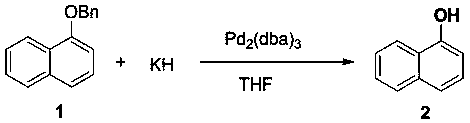
[0038] Under nitrogen protection, Pd 2 (dba) 3 (2.7 mg, 0.003 mmol, 1 mol%) and potassium hydride (30% in oil, 200 mg, 1.5 mmol, 5 equiv) were suspended in THF (1.0 mL), stirred at 25°C for 5 minutes, and compound 1 (0.3mmol) was added solution in THF (0.5 mL), then react at -30°C for 48 hours, add ice water to stop the reaction, adjust the pH value to 3.5 with dilute hydrochloric acid, extract with ethyl acetate, combine the extracts, dry with sodium sulfate, and rotary evaporate Evaporated to dryness and purified by column chromatography, the product 2 was obtained with a yield of 65%.
the structure of the environmentally friendly knitted fabric provided by the present invention; figure 2 Flow chart of the yarn wrapping machine for environmentally friendly knitted fabrics and storage devices; image 3 Is the parameter map of the yarn covering machine
Login to View More
PUM
Login to View More
Abstract
The invention discloses an application of a metallide / palladium compound catalytic reduction system in debenzylation reaction and deuterization reaction of benzyl-containing compounds. The reaction comprises the following steps: under the protection of nitrogen, suspending a palladium compound and a metallide in a solvent, stirring for 5 minutes, adding the benzyl-containing compounds, carrying out a reaction for 0.5 to 48 h at the temperature of -30 DEG C to 150 DEG C, adding ice water to stop the reaction, adjusting the pH value to 3.5 with diluted hydrochloric acid, extracting the reactionsolution by a solvent, drying by distillation, purifying by column chromatography, and thus completing the reaction.
Description
technical field [0001] The invention belongs to the technical field of organic synthesis, and in particular relates to the application of a metalhydride (deuterium) compound / palladium compound catalytic reduction system in debenzylation and deuteration reactions. Background technique [0002] Sodiumhydride is a strong base that is often used in laboratories and industries, and is usually used for hydrogen extraction of substrates to form corresponding sodium salts. Although it has been used for more than 100 years, sodiumhydride is rarely used as a reducing agent, and there are few related reports. Until recently, several research groups reported new uses of sodium hydride as a reducing agent. For example, sodium hydride is used as a reducing agent to reduce amides to aldehydes, and bromobenzene debromination, etc., but a large excess of sodium hydride is required here, and at least 2 equivalents of sodium iodide are required as accelerators; another example is at 1,10 ...
Claims
the structure of the environmentally friendly knitted fabric provided by the present invention; figure 2 Flow chart of the yarn wrapping machine for environmentally friendly knitted fabrics and storage devices; image 3 Is the parameter map of the yarn covering machine
Login to View More
Application Information
Patent Timeline
Application Date:The date an application was filed.
Publication Date:The date a patent or application was officially published.
First Publication Date:The earliest publication date of a patent with the same application number.
Issue Date:Publication date of the patent grant document.
PCT Entry Date:The Entry date of PCT National Phase.
Estimated Expiry Date:The statutory expiry date of a patent right according to the Patent Law, and it is the longest term of protection that the patent right can achieve without the termination of the patent right due to other reasons(Term extension factor has been taken into account ).
Invalid Date:Actual expiry date is based on effective date or publication date of legal transaction data of invalid patent.




 Login to View More
  Login to View More