Check patentability & draft patents in minutes with Patsnap Eureka AI!

Method for preparing high-viscosity dicyandiamide-formaldehyde condensation polymer through aluminum sulfate catalysis and application of high-viscosity dicyandiamide-formaldehyde condensation polymer

A formaldehyde polycondensate, catalytic preparation technology, applied in chemical instruments and methods, water pollutants, textile industry wastewater treatment and other directions, can solve the problems of low solid content, limited wide use, high cost, wide pH applicable range, decolorization Good effect, less dosage effect

Inactive Publication Date: 2018-08-31
山西尼希米环保科技有限公司
View PDF3 Cites 2 Cited by
  • Summary
  • Abstract
  • Description
  • Claims
  • Application Information

AI Technical Summary

Problems solved by technology

A serious disadvantage of the oxidation method is the high processing cost, which limits its widespread use
[0007] In view of the fact that industrial dicyandiamide-formaldehyde polymers exist in liquid form, there are disadvantages of low solid content, inconvenient transportation and high cost of liquid decolorizers, or special equipment is required for drying, which increases production costs

Method used

the structure of the environmentally friendly knitted fabric provided by the present invention; figure 2 Flow chart of the yarn wrapping machine for environmentally friendly knitted fabrics and storage devices; image 3 Is the parameter map of the yarn covering machine
View more

Image

Smart Image Click on the blue labels to locate them in the text.
Viewing Examples
Smart Image
  • Method for preparing high-viscosity dicyandiamide-formaldehyde condensation polymer through aluminum sulfate catalysis and application of high-viscosity dicyandiamide-formaldehyde condensation polymer
  • Method for preparing high-viscosity dicyandiamide-formaldehyde condensation polymer through aluminum sulfate catalysis and application of high-viscosity dicyandiamide-formaldehyde condensation polymer
  • Method for preparing high-viscosity dicyandiamide-formaldehyde condensation polymer through aluminum sulfate catalysis and application of high-viscosity dicyandiamide-formaldehyde condensation polymer

Examples

Experimental program
Comparison scheme
Effect test

Embodiment 1

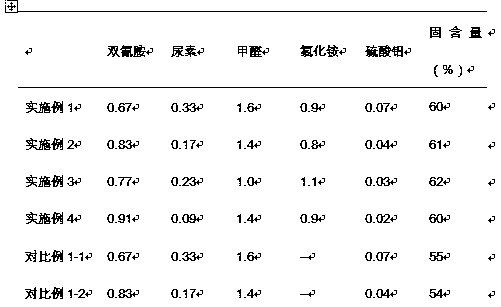
[0021] Add 28.77g of dicyandiamide, 10.26g urea, 24.73g ammonium chloride and 44ml formaldehyde solution in a four-necked flask with stirring, condensing reflux tube and thermometer, then fully mix the above-mentioned ingredients and heat slowly, react 10 After ~15 minutes, the reaction system is exothermic, stop heating, the temperature of the mixing system is automatically raised to 35~45°C, then add 12g of aluminum sulfate, keep the temperature at 35~45°C for 20 minutes, then add 23ml of formaldehyde solution, heat up After reacting for 3 hours at 75°C, the temperature was slowly lowered to room temperature. The obtained high-viscosity dicyandiamide-formaldehyde condensation polymer is a colorless transparent viscous solid.

Embodiment 2

[0023] Add 30.53g of dicyandiamide, 4.47g of urea, 18.72g of ammonium chloride and 30ml of formaldehyde solution in a four-neck flask with stirring, condensing reflux tube and thermometer, then fully mix the above-mentioned ingredients and heat slowly, react 10 After ~15 minutes, the reaction system is exothermic, stop heating, the temperature of the mixing system is automatically raised to 35~45°C, then add 6g of aluminum sulfate, keep the temperature at 35~45°C for 20 minutes, then add 20ml of formaldehyde solution, heat up After reacting for 3 hours at 70°C, the temperature was slowly lowered to room temperature. The obtained high-viscosity dicyandiamide-formaldehyde condensation polymer is a colorless transparent viscous solid.

Embodiment 3

[0025] Add 25.22g of dicyandiamide, 5.39g of urea, 22.95g of ammonium chloride and 20ml of formaldehyde solution in a four-necked flask with stirring, condensing reflux tube and thermometer, then fully mix the above-mentioned ingredients and heat slowly, react 10 After ~15 minutes, the reaction system is exothermic, stop heating, the temperature of the mixing system is automatically raised to 35~45°C, then add 4g of aluminum sulfate, keep the temperature at 35~45°C for 20 minutes, then add 20ml of formaldehyde solution, heat up to 65°C, reacted for 3 hours, and then slowly cooled down to room temperature. The obtained high-viscosity dicyandiamide-formaldehyde condensation polymer is a colorless transparent viscous solid.

the structure of the environmentally friendly knitted fabric provided by the present invention; figure 2 Flow chart of the yarn wrapping machine for environmentally friendly knitted fabrics and storage devices; image 3 Is the parameter map of the yarn covering machine
Login to View More

PUM

No PUM Login to View More

Abstract

The invention relates to a method for preparing a high-viscosity dicyandiamide-formaldehyde condensation polymer through aluminum sulfate catalysis and application of the high-viscosity dicyandiamide-formaldehyde condensation polymer. Aluminum sulfate serves as a catalyst, and dicyandiamide, formaldehyde, urea and ammonium chloride are subjected to a polycondensation reaction to prepare the high-viscosity dicyandiamide-formaldehyde condensation polymer. The method has the advantages of being simple in process, easy to operate, good in decoloring effect and high in COD removal rate, and the defects that existing liquid decolorizer is inconvenient to transport and high in cost and solidification of the liquid decolorizer increases the production cost can be overcome.

Description

Technical field [0001] The invention belongs to the technical field of sewage treatment, and specifically relates to a method for preparing high-viscosity dicyandiamide-formaldehyde condensation polymer catalyzed by aluminum sulfate and its use for reducing the color and COD of printing and dyeing wastewater. Background technique [0002] The textile printing and dyeing industry is a large water consumer. Its wastewater discharge and total pollutant volume rank second and fourth among the national industrial sectors respectively. It is one of the key polluting industries in my country. Wastewater contains dyes, slurries, additives, acids, alkali, fiber impurities and inorganic salts with high color and complex composition. The amino compounds and heavy metal elements such as copper, chromium, zinc, and arsenic in the dye structure are highly toxic. Currently, 10% to 22% of dyes in the dyeing process are discharged into wastewater, seriously polluting the environment. With ...

Claims

the structure of the environmentally friendly knitted fabric provided by the present invention; figure 2 Flow chart of the yarn wrapping machine for environmentally friendly knitted fabrics and storage devices; image 3 Is the parameter map of the yarn covering machine
Login to View More

Application Information

Patent Timeline
no application Login to View More
Patent Type & Authority Applications(China)
IPC IPC(8): C08G12/16C02F1/56C02F101/30C02F103/30
CPCC08G12/16C02F1/56C02F2101/308C02F2103/30
Inventor 王颖张冰如苏忠勇
Owner 山西尼希米环保科技有限公司
Features
  • R&D
  • Intellectual Property
  • Life Sciences
  • Materials
  • Tech Scout
Why Patsnap Eureka
  • Unparalleled Data Quality
  • Higher Quality Content
  • 60% Fewer Hallucinations
Social media
Patsnap Eureka Blog
Learn More