Method for quantitatively determining theophylline and theobromine
A technique for quantitative determination of theobromine, applied in the direction of material excitation analysis, fluorescence/phosphorescence, etc., can solve the problems of complex sample preparation, unavoidable derivative reagents, long detection time, etc., and achieve strong anti-interference ability, good response, The effect of high sensitivity
- Summary
- Abstract
- Description
- Claims
- Application Information
AI Technical Summary
Problems solved by technology
Method used
Image



Examples
Embodiment 1
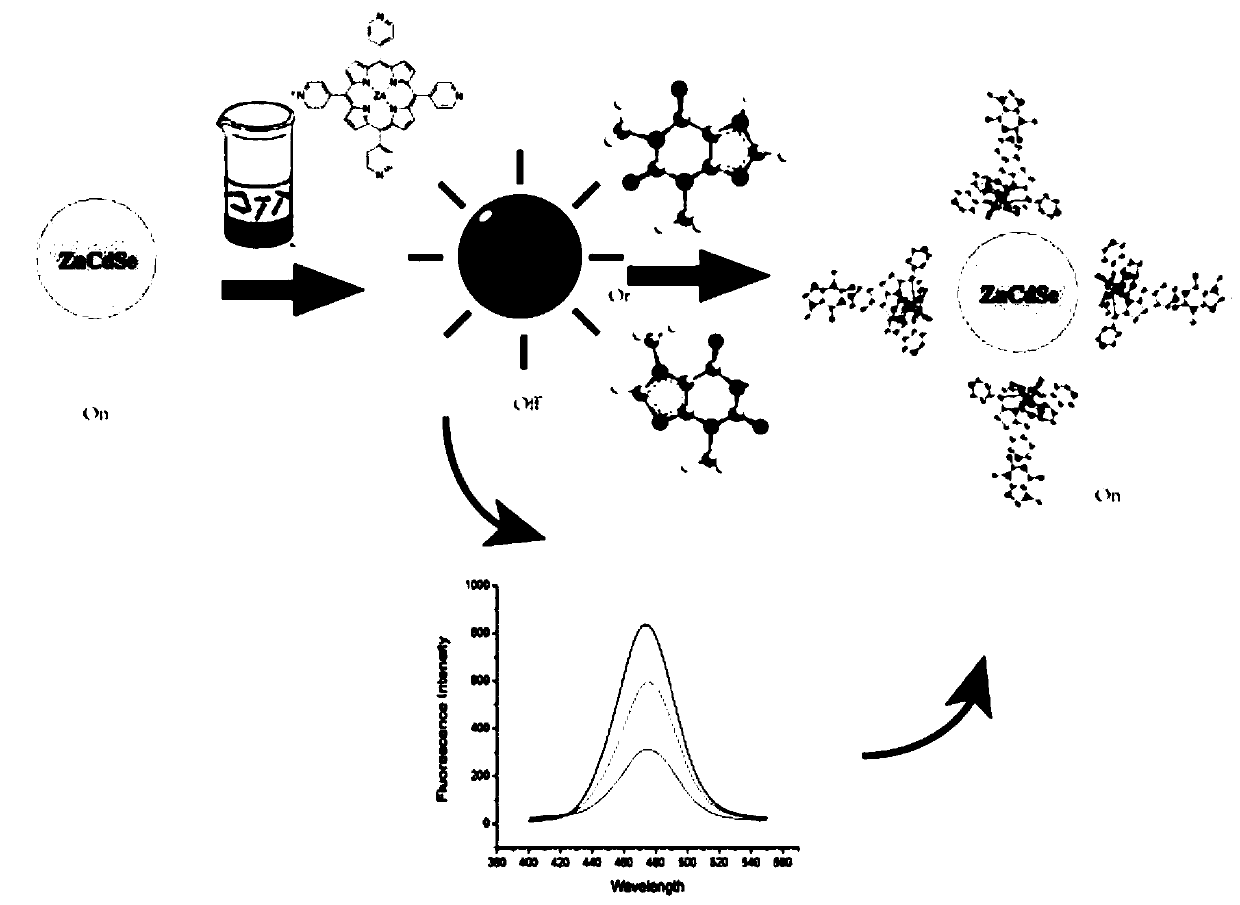
[0039] Embodiment 1: The recognition and quantitative analysis of theophylline by the reversible nano-porphyrin fluorescent sensor, the schematic diagram of the method is shown in 1, and the steps are as follows:
[0040] (1) Synthesis of ZnCdSe quantum dot fluorescent probe
[0041] Dissolve zinc dichloride (0.035g, 6.4mM) and N-acetyl-L-cysteine (0.1253g, 19.2mM) in 40mL of ultrapure water, stir for 20 minutes in an ice bath, and use Adjust the pH of the solution to 9.7 with sodium hydroxide solution, adjust the pH by adding 300 μL of cadmium dichloride (0.00058 g, 0.237 mM), then fill with nitrogen and stir in an ice bath for 5 to 10 minutes. Add NaHSe (prepared from 0.001 g / mL selenium powder and 0.0029 g / mL sodium borohydride) and stir for 5 minutes. Finally, the solution was put into a reaction kettle and reacted in an oven at 200° C. for 65 minutes. Cooling to room temperature yielded 2.37×10 -8 mol / L ZnCdSe quantum dot fluorescent probe.
[0042] (2) Synthesis of...
Embodiment 2
[0048] Embodiment 2: Quantitative analysis of theobromine by the reversible nano-porphyrin fluorescent sensor, the schematic diagram of the method is shown in 1, and the steps are as follows:
[0049] (1) Synthesis of ZnCdSe quantum dot fluorescent probe
[0050] The ZnCdSe quantum dot fluorescent probe was synthesized by the method of step (1) in Example 1.
[0051] (2) Synthesis of tetrakis-(4-pyridyl)zinc porphyrin self-assembly solution
[0052] The method of step (2) in Example 1 was used to synthesize tetrakis-(4-pyridyl)zinc porphyrin self-assembly solution.
[0053] (3) Preparation of switch nanoporphyrin fluorescent sensor
[0054] The nano-porphyrin fluorescence sensor was prepared by the method of step (3) in Example 1.
[0055] (4) Quantitative analysis of theobromine by reversible nanoporphyrin fluorescent sensor
[0056] Add 100 μL of theobromine aqueous solution to a 1.5mL cuvette, 80 μL of 1.392×10 -4 mol / L tetrakis-(4-pyridyl)zinc porphyrin self-assembly ...
PUM
| Property | Measurement | Unit |
|---|---|---|
| Particle size | aaaaa | aaaaa |
Abstract
Description
Claims
Application Information
 Login to View More
PatSnap Eureka turns technology decisions into work you can execute. Powered by our Innovation Knowledge Graph, it runs expert workflows across engineering, life sciences, materials and intellectual property. Get your review-ready output in minutes.


