Check patentability & draft patents in minutes with Patsnap Eureka AI!

Method for synthesizing N-difluoromethyl-containing compound

A technology of difluoromethylation and difluoromethylation, which is applied in the direction of organic chemistry, can solve the problems of high reaction temperature, expensive difluoromethylation reagents, and high price of chlorodifluoromethylphenyl sulfone, and achieve photocatalytic Mild reaction conditions, simple reaction steps, and good substrate adaptability

Active Publication Date: 2019-11-22
ZHEJIANG UNIV OF TECH
View PDF2 Cites 1 Cited by
  • Summary
  • Abstract
  • Description
  • Claims
  • Application Information

AI Technical Summary

Problems solved by technology

[0003] In 2007, Zheng and Ji discovered a difluoromethylation of secondary amines in acetonitrile solution using chlorodifluoromethylphenyl sulfone as a difluoromethylation reagent and potassium hydroxide as a base. method, but the price of chlorodifluoromethyl sulfone used in this method is relatively high, and it is not suitable for mass production
[0005] In 2014, G.K.Surya Prakash discovered a method of difluoromethylation of secondary amines under the joint action of lithium iodide and (trifluoromethyl)trimethylsilane, using triglyme as a solvent, and 170 degrees Celsius. method (OrganicLetters,16(1),54-57; 2014), but the reaction temperature required for this method is too high
However, this method has the disadvantage that the difluoromethylation reagent used is too expensive

Method used

the structure of the environmentally friendly knitted fabric provided by the present invention; figure 2 Flow chart of the yarn wrapping machine for environmentally friendly knitted fabrics and storage devices; image 3 Is the parameter map of the yarn covering machine
View more

Image

Smart Image Click on the blue labels to locate them in the text.
Viewing Examples
Smart Image
  • Method for synthesizing N-difluoromethyl-containing compound
  • Method for synthesizing N-difluoromethyl-containing compound
  • Method for synthesizing N-difluoromethyl-containing compound

Examples

Experimental program
Comparison scheme
Effect test

Embodiment 1

[0035]

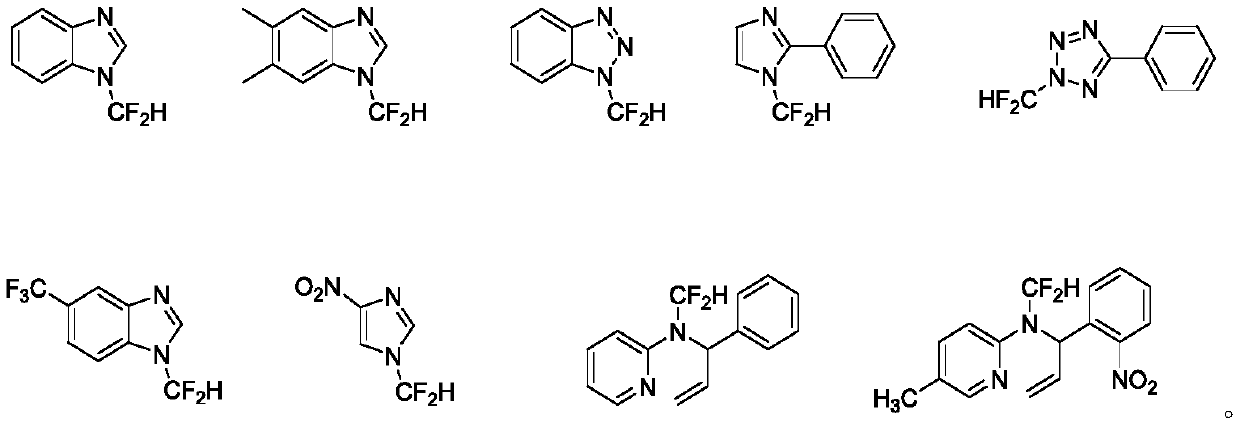
[0036] Add 0.3mmol benzimidazole, 0.009mmol photosensitizer, and 0.6mmol potassium phosphate into a 15ml schlenck tube. After the nitrogen protection is completed, add 0.6mmol ethyl bromodifluoroacetate and 3mL DMF with a syringe. Then, react at room temperature for 12 hours under 15W blue light irradiation. After the reaction was over, add two spoons of column chromatography silica gel (100-200 mesh) in the reaction solution, and remove the solvent by distillation under reduced pressure, then obtain the pure product by column chromatography (with petroleum ether / ethyl acetate=50 :1 as eluent). The material was a yellow liquid, 75% yield.

[0037] Characterization data: 1 H NMR (500MHz, CDCl 3 )δ8.13(s,1H),7.87-7.85(m,1H),7.63-7.62(m,1H),7.43-7.38(m,2H),7.35(t,J=70.5 Hz,1H); 13 C NMR (125MHz, CDCl3) δ143.9, 139.1, 130.6, 124.8, 124.2, 121.0, 111.1, 109.0 (t, J = 248.75Hz).

Embodiment 2

[0039]

[0040] Add 0.3mmol 5.6-dimethylbenzimidazole, 0.009mmol photosensitizer, and 0.6mmol potassium phosphate into a 15ml Schlenck tube. After the nitrogen protection is completed, add 0.9mmol ethyl bromodifluoroacetate and 3mL DMF with a syringe. Then, react at room temperature for 12 hours under 15W blue light irradiation. After the reaction was over, add two spoons of column chromatography silica gel (100-200 mesh) in the reaction solution, and remove the solvent by distillation under reduced pressure, then obtain the pure product by column chromatography (with petroleum ether / ethyl acetate=50 :1 as eluent). The material was a yellow liquid, 60% yield.

[0041] Characterization data: 1 H NMR (500MHz, CDCl 3 )δ7.92(s,1H),7.52(s,1H),7.30(s,1H),7.19(t,J=60.5Hz,1H),2.33(s,3H),2.31(s,3H) . 13 C NMR (125MHz, CDCl 3 )δ142.66, 138.41, 134.31, 133. 31, 129.14, 121.04, 111.35, 109.13 (t, J=249.2Hz), 20.67, 20.42.

Embodiment 3

[0043]

[0044] Add 0.3mmol benzotriazole, 0.06mmol photosensitizer, and 0.6mmol potassium phosphate into a 15ml schlenck tube. After the nitrogen protection is completed, add 0.6mmol ethyl bromodifluoroacetate and 3mL DMF with a syringe. Then, react at room temperature for 12 hours under 15W blue light irradiation. After the reaction was over, add two spoons of column chromatography silica gel (100-200 mesh) in the reaction solution, and remove the solvent by distillation under reduced pressure, then obtain the pure product by column chromatography (with petroleum ether / ethyl acetate=50 :1 as eluent). The material was a yellow liquid, 50% yield.

[0045] Characterization data: 1 H NMR (500MHz, CDCl 3 )δ8.15(d, J=8.0Hz, 1H), 7.88(t, J=58.5Hz, 1H), 7.85(d, J=8.5Hz, 1H), 7.65(t, J= 7.5Hz, 1H) ,7.51(t,J=7.5Hz,1H); 13 C NMR (125MHz, CD Cl 3 )δ146.5, 130.0, 129.5, 125.6, 120.5, 111.3 (t, J=250.0Hz), 1 10.8.

the structure of the environmentally friendly knitted fabric provided by the present invention; figure 2 Flow chart of the yarn wrapping machine for environmentally friendly knitted fabrics and storage devices; image 3 Is the parameter map of the yarn covering machine
Login to View More

PUM

No PUM Login to View More

Abstract

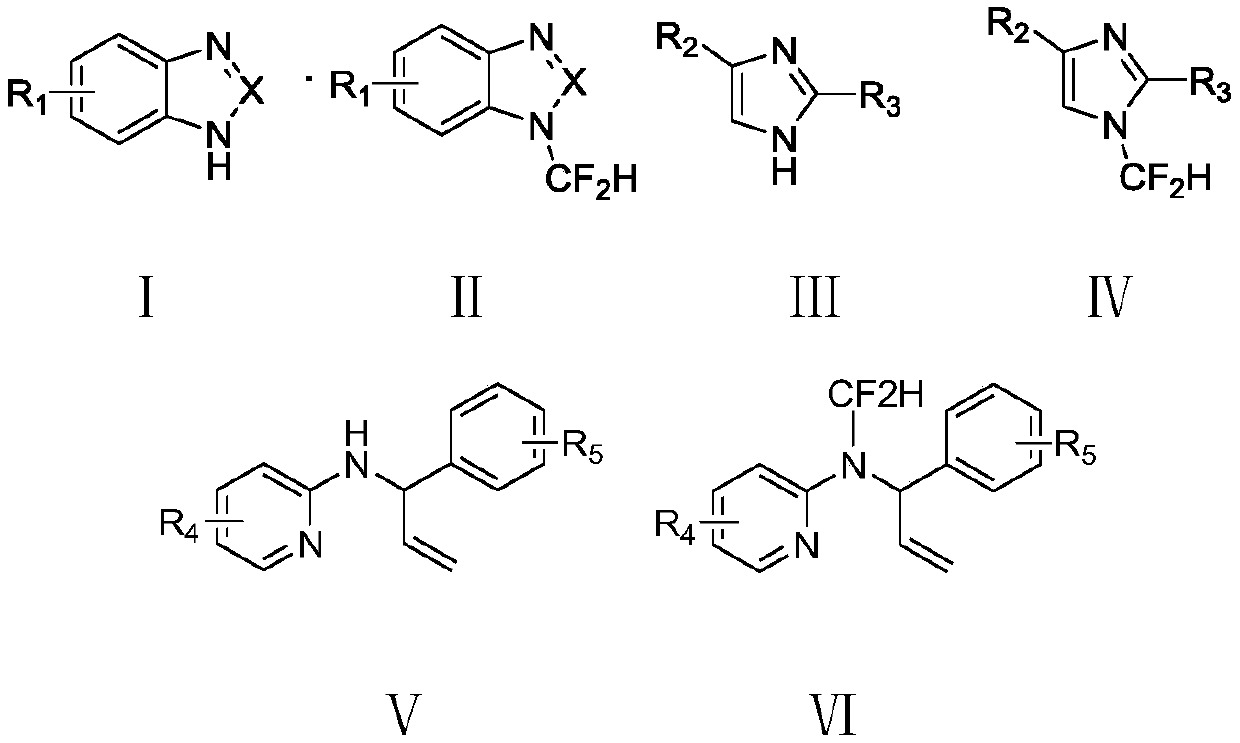
The invention discloses a method for synthesizing a N-difluoromethyl-containing compound. The method comprises reacting a nitrogen-containing nucleophilic reagent as shown in a formula I or III or V as a starting material for 6-24 hours in the presence of a photosensitizer, an alkaline substance and a solvent, and by adopting ethyl bromodifluoroacetate as a difluoromethylation reagent, and subjecting the obtained reaction solution to separation and purification to obtain the N-difluoromethyl-containing compound as shown in a formula II or IV or VI, wherein the mole ratio of the nitrogen-containing nucleophilic reagent shown in the formula I or III or VI, the difluoromethylation reagent, the photosensitizer and the alkaline substance is 1:(1-3):(0.02-0.05):(1-3). The difluoromethylation reagent used in the method is cheap and easily available and good in substrate adaptability, and N-difluoromethylation of various substituent groups can be realized; the photocatalytic reaction conditions are mild; reaction steps are simple, and the method is a novel route for synthesizing various N-difluoromethyl-containing compounds.

Description

technical field [0001] The invention relates to a method for synthesizing organic compounds, in particular to a method for preparing a compound containing N-difluoromethyl. Background technique [0002] In the field of organic chemistry, the special physical and chemical properties of fluorine have won an important position in physiologically active substances such as medicine and pesticides. The introduction of fluorine in the molecular design process of physiologically active substances can change its biological activity by affecting its properties such as fat solubility, stability, and permeability; it can also change various factors that affect the conformational relationship, such as binding to target receptors or enzymes , Transportation from the application point to the target site hinders metabolic inactivation and other effects to enhance the performance of the compound, which makes many fluorine-containing drugs relatively have the characteristics of less dosage, l...

Claims

the structure of the environmentally friendly knitted fabric provided by the present invention; figure 2 Flow chart of the yarn wrapping machine for environmentally friendly knitted fabrics and storage devices; image 3 Is the parameter map of the yarn covering machine
Login to View More

Application Information

Patent Timeline
no application Login to View More
IPC IPC(8): C07D235/06C07D233/56C07D233/93C07D249/18C07D257/04C07D213/74
CPCC07D213/74C07D233/56C07D233/93C07D235/06C07D249/18C07D257/04
Inventor 刘运奎胡晓君周丙伟
Owner ZHEJIANG UNIV OF TECH
Features
  • R&D
  • Intellectual Property
  • Life Sciences
  • Materials
  • Tech Scout
Why Patsnap Eureka
  • Unparalleled Data Quality
  • Higher Quality Content
  • 60% Fewer Hallucinations
Social media
Patsnap Eureka Blog
Learn More