Degradable temporary plugging agent for workover and preparation method thereof
Inactive Publication Date: 2020-01-10
DAGANG OIL FIELD GRP +1
View PDF7 Cites 19 Cited by
Summary
Abstract
Description
Claims
Application Information
AI Technical Summary
This helps you quickly interpret patents by identifying the three key elements:
Problems solved by technology
Method used
Benefits of technology
Problems solved by technology
However, with the development of oil fields, the water content of oil wells in most onshore oil fields in my country has gradually increased. Taking Dagang Oilfield as an example, the average water content of oil wells is above 70%, and some oil wells have water content above 90%. The degradation rate of oil-soluble temporary plugging agent Obvious reduction
[0004] In addition, the pressure between the various layers of the water injection well is unbalanced. During the workover, well killing, sand washing and other operations, the fluid leakage into the well is serious, and many wells cannot be killed and circulated normally, resulting in the uncontinuity of the operation process and seriously affecting The operation and normal production of the water well will be affected, and it will also cause damage to the formation. Some measures for water injection wells also need to apply temporary plugging technology
[0005] The currently used gel-type plugging materials such as bulky particles are variable elastic materials, and their plugging effect is good, but because they cannot degrade by themselves, they often need to be removed by oxidizing agents or acid solutions, which not only poses certain safety hazards , and increase the construction cost
Method used
the structure of the environmentally friendly knitted fabric provided by the present invention; figure 2 Flow chart of the yarn wrapping machine for environmentally friendly knitted fabrics and storage devices; image 3 Is the parameter map of the yarn covering machine
View more
Image
Smart Image Click on the blue labels to locate them in the text.
Viewing Examples
Smart Image
Click on the blue label to locate the original text in one second.
Reading with bidirectional positioning of images and text.
Smart Image
Examples
Experimental program
Comparison scheme
Effect test
Embodiment 1
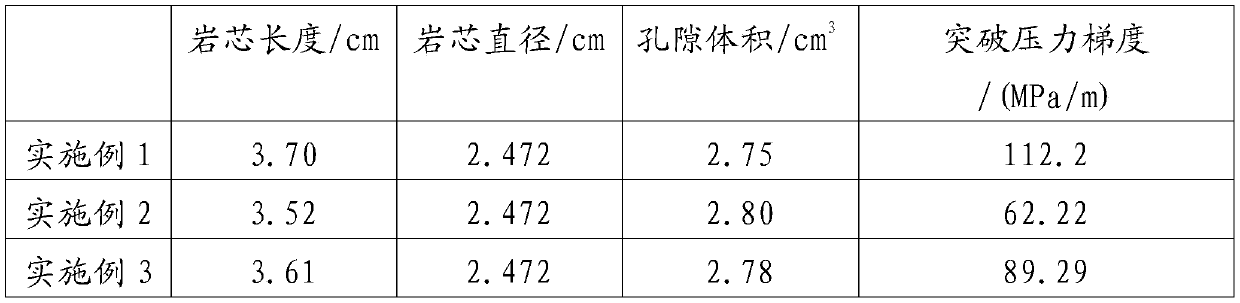
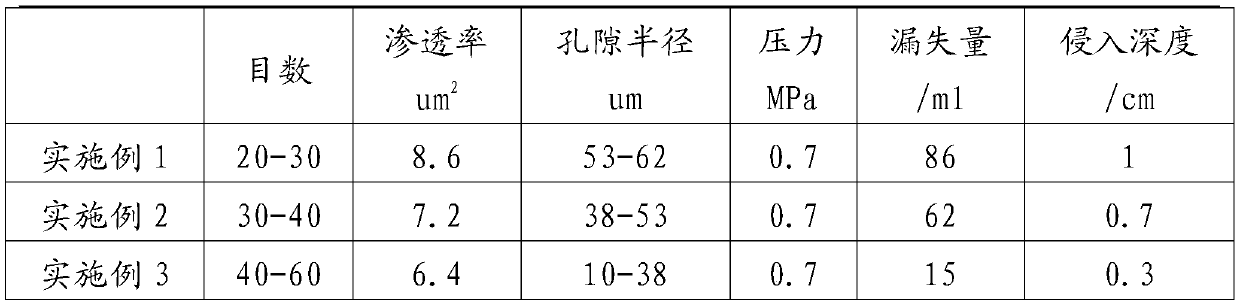
[0023] (1) Weigh 15g of corn flour and add it to 134.756g of distilled water, stir at 65°C for 30min to make it gelatinized;
[0024] (2) Keep the temperature of the solution at 20°C, add 10 g of acrylic acid and 30 g of acrylamide in sequence, adjust the pH value to 6.5-7 with 10% sodiumhydroxide solution, and stir for 20 minutes to obtain intermediate solution 1;
[0025] (3) Weigh 12g of sodium alginate, 0.004g of hydroquinone, and 10g of bentonite into intermediate liquid 1, stir for 30 minutes to obtain a uniform solution, and obtain intermediate liquid 2;
[0026] (4) Weigh 0.04g of polyethyleneglycol diacrylate and add it to intermediate liquid 2, and pass it through nitrogen for protection for 30-50min to obtain intermediate liquid 3;
[0027] (5) Adjust the temperature of the solution to 50°C, weigh 0.6g of ammoniumpersulfate and 0.6g of sodiumbisulfite and add them to the intermediate liquid 3, continue to pass nitrogen for 30min, then let the reaction stand for ...
Embodiment 2
[0029] (1) Weigh 20g of corn flour and add it to 37.79g of distilled water, and stir for 30min at 65°C to make it gelatinized;
[0030] (2) Keep the temperature of the solution at 20°C, add 14g of acrylic acid and 42g of acrylamide in sequence, adjust the pH value to 6.5-7 with 10% sodium hydroxide solution, and stir for 20 minutes to obtain intermediate solution 1;
[0031] (3) Weigh 24g of sodium alginate, 0.01g of hydroquinone, and 30g of nanoclay into intermediate solution 1, stir for 30 minutes to obtain a uniform solution, and obtain intermediate solution 2;
[0032] (4) Weigh 0.2 g of polyethyleneglycol diacrylate and add it to intermediate liquid 2, and pass through nitrogen for protection for 30-50 minutes to obtain intermediate liquid 3;
[0033] (5) Adjust the temperature of the solution to 50°C, weigh 1.0g of ammoniumpersulfate and 1.0g of sodium bisulfite and add them to the intermediate liquid 3, continue to pass nitrogen for 30min, then let the reaction stand ...
Embodiment 3
[0035] (1) Weigh 18g of corn flour and add it to 96.272g of distilled water, stir at 65°C for 30min to make it gelatinized;
[0036] (2) Keep the temperature of the solution at 20° C., add 12 g of acrylic acid and 36 g of acrylamide in sequence, adjust the pH value to 6.5-7 with 10% sodium hydroxide solution, and stir for 20 minutes to obtain intermediate solution 1;
[0037] (3) Weigh 16g of sodium alginate, 0.008g of hydroquinone, 10g of bentonite and 10g of nanoclay and add them to intermediate solution 1, stir for 30 minutes to obtain a uniform solution, and obtain intermediate solution 2;
[0038] (4) Weigh 0.12 g of polyethyleneglycol diacrylate and add it to intermediate liquid 2, and pass it through nitrogen for protection for 30-50 minutes to obtain intermediate liquid 3;
[0039] (5) Adjust the temperature of the solution to 50°C, weigh 0.8g of ammoniumpersulfate and 0.8g of sodium bisulfite and add them to the intermediate liquid 3, continue to pass nitrogen for 3...
the structure of the environmentally friendly knitted fabric provided by the present invention; figure 2 Flow chart of the yarn wrapping machine for environmentally friendly knitted fabrics and storage devices; image 3 Is the parameter map of the yarn covering machine
Login to View More
PUM
Login to View More
Abstract
The invention belongs to the field of workover operations, and particularly relates to a degradable temporary plugging agent for workover and a preparation method thereof. The degradable temporary plugging agent comprises the following components in parts by mass: 5-7% of acrylic acid, 15-21% of acrylamide, 5-15% of inorganic mineral soil, 0.002-0.005% of a polymerization inhibitor, 6-12% of a degradation promoter, 0.02-0.1% of a crosslinking agent, 0.6-1.0% of an initiator, 7-10% of corn flour and the balance of water. The degradable temporary plugging agent for workover disclosed by the invention has good degradation performance and does not need to add an additional degradation process; for high-water cut oil wells, water wells and the like, the degradable temporary plugging agent can be degraded by itself and resume operation and production only under the condition of a reservoir (under the condition of 90 DEG C, the 48-hour degradation rate can reach more than 90%).
Description
technical field [0001] The invention belongs to the field of well workover operations, and in particular relates to a degradable temporary plugging agent for well workover and a preparation method thereof. Background technique [0002] Workover fluid loss is one of the biggest problems encountered in the workover operation, which not only makes the workover operation impossible, but also causes oil layer damage due to the workover fluid intrusion into the reservoir. Even if the workover operation is carried out smoothly, the oil well after operation The production recovery period is long, and even the production of oil wells cannot be restored to the production before operation. Targeted implementation of temporary plugging technology is one of the effective ways to solve such problems. [0003] At present, the widely used temporary plugging agents can be classified into water-soluble temporary plugging agents, oil-soluble temporary plugging agents, acid-soluble temporary pl...
Claims
the structure of the environmentally friendly knitted fabric provided by the present invention; figure 2 Flow chart of the yarn wrapping machine for environmentally friendly knitted fabrics and storage devices; image 3 Is the parameter map of the yarn covering machine
Login to View More
Application Information
Patent Timeline
Application Date:The date an application was filed.
Publication Date:The date a patent or application was officially published.
First Publication Date:The earliest publication date of a patent with the same application number.
Issue Date:Publication date of the patent grant document.
PCT Entry Date:The Entry date of PCT National Phase.
Estimated Expiry Date:The statutory expiry date of a patent right according to the Patent Law, and it is the longest term of protection that the patent right can achieve without the termination of the patent right due to other reasons(Term extension factor has been taken into account ).
Invalid Date:Actual expiry date is based on effective date or publication date of legal transaction data of invalid patent.


 Login to View More
  Login to View More