Check patentability & draft patents in minutes with Patsnap Eureka AI!

Chloromethane gas dehydration process in butyl rubber production process

A production process and butyl rubber technology, applied in the field of separation and purification, can solve the problems of high hygroscopicity, corrosion of equipment, and difficulty in recycling of triethylene glycol, so as to avoid high energy consumption and environmental pollution, reduce industrial costs, and shorten the service life Effect

Inactive Publication Date: 2021-01-08
BEIJING UNIV OF CHEM TECH
View PDF7 Cites 0 Cited by
  • Summary
  • Abstract
  • Description
  • Claims
  • Application Information

AI Technical Summary

Problems solved by technology

[0003] In addition, there are many other dehydration methods reported in the literature, such as physical dehydration method: NaA molecular sieve is used to remove water in monochloromethane: the advantage is that the adsorbent can be regenerated and reused; the disadvantage is that regeneration generally uses high-temperature inert gas to heat the adsorbent to vaporize water Brought out, the residual material gas in the adsorbent is difficult to recycle, the pollution is large, and the regeneration energy consumption is high; the dehydration of triethylene glycol: the advantage is that triethylene glycol has high hygroscopicity, low vapor pressure, small regeneration loss, and the regeneration process does not need to introduce inertness Gas, less environmental pollution; disadvantages: triethylene glycol still has a certain saturated vapor pressure, which will cause certain losses; long-term operation is prone to oxidation reactions, generating acidic organic acids, which corrode equipment; triethylene glycol is easy to foam and needs to be added Defoamer, which increases the cost; the desorption tower is used in the regeneration process, and the mass transfer and diffusion efficiency of water from triethylene glycol is low. To achieve a better regeneration effect, the regeneration temperature is high (generally at 180 ° C), and the energy consumption is high.
In addition, the solubility of triethylene glycol to some gases is large, which increases the investment in regeneration process equipment, the regeneration process is complicated, and the operation is high.

Method used

the structure of the environmentally friendly knitted fabric provided by the present invention; figure 2 Flow chart of the yarn wrapping machine for environmentally friendly knitted fabrics and storage devices; image 3 Is the parameter map of the yarn covering machine
View more

Image

Smart Image Click on the blue labels to locate them in the text.
Viewing Examples
Smart Image
  • Chloromethane gas dehydration process in butyl rubber production process

Examples

Experimental program
Comparison scheme
Effect test

Embodiment 1

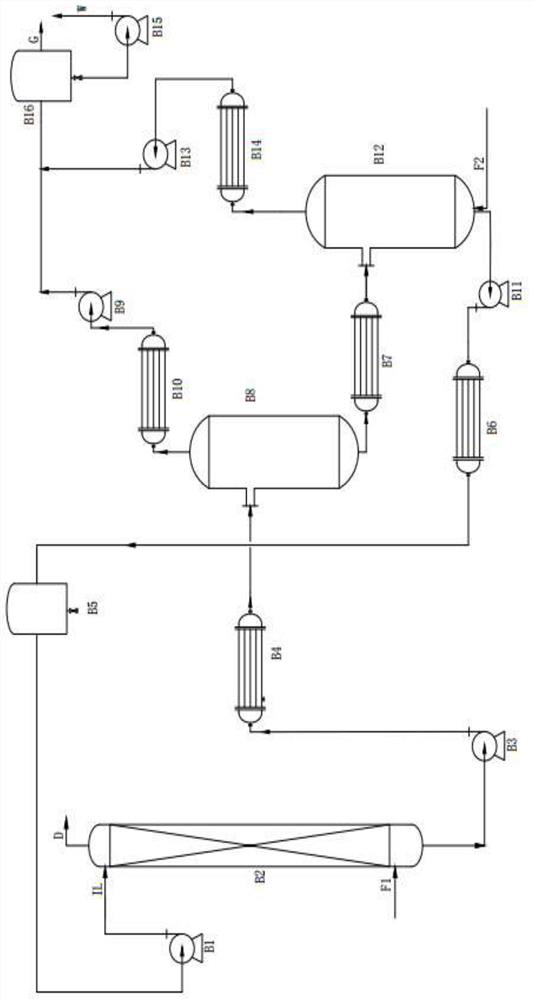
[0017] Such as figure 1 The absorption process is shown. The operating condition of absorption tower is: temperature 25 ℃, pressure absolute pressure 400kp, theoretical column number 6, come from the massfraction of one strand of industrial material (monochloromethane, isobutylene, water, hexane, isoprene of halogenation reaction is 94.66%, 4.72%, 0.3%, 0.2, 0.12) feed from the bottom of the absorption tower, the mass flow rate is controlled at 1000kg / h, ionic liquid [EMIM] + [BF 4 ] - (1-ethyl-3-methylimidazolium tetrafluoroboric acid) is added from the top of the absorption tower as an absorbent, and the mass flow rate is 535kg / h. The water in the material is removed, and the water-rich ionic liquid at the bottom of the absorption tower enters the first flash tank to remove most of the methyl chloride contained in it. The operating conditions of the first flash tank are: temperature 50 ° C, pressure 0.05 atm, Then enter the second flash tank to remove the water contained...

Embodiment 2

[0028] The absorption process is shown in the figure. The operating conditions of the absorption tower are: 25°C of temperature, 400kp of absolute pressure, 6 theoretical towers, a stream of industrial materials from the halogenation reaction (the mass fraction of monochloromethane, isobutylene, water, hexane, isoprene is 94.66 %, 4.72%, 0.3%, 0.2, 0.12) feed from the bottom of the absorption tower, mass flow control 1000kg / h, ionic liquid [EMIM] + [BF 4 ] - (1-ethyl-3-methylimidazolium tetrafluoroboric acid) is added from the top of the absorption tower as an absorbent, and the mass flow rate is 535kg / h. At this time, the water content of the tower top material is 50ppm, which shows that the use of ionic liquid dehydration technology can significantly dehydrate In addition to the water in the material, the water-rich ionic liquid at the bottom of the absorption tower enters the first flash tank to remove most of the methyl chloride contained in it. The operating conditions ...

Embodiment 3

[0036] The absorption process is shown in the figure. The operating conditions of the absorption tower are: temperature 25°C, absolute pressure 400kp, theoretical tower number 6, a stream of industrial materials from the halogenation reaction (the mass fraction of monochloromethane, isobutylene, water, hexane, isoprene is 94.66 %, 4.72%, 0.3%, 0.2, 0.12) feed from the bottom of the absorption tower, mass flow control 1000kg / h, ionic liquid [EMIM] + [BF4] - (1-Ethyl-3-methylimidazolium tetrafluoroboric acid) is added from the top of the absorption tower as an absorbent, and the mass flow rate is 535kg / h. At this time, the water content of the tower top material is 50ppm, which shows that the use of ionic liquid dehydration technology can significantly dehydrate In addition to the water in the material, the water-rich ionic liquid at the bottom of the absorption tower enters the first flash tank to remove most of the methyl chloride contained in it. The operating conditions of ...

the structure of the environmentally friendly knitted fabric provided by the present invention; figure 2 Flow chart of the yarn wrapping machine for environmentally friendly knitted fabrics and storage devices; image 3 Is the parameter map of the yarn covering machine
Login to View More

PUM

No PUM Login to View More

Abstract

The invention discloses a chloromethane gas dehydration process in a butyl rubber production process, and belongs to the technical field of separation and purification. The method comprises the stepsof feeding an industrial material containing a certain amount of water into an absorption tower through a pipeline, wherein the operation conditions of the absorption tower are preferably as follows:the temperature is 25 DEG C, the absolute pressure is 4atm, and the number of theoretical plates is 6. The water content in the industrial material is 0.1%-2% (mass fraction, similarly hereinafter), the ionic liquid rich in water at the bottom of the tower firstly enters a first flash tank to remove most chloromethane contained in the ionic liquid, then enters a second flash tank to remove water contained in the ionic liquid, the ionic liquid extracted from the bottom of the second flash tank is recycled, and finally, the water content in the gas discharged from the tower reaches ppm level.

Description

technical field [0001] The invention relates to a methyl chloride gas dehydration process in the production process of butyl rubber. A single ionic liquid is selected as the absorbent. The cations of the ionic liquid can be imidazoles, pyridines, quaternary ammonium salts, etc., and the anions can be bistrifluoromethanesulfonimide, tetrafluoroborate, hexafluorophosphate, acetate, sulfuric acid diethyl ester etc. It belongs to the technical field of separation and purification. Background technique [0002] Industrially, methyl chloride is an indispensable solvent in the production of butyl rubber, and the water content in methyl chloride directly affects the quality of the final product. The dehydration process of methyl chloride in butyl rubber equipment usually adopts the method of adsorption of activated alumina to remove the water in wet methyl chloride, which can basically meet the production requirements, but the desiccant has a short service life, frequent regenerat...

Claims

the structure of the environmentally friendly knitted fabric provided by the present invention; figure 2 Flow chart of the yarn wrapping machine for environmentally friendly knitted fabrics and storage devices; image 3 Is the parameter map of the yarn covering machine
Login to View More

Application Information

Patent Timeline
no application Login to View More
Patent Type & Authority Applications(China)
IPC IPC(8): B01D53/26B01D53/14
CPCB01D53/1425B01D53/263B01D2257/80
Inventor 雷志刚王振行张傑刘胜利朱瑞松
Owner BEIJING UNIV OF CHEM TECH
Features
  • R&D
  • Intellectual Property
  • Life Sciences
  • Materials
  • Tech Scout
Why Patsnap Eureka
  • Unparalleled Data Quality
  • Higher Quality Content
  • 60% Fewer Hallucinations
Social media
Patsnap Eureka Blog
Learn More