
High-quenching-hardness martensitic stainless steel coil for measuring tool and preparation method thereof
A martensitic stainless steel, quenching hardness technology, used in temperature control, manufacturing tools, metal rolling and other directions, can solve the problem of the complete scrap steel smelting molten steel purity and mechanical properties of finished products are difficult to control stably, die casting billets are prone to shrinkage, Looseness, segregation, energy consumption and high production costs, to reduce the probability of material water ripple defects, avoid uneven deformation of finished products, and achieve good surface quality
- Summary
- Abstract
- Description
- Claims
- Application Information
AI Technical Summary
Problems solved by technology
Method used
Image



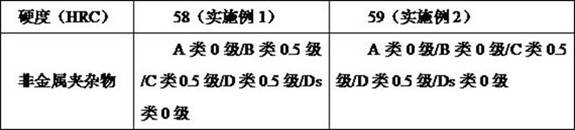
Examples
Embodiment 1
[0037] Embodiment 1: Take the preparation of a martensitic stainless steel strip for measuring tools with a width of 1250 mm and a thickness of 4.3 mm as an example.
[0038] ①Smelting: Smelting martensitic stainless steel with high-purity molten steel through the process of dephosphorizing converter pretreatment-AOD decarburization-LF refining for pure blast furnace molten iron; sampling for laboratory analysis and confirmation, the chemical elements in molten steel The mass percentages are: carbon 0.48%, silicon 0.45%, manganese 0.40%, phosphorus 0.018%, sulfur 0.001%, chromium 13.12%, nickel 0.14%, molybdenum ≤ 0.10%, vanadium ≤ 0.15%, nitrogen 0.0189%, the rest is iron and Unavoidable residual elements.
[0039] ②Continuous casting: The size of the casting slab is 220mm×1250mm×10500mm, the superheat of the tundish is controlled at 40°C, the temperature of the tundish is 1505°C, and a 220mm mold is used for casting.
[0040] ③ Grinding: The continuous casting slab in the a...
Embodiment 2
[0048] Embodiment 2: Take the preparation of a martensitic stainless steel strip for measuring tools with a width of 1250 mm and a thickness of 2.8 mm as an example.
[0049] ①Smelting: Smelting martensitic stainless steel with high-purity molten steel through the process of dephosphorizing converter pretreatment-AOD decarburization-LF refining for pure blast furnace molten iron; sampling for laboratory analysis and confirmation, the chemical elements in molten steel The mass percentage is: carbon 0.49%, silicon 0.52%, manganese 0.42%, phosphorus 0.021%, sulfur 0.0012%, chromium 13.08%, nickel 0.139%, molybdenum ≤ 0.10%, vanadium ≤ 0.15%, nitrogen 0.0218%, the rest is iron and Unavoidable residual elements.
[0050] ② Continuous casting: The size of the slab is 220mm×1250mm×10500mm, the superheat of the tundish is controlled at 38°C, the temperature of the tundish is 1503°C, and a 220mm mold is used for casting.
[0051] ③ Grinding: The continuous casting slab in the above st...
PUM
| Property | Measurement | Unit |
|---|---|---|
| thickness | aaaaa | aaaaa |
| hardness | aaaaa | aaaaa |
| hardness | aaaaa | aaaaa |
Abstract
Description
Claims
Application Information
 Login to View More