Check patentability & draft patents in minutes with Patsnap Eureka AI!

Multi-modified lignosulfonate dye dispersant and preparation method thereof

A technology of lignosulfonate and dye dispersant, which is applied in the direction of dyeing, textile and paper making, etc., can solve the problems of low reduction rate fiber stain, strong reducibility to azo dyes, poor high temperature stability, etc., and achieves excellent High temperature stability, cheap raw materials, and excellent performance

Pending Publication Date: 2022-06-21
DALIAN POLYTECHNIC UNIVERSITY
View PDF4 Cites 0 Cited by
  • Summary
  • Abstract
  • Description
  • Claims
  • Application Information

AI Technical Summary

Problems solved by technology

[0006] Aiming at the current problems of lignin-based dye dispersants such as serious fiber staining, poor dispersion performance, poor high-temperature stability, and strong reducibility to azo dyes, the present invention develops a dispersant that uses alkali lignin as a raw material, has high stability, Multi-modified lignosulfonate dye dispersant with good dispersion performance, low reduction rate to azo dyes, and low fiber staining and preparation method thereof

Method used

the structure of the environmentally friendly knitted fabric provided by the present invention; figure 2 Flow chart of the yarn wrapping machine for environmentally friendly knitted fabrics and storage devices; image 3 Is the parameter map of the yarn covering machine
View more

Image

Smart Image Click on the blue labels to locate them in the text.
Viewing Examples
Smart Image
  • Multi-modified lignosulfonate dye dispersant and preparation method thereof
  • Multi-modified lignosulfonate dye dispersant and preparation method thereof
  • Multi-modified lignosulfonate dye dispersant and preparation method thereof

Examples

Experimental program
Comparison scheme
Effect test

Embodiment 1

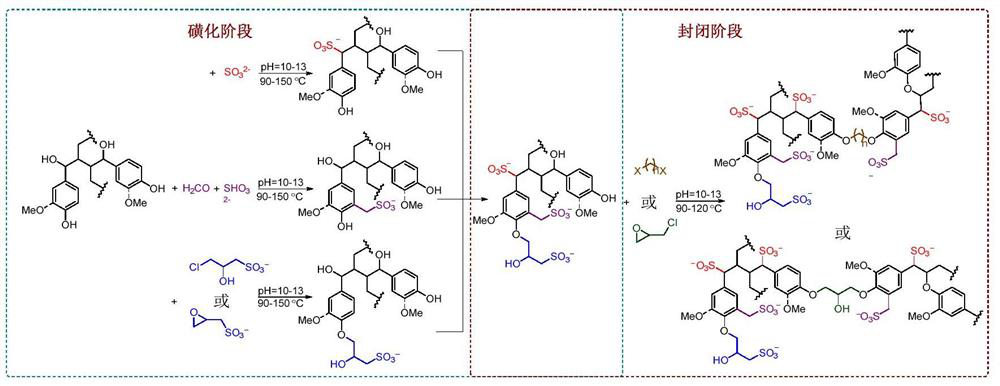
[0033] Add 50 grams of alkali lignin to 500 mL of water, add NaOH to adjust the pH to 10 to dissolve the lignin, add 5 grams of sodium sulfite, react at 150 °C for 2 hours, add 5 grams of formaldehyde, adjust the temperature to 90 °C, and react for 2.5 hours, Then 20 g of dibromohexane was added to react for 2 h. After cooling to room temperature, the purified product was dialyzed against a dialysis bag with a molecular weight of 1000. Then, the solution after dialysis is subjected to vacuum rotary evaporation to remove most of the water, and finally the viscous solution after rotary evaporation is freeze-dried to finally obtain powdery multi-modified lignosulfonate.

Embodiment 2

[0035] Add 50 grams of alkali lignin to 500 mL of water, add NaOH to adjust the pH to 10 to dissolve the lignin, add 5 grams of sodium sulfite, react at 150 °C for 2 hours, and then add 25 grams of sodium 3-chloro-2-hydroxypropyl sulfonate , heated to 90°C, reacted for 2.5h, then added 12 grams of epichlorohydrin to react for 2h, cooled to room temperature, and purified the product by dialysis with a dialysis bag with a molecular weight of 1000. Then, the solution after dialysis is subjected to vacuum rotary evaporation to remove most of the water, and finally the viscous solution after rotary evaporation is freeze-dried to finally obtain powdery multi-modified lignosulfonate.

Embodiment 3

[0037] Add 50 grams of alkali lignin to 500 mL of water, add NaOH to adjust the pH to 10 to dissolve the lignin, add 5 grams of sodium sulfite, react at 150 °C for 2 hours, and add 25 grams of sodium 3-chloro-2-hydroxypropyl sulfonate. The temperature was raised to 90° C., the reaction was carried out for 2.5 hours, and 20 grams of 1,6-dibromohexane were added to react for 2 hours to obtain a modified lignosulfonate solution product. After cooling to room temperature, the purified product was dialyzed against a dialysis bag with a molecular weight of 1000. Then, the solution after dialysis is subjected to vacuum rotary evaporation to remove most of the water, and finally the viscous solution after rotary evaporation is freeze-dried to finally obtain powdery multi-modified lignosulfonate.

the structure of the environmentally friendly knitted fabric provided by the present invention; figure 2 Flow chart of the yarn wrapping machine for environmentally friendly knitted fabrics and storage devices; image 3 Is the parameter map of the yarn covering machine
Login to View More

PUM

No PUM Login to View More

Abstract

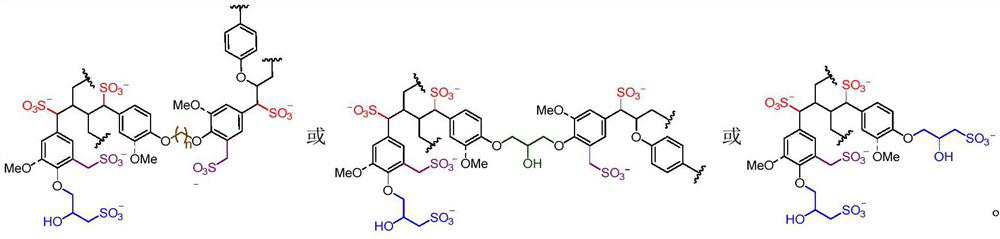
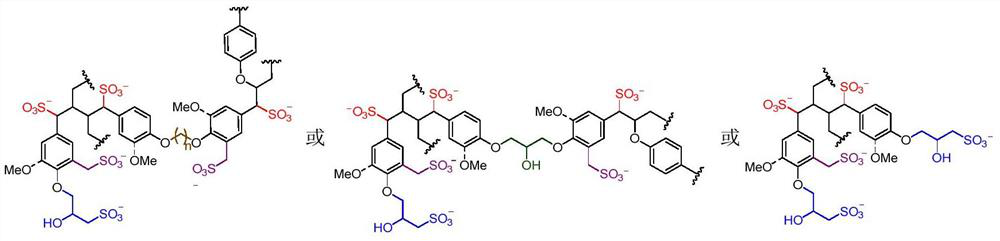
According to the multi-modified lignin dye dispersant and the preparation method thereof, industrial alkali lignin is used as a raw material, a sulfonation reagent 1 and a sulfonation reagent 2 are used as a sulfonation reagent system under the alkaline condition, sulfonic acid groups are introduced at different sites at the same time, and the content of hydrophilic sulfonic acid groups can be greatly increased. And selectively adding a blocking reagent to reduce the content of residual hydroxyl and increase the molecular weight. The multi-modified lignosulfonate can be applied to a dye dispersing agent, a disperse dye system with good dispersity and excellent high-temperature stability can be prepared without grinding, and the multi-modified lignosulfonate has extremely low contamination resistance, has a relatively low reduction rate for azo dyes, can remarkably improve the dye-uptake rate, and can be applied to the dye dispersing agent. The production cost of the printing and dyeing industry can be greatly reduced. The prepared multi-modified lignin dye dispersant is simple in method and excellent in performance, the raw materials are cheap and wide in source, and the multi-modified lignin dye dispersant has potential application and popularization prospects.

Description

technical field [0001] The invention relates to a multi-modified lignin-based dye dispersant and a preparation method thereof, belonging to the technical field of dye dispersants. Background technique [0002] In general, disperse dyes have poor water solubility and are difficult to diffuse into polyester fibers efficiently. The addition of dye dispersant can improve its dispersibility and stability, and significantly improve dyeing efficiency. [0003] The most commonly used dispersants are naphthalene sulfonate and sulfonated lignin. Among them, naphthalene sulfonate mainly comes from non-renewable petrochemical resources, which is expensive and toxic, which is not conducive to sustainable development and environmental protection. Lignin is the second most abundant renewable biomass resource on the earth. Currently, it is mainly used as industrial waste, and its calorific value is recovered through combustion, and its high-value utilization rate is only 2%. Therefore, t...

Claims

the structure of the environmentally friendly knitted fabric provided by the present invention; figure 2 Flow chart of the yarn wrapping machine for environmentally friendly knitted fabrics and storage devices; image 3 Is the parameter map of the yarn covering machine
Login to View More

Application Information

Patent Timeline
no application Login to View More
IPC IPC(8): C08H7/00D06P1/16D06P1/46
CPCC08H6/00D06P1/16D06P1/46D06P3/54C09B67/0086D06P1/18
Inventor 陈小红孙润仓燕莎莎肖领平
Owner DALIAN POLYTECHNIC UNIVERSITY
Features
  • R&D
  • Intellectual Property
  • Life Sciences
  • Materials
  • Tech Scout
Why Patsnap Eureka
  • Unparalleled Data Quality
  • Higher Quality Content
  • 60% Fewer Hallucinations
Social media
Patsnap Eureka Blog
Learn More