Process for preparing protein, DNA and lipid microarray by using APES modified glass slide
A microarray and protein technology, which is applied in the field of biochip/microarray preparation, can solve the problems of parallel detection of autoantibodies, increase the physical and mental burden of patients, and inconvenience clinicians, and achieve high sensitivity, good fixation effect, and coincidence rate high effect
- Summary
- Abstract
- Description
- Claims
- Application Information
AI Technical Summary
Problems solved by technology
Method used
Image

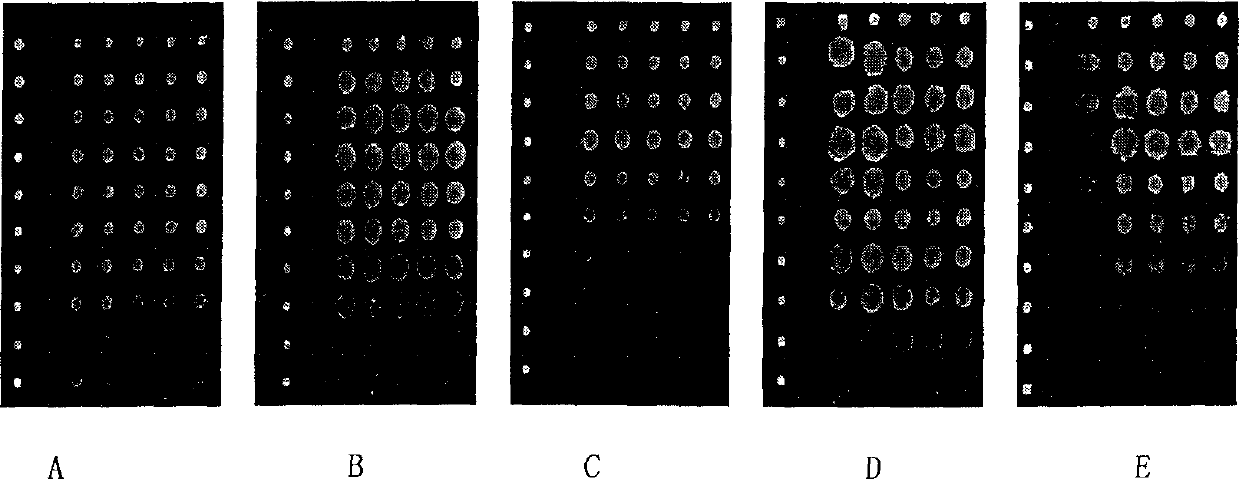


Examples
Embodiment 1
[0060] (1) Rinse the slides with 1N NaOH and concentrated sulfuric acid respectively, rinse with double distilled water until the slides are clean, and spin dry in a centrifuge;
[0061] (2) Put the above-mentioned cleaned glass slides into APES diluted with acetone with a volume ratio of 1:47, and stay for 30-40 seconds;
[0062] (3) Take out the slide, stop for a while, control the dry droplets, and then rinse with pure acetone solution to remove unbound APES;
[0063] (4) Using the APES-modified slide as a substrate, immobilize proteins to prepare a microarray.
[0064] Human IgG starting from 50mg / mL, with PBST (each liter containing NaCl 8.0g, KCl 0.20g, Na 2 HPO 4 1.44g, KH 2 PO 4 0.24g, Tween-20 1ml) for serial dilution, the concentrations are 50, 25, 10, 5, 2.5, 1, 0.5, 0.25, 0.1, 0.05mg / ml, a total of ten gradients. On the above APES-modified slides, 5 replicates per row for each concentration point; positive control uses IgG diluted in the same spotting solution...
Embodiment 2
[0066] (1) Rinse the slides with 1N NaOH and concentrated sulfuric acid respectively, rinse with double distilled water until the slides are clean, and spin dry in a centrifuge;
[0067] (2) Put the above-mentioned cleaned glass slides into APES diluted with acetone with a volume ratio of 1:50, and stay for 20 to 30 seconds;
[0068] (3) Take out the slide, stop for a while, control the dry droplets, and then rinse with pure acetone solution to remove unbound APES;
[0069] (4) After recovery of the vector plasmid pcDNAII frozen at -70°C, inoculate LB (LB-Amp) agar solid medium containing 50 ml of ampicillin, and overnight at 37°C. Pick a single colony and inoculate it in LB-Amp liquid medium, shake the plasmid overnight at 37°C, extract the plasmid with a plasmid extraction kit, verify it by agarose gel electrophoresis, and measure its concentration to be 300 μg / ml.
[0070] (5) Using the above-mentioned APES-modified glass slide as a substrate, the extracted plasmid DNA was...
Embodiment 3
[0072] (1) Rinse the slides with 1N NaOH and concentrated sulfuric acid respectively, rinse with double distilled water until the slides are clean, and spin dry in a centrifuge;
[0073] (2) Put the above-mentioned cleaned glass slides into APES diluted with acetone with a volume ratio of 1:48, and stay for 32 to 42 seconds;
[0074] (3) Take out the slide, stop for a while, control the dry droplets, and then rinse with pure acetone solution to remove unbound APES;
[0075] (4) The cardiolipin solution purchased from Sigma was serially diluted with dimethyl sulfoxide (DMSO), and the concentrations were respectively 4000, 2000, 1000, 500, 200, 100 μg / ml, and sampled with a Cartisian sample spotter, Prepare microarrays.
PUM
 Login to View More
 Abstract
Description
Claims
Application Information
 Login to View More