[0021] The sequences flanking the RGD-containing peptides (bold, underlined) above are modified p17 / p24 HIV-1
protease cleavage sites (VSQNYVIVL). The natural p17 / p24 HIV-1 protease cleavage site is VSQNYPIVL, and HIV-1 protease cleaves at the YP junction. The modified p17 / p24 HIV-1 protease cleavage sites (VSQNYVIVL) used in the designed peptides have a
proline to
valine substitution in the P1' position of the cleavage site. This modification was used so that the peptides released following cleavage by HIV-1 protease have a
valine (V) N-terminal terminal
amino acid which is stabilizing according to the N-end rule; the mammalian N-end rule associates the
intracellular half-life of a
protein with its N-terminal
amino acid. Cleavage of the modified p17 / p24 HIV-1 protease cleavage sites occurs at the YV junction, and the substitution of
valine for
proline has been shown to only have a minor effect on cleavage by HIV-1 protease. See Falnes et al. (1999) Biochem. J. 343:199-207. This modification substantially improves the stability of the released apoptosis-inducing peptides so that they are more likely to activate
caspase-3 and the cell suicide pathway.
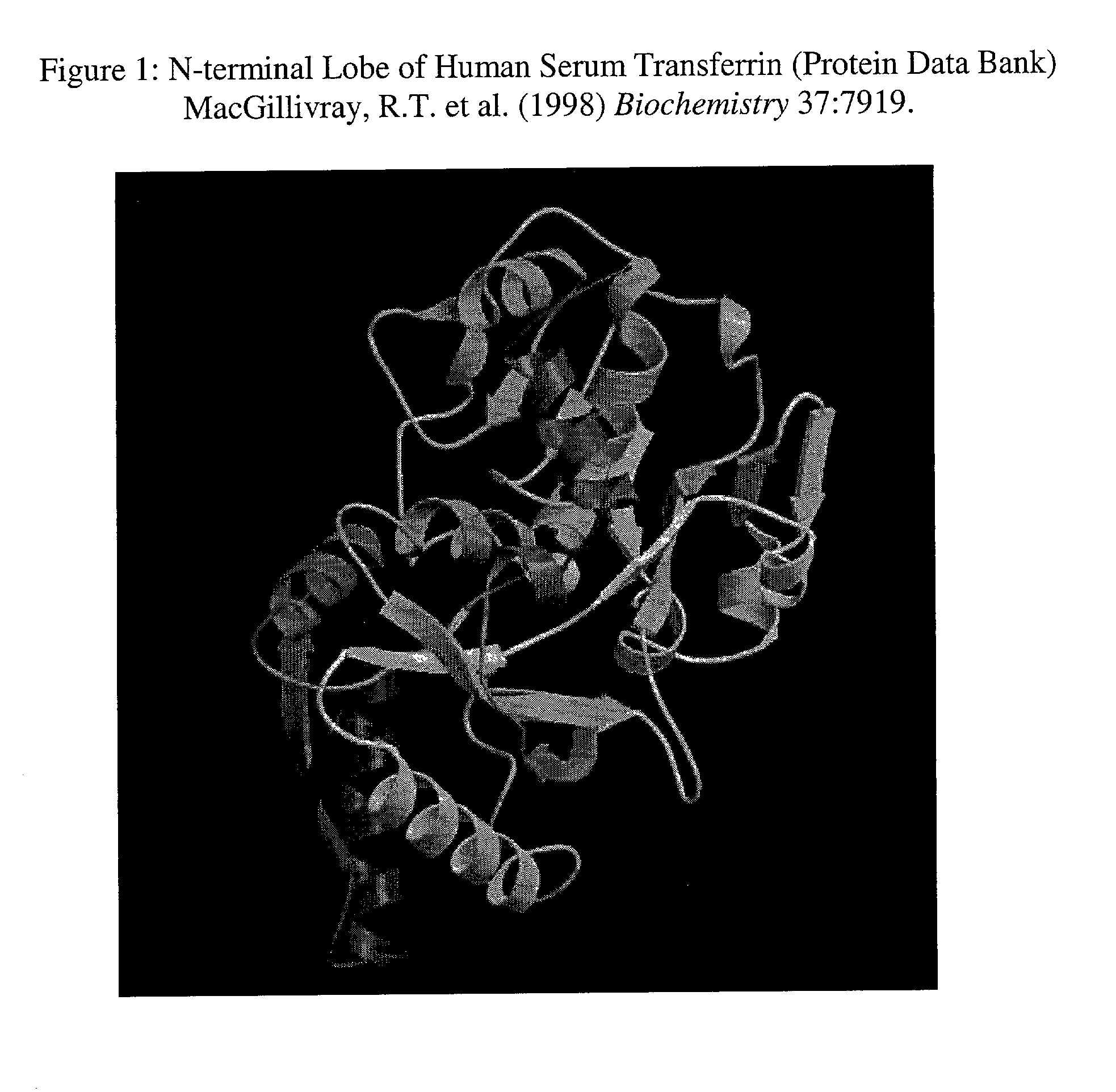
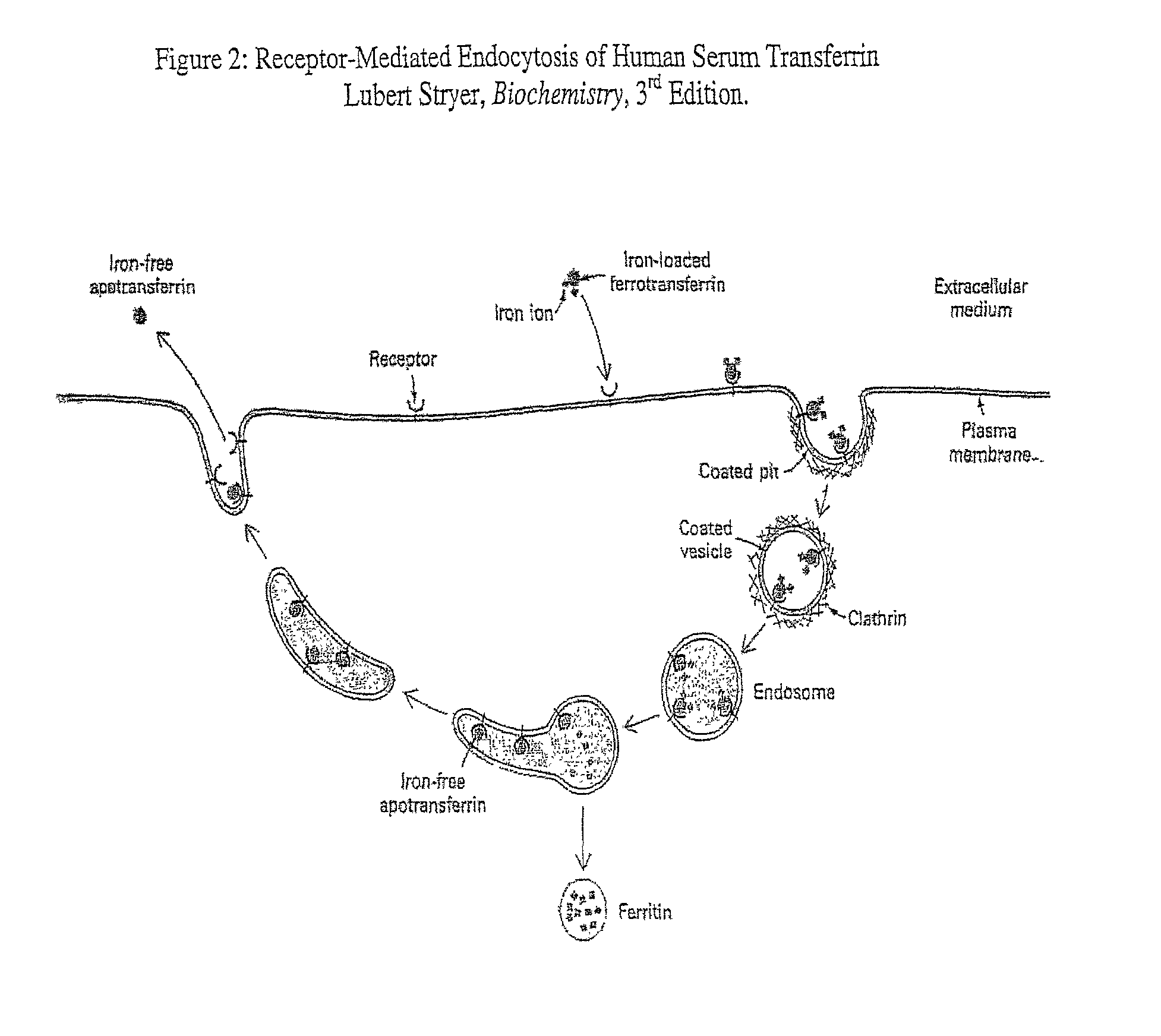
[0022] Those in the art will appreciate that human serum
transferrin, a monomeric
glycoprotein that binds tightly and reversibly to two
ferric ions together with two
bicarbonate co-ions, regulates the availability of free iron in body fluids, and also mediates the transport and cell uptake of iron by
receptor-mediated
endocytosis. See Huebers, H. et al. (1981) Proc. Natl. Acad. Sci. USA 78:1, 621-625; Jeffrey P. D. et al.(1998)
Biochemistry 37:13978-13986; Ali, S. A et al. (1999) J. Biol. Chem. 274:34, 24066-24073. By this process, the transferrin molecule binds to the
transferrin receptor on the membrane of cells and the complex is subsequently enveloped by the cell. Significantly, HIV replication has been shown to induce upregulation of HST
receptor expression since HIV-infected cells exhibit a higher need for iron. See Levy, J. A. (1993) Microbiol. Rev. 57:183-289. Even more significantly, while conjugating peptides to human serum transferrin has been shown to induce an
antibody immune response, hiding peptides within the loops of transferrin has not been associated with detectable
antibody production. See Ali et al. (1999) FEBS Letters 459:230-232. Thus, human serum tranferrin provides an attractive pathway for the delivery of engineered peptides into HIV-infected cells as it takes
advantage of a pre-evolved
cell entry mechanism, exercises selectivity for HIV-infected cells which possess a greater number of transferrin receptors, and minimizes
immunogenicity which often complicates the use of peptide drugs.
[0023] The
efficacy of this mechanism is further enhanced by selecting
insertion sites that are removed from the transferrin C-terminal lobe, known to be important for iron and
bicarbonate binding. The C-terminal lobe of transferrin also possesses the
primary sites for HST
receptor recognition. See Zak et. al., J. Biol. Chem., 269:10, 7110-7114. Stability of the peptides once released into the
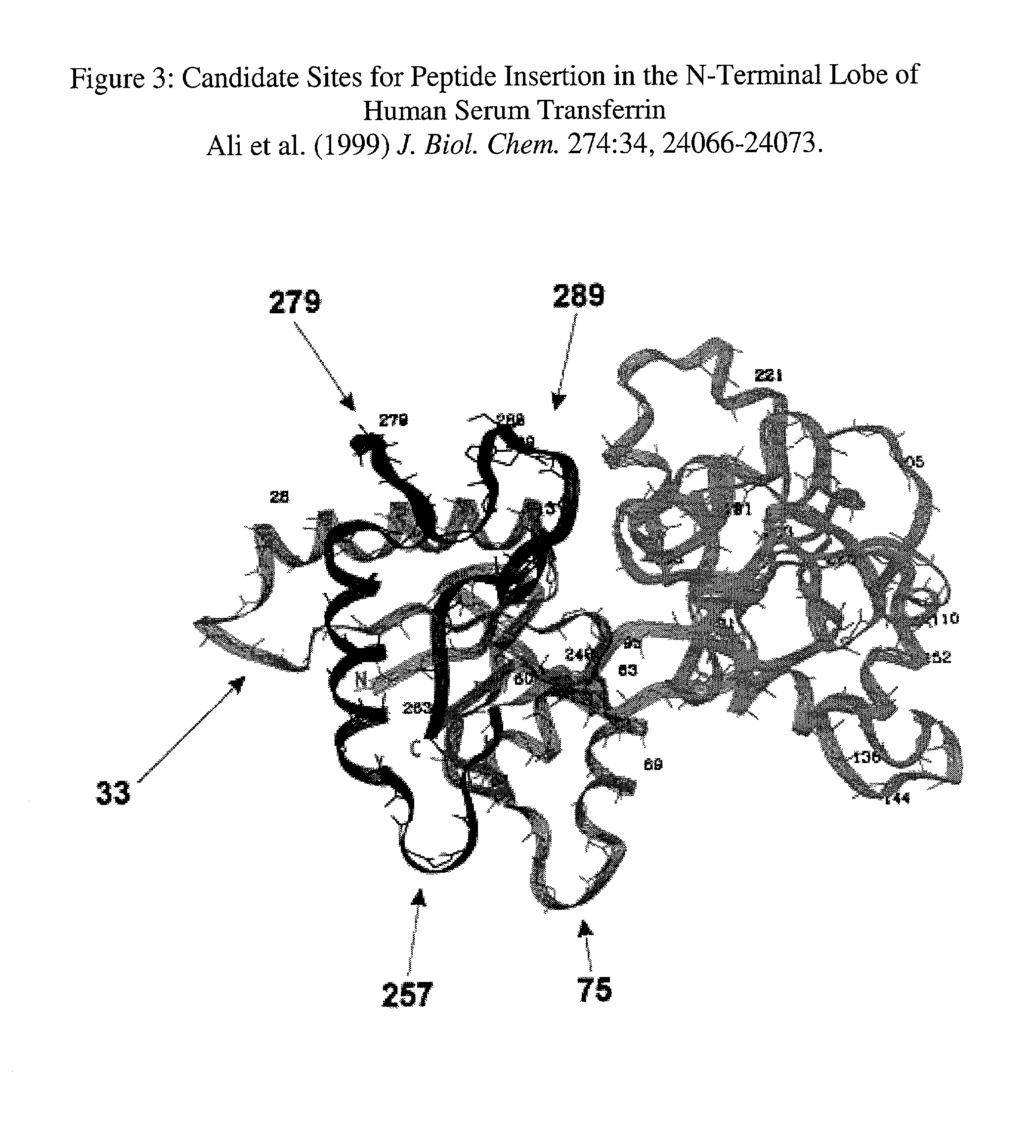
cytoplasm is improved by including two modified p17 / p24 HIV-1 protease cleavage sites in substitution for the natural p17 / p24 cleavage sequence VSQNYPIVL. In this manner the released peptide conforms with the stabilizing N-end rule, and the peptide can be inserted into the N-terminal lobe surface exposed loops of transferrin, which are removed from the
iron transport machinery. Surface exposed loops of the HST protein are the chosen targets of peptide
insertion due to their flexibility and therefore resulting ability to tolerate insertions without significantly distorting the overall
tertiary or three-dimensional
spatial structure of the protein. See Finkelstein, A. V. (1997) Curr. Opin. Struct. Biol. 7:60-71. Furthermore, surface exposed loops are chosen so that peptide sequences can be exposed to HIV-1 protease recognition and cleavage.


 Login to View More