Unlock instant, AI-driven research and patent intelligence for your innovation.

System for representing the logical and physical information of an integrated circuit

a technology of integrated circuits and logical and physical information, applied in the direction of static indicating devices, instruments, program control, etc., can solve the problems of circuits placed too far from each other to meet timing constraints or power consumption constraints, and achieve the effect of enhancing performance and meeting timing and power consumption constraints

Active Publication Date: 2005-09-08
XILINX INC
View PDF9 Cites 33 Cited by
  • Summary
  • Abstract
  • Description
  • Claims
  • Application Information

AI Technical Summary

Benefits of technology

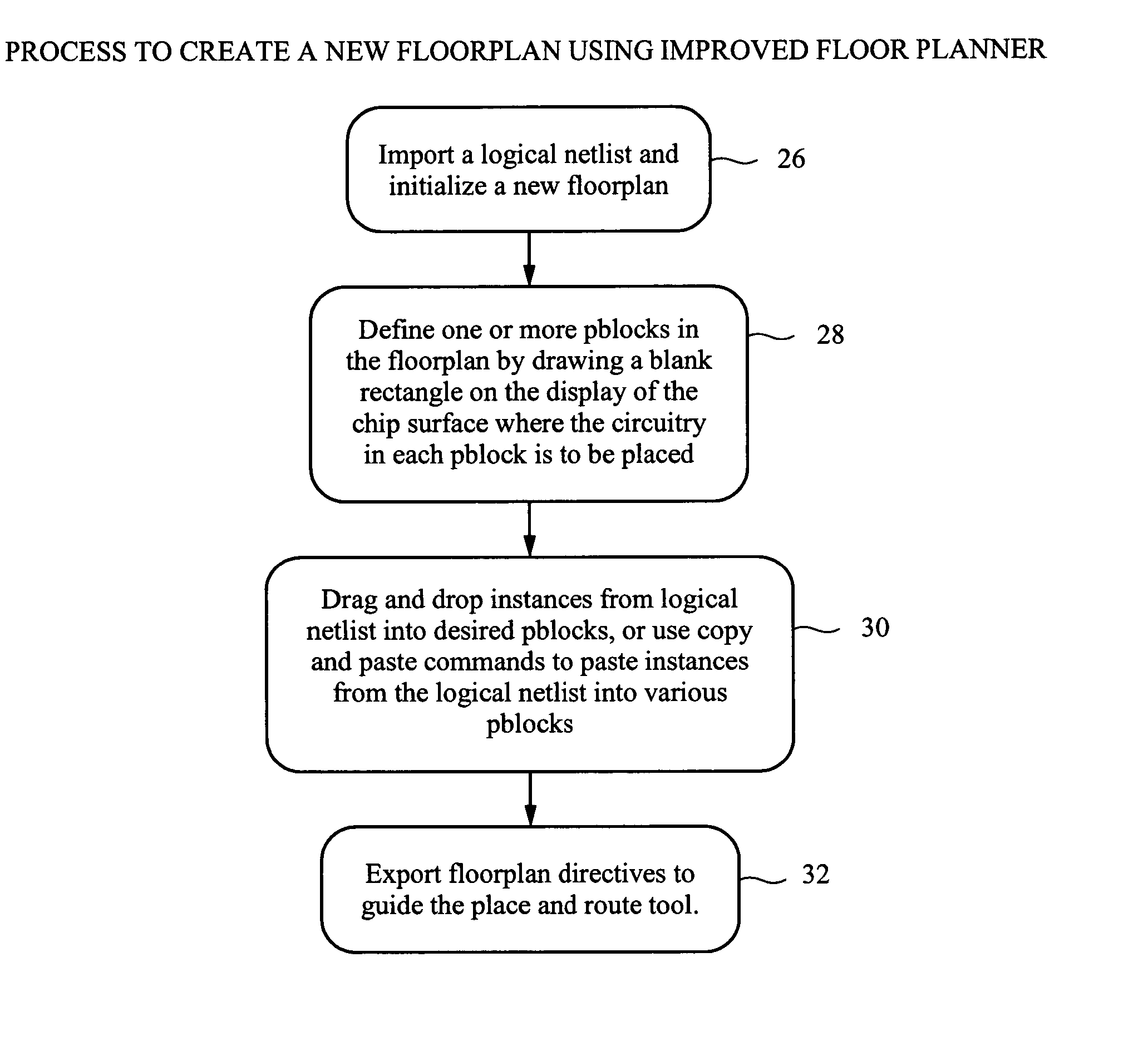
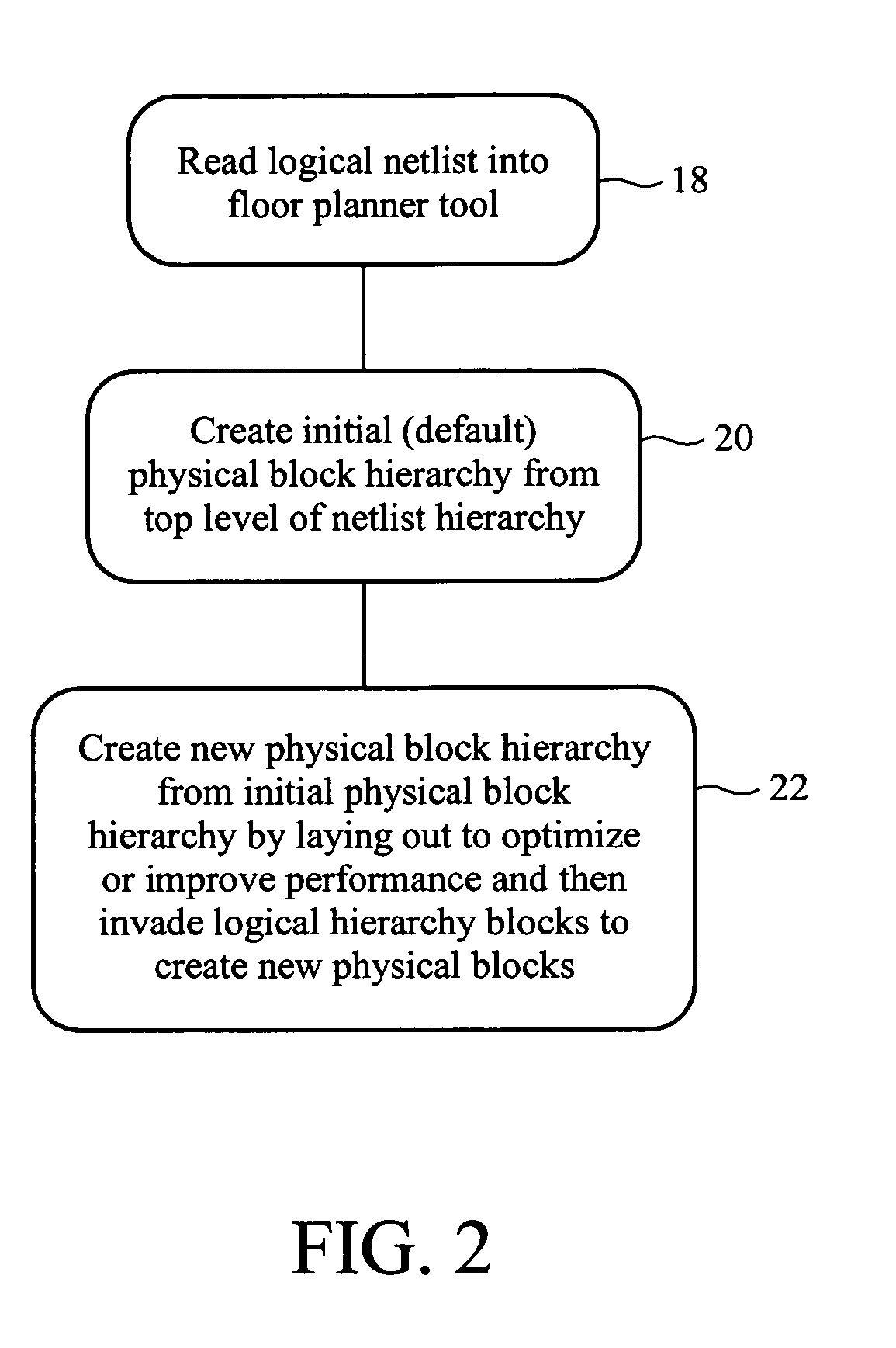
[0022] The teachings of the invention contemplate computer processes, programmed computers and computer readable media which contain instructions to control a computer. These inventions implement a floor planning tool which allows users to creates new physical hierarchies to place circuits (instances) from a logical netlist (which contains no physical placement information) onto a floorplan of any integrated circuit. This allows the user to give guidance to a place and route tool on where specific circuits are to be placed in the final chip layout so as to enhance performance and ensure that timing and power consumptions constraints can be met. This floor planning tool is useful in laying out conventional integrated circuits, FPGAs, ASICs, structured ASICs and any other type of integrated circuit.
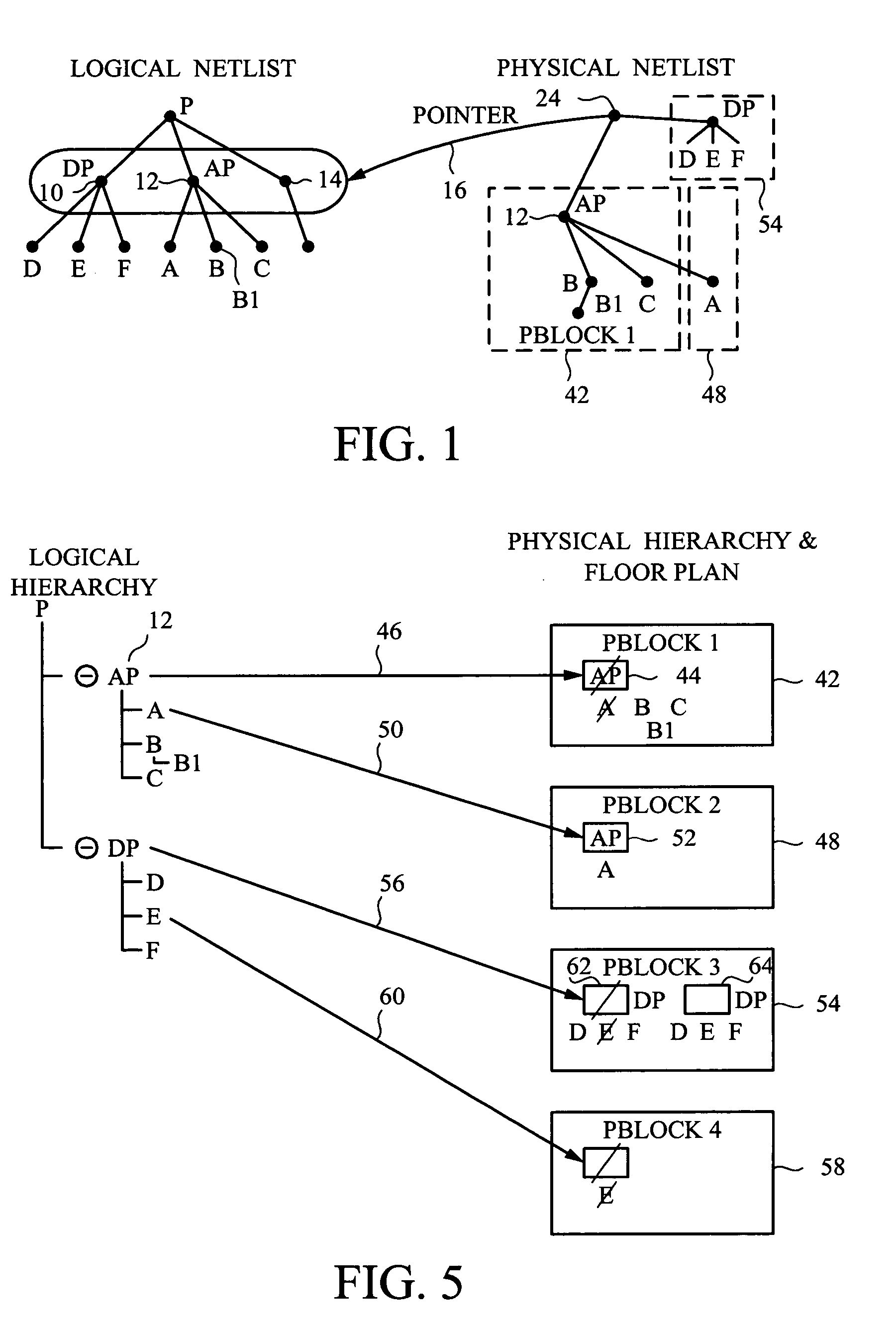
[0023] The teachings of the invention include a data structure stored on a computer readable medium for physical blocks (hereafter pblock) which can be nested to define a pblock hierarchy. The computer readable medium can be anything which can be read by a computer including CD-ROM, floppy disk, hard disk, DVD-R media, random access memory, flash memory, magnetic tape, punch cards, etc. Each pblock has its own data object which defines the location of the pblock on the floor plan of the integrated circuit (chip) being designed. The floorplan provides the proposed placement of the circuits to be integrated on said chip. Each pblock data object also includes a list of child pblocks, said child pblocks being pblocks which are contained within the parent pblock. Each pblock data object includes a list of instances or circuits that are assigned to the pblock. Each instance entry on the list is implemented through use of a pointer to the data object which defines the instance in the original logical netlist thereby reducing the amount of data that needs to be stored for the physical hierarchy.
[0025] Use of pblocks and a physical hierarchy to define the positions of circuits on chip floorplans greatly improves the performance of the chip because the logical netlist includes no position information. This leaves it up to the place and route tool to put circuits on the chip surface wherever it determines they need to be. This can result in some circuits being placed too far away from each other to meet timing constraints or power consumption constraints. By allowing the designer to place pblocks on a chip floorplan and then populate them with circuits from the logical netlist, a designer can place circuits that have hard to meet timing and power constraints close to each other in the final design. This decreases the amount of parasitic capacitance (parasitic capacitance is proportional to length) in the conductive lines between the chips and reduces the propagation delays and power consumption on these shorter lines.
[0053] 6) Another subspecies is to make each pblock stand alone in the sense that all nets into or out of the pblock terminate on a pblock boundary pin, and each pblock has its own timing and power constraints for its nets. In this way, large netlists do not have to be stored in their entirety in the RAM of the place and route workstation. Instead, individual pblocks can be output from the floor planning tool to the place and route tool as if each individual pblock was its own stand alone chip. This allows place and route tools to work with large netlists using the directives output by the floor planner tool without exceeding the RAM capacity of the machine.

Problems solved by technology

This can result in some circuits being placed too far away from each other to meet timing constraints or power consumption constraints.

Method used

the structure of the environmentally friendly knitted fabric provided by the present invention; figure 2 Flow chart of the yarn wrapping machine for environmentally friendly knitted fabrics and storage devices; image 3 Is the parameter map of the yarn covering machine
View more

Image

Smart Image Click on the blue labels to locate them in the text.
Viewing Examples
Smart Image
  • System for representing the logical and physical information of an integrated circuit
  • System for representing the logical and physical information of an integrated circuit
  • System for representing the logical and physical information of an integrated circuit

Examples

Experimental program
Comparison scheme
Effect test

Embodiment Construction

Definitions

[0071] The teachings of the invention contemplate a general purpose computer coupled to a display, a keyboard and a pointing device and programmed with an operating system which executes as an application the floor planning software to be described below. The computer typically has a hard disk, and one or more ports for inputting and outputting data and may have a CD-ROM drive, floppy disk drive, DVD-RAM drive etc. to read in data stored on portable media.

[0072] To best understand the descriptions herein, consider the following terminology definitions. [0073] Instance—a piece or block of logic. It can be ‘flat’ (aka primitive), e.g., something simple and indivisible like an ‘AND’ or ‘NOT’. It can also be hierarchical—e.g., something that is defined by and includes at a lower level in a hierarchy, individual instance of simpler circuits such as a set of flat instances to form a more complex block of logic, such as an ALU or large RAM. [0074] Pin—represents an input or o...

the structure of the environmentally friendly knitted fabric provided by the present invention; figure 2 Flow chart of the yarn wrapping machine for environmentally friendly knitted fabrics and storage devices; image 3 Is the parameter map of the yarn covering machine
Login to View More

PUM

No PUM Login to View More

Abstract

A floor planner tool for integrated circuit design which provides tools and displays for a designer to create a floor plan to define desired placement of circuits defined in a logical netlist by creating a physical hierarchy comprised of nested pblocks. Each pblock is a data structure which contains data which defines which circuits from the logical netlist are assigned to it. Each pblock stands alone and can be input to a place and route tool without the rest of the physical hierarchy. Each pblock data structure contains pointers to the circuits on the netlist assigned to that plbock, identifies other pblocks nested within it and contains a list of pins for the instances within the pblock. Net data structures in the physical hierarchy define which nets are connected to which pins.

Description

FIELD OF USE AND BACKGROUND OF THE INVENTION [0001] Field programmable gate arrays (FPGAs) and application specific integrated circuits are increasingly popular types of integrated circuits. However, increasingly complex integrated circuits in general are increasing in popularity because integration of large systems on a chip substantially reduces manufacturing costs over other classic forms of construction of circuits. [0002] When designing integrated circuits, the final design is reduced to a file called a netlist. A netlist is a description of the devices that are to be fabricated on an integrated circuit and the connections between each terminal of each device to form the circuit. [0003] Layouts of integrated circuits are typically done on workstations which have a fixed amount of random access memory (RAM). In complex integrated circuits, the netlist can be so large that it cannot all be stored in the RAM available on the workstation. This results in part of the netlist being s...

Claims

the structure of the environmentally friendly knitted fabric provided by the present invention; figure 2 Flow chart of the yarn wrapping machine for environmentally friendly knitted fabrics and storage devices; image 3 Is the parameter map of the yarn covering machine
Login to View More

Application Information

Patent Timeline
no application Login to View More
IPC IPC(8): G06F9/45G06F17/50
CPCG06F17/5072G06F30/392
Inventor KNOL, DAVID A.RAJE, SALIL RAVINDRA
Owner XILINX INC