
Method for fabricating solid oxide fuel cell module
a fuel cell module and solid oxide technology, applied in the direction of cell components, final product manufacturing, sustainable manufacturing/processing, etc., can solve the problems of low productivity, poor production yield, cracking of fuel electrodes, etc., and achieve the enhancement of solid oxide fuel cell module productivity, high gas sealing performance, and cost reduction
- Summary
- Abstract
- Description
- Claims
- Application Information
AI Technical Summary
Benefits of technology
Problems solved by technology
Method used
Image

Examples
example 1
of Configuration of Cells Disposed on a Substrate Face
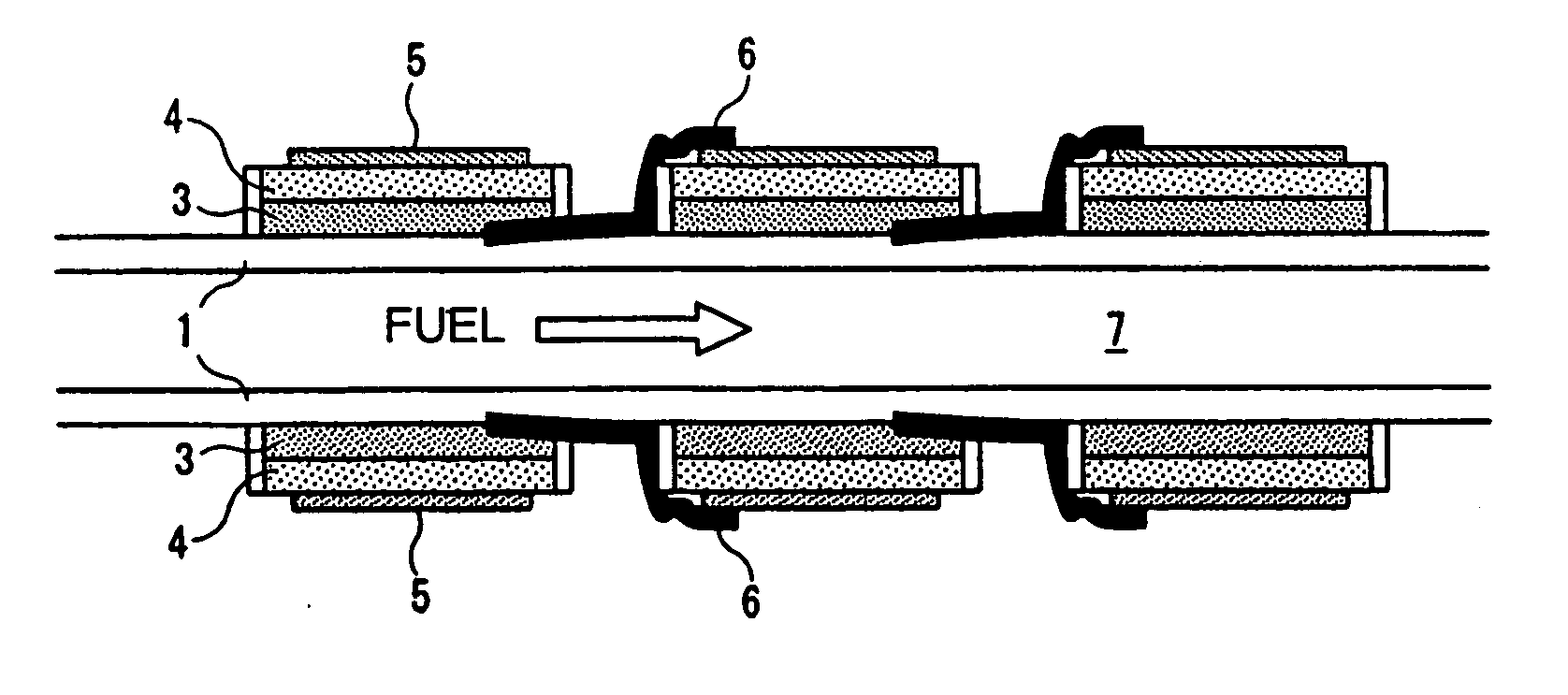
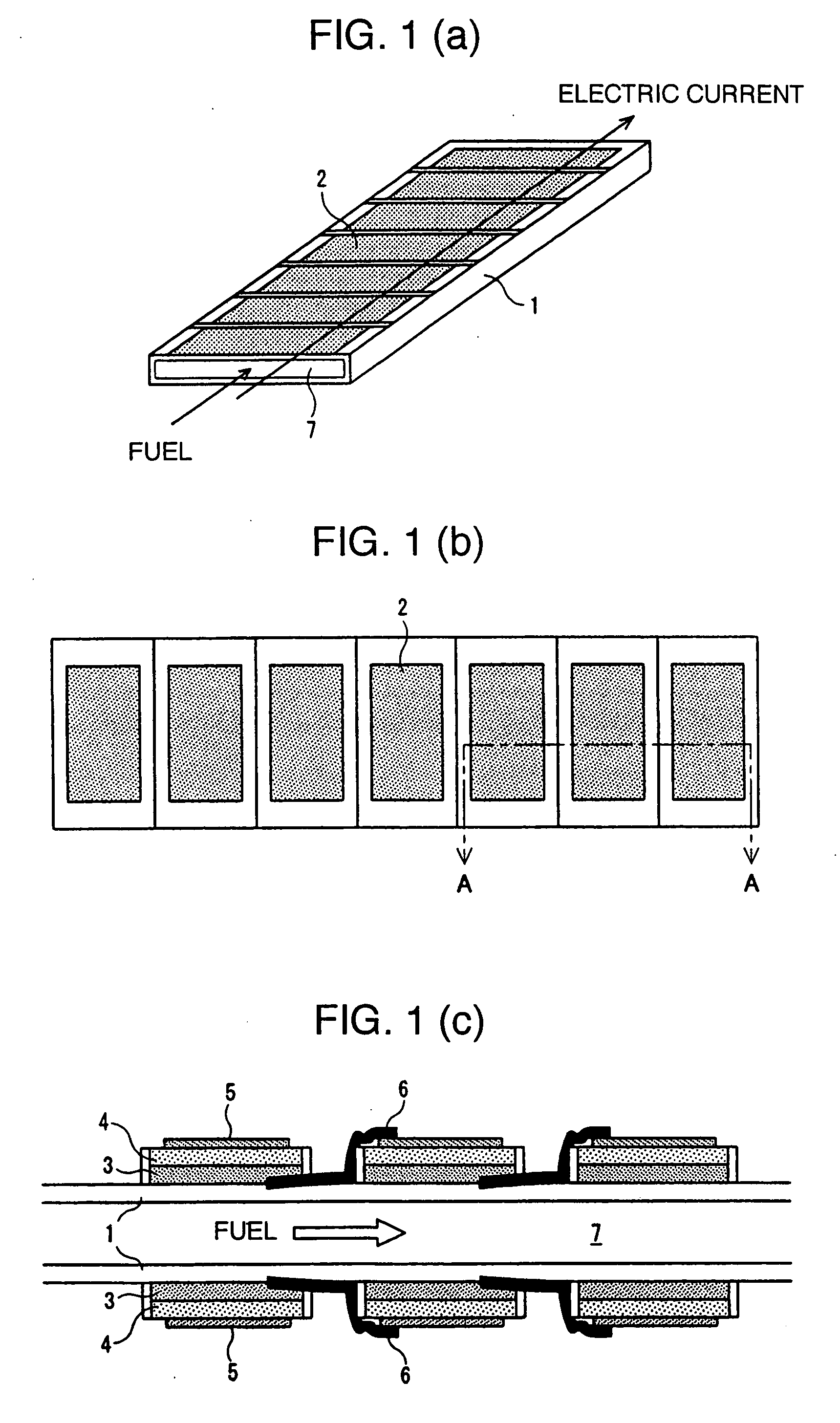
[0073] A plurality of cells each comprising a fuel electrode, an electrolyte, and an air electrode, stacked in sequence, are formed on a substrate with an internal fuel flow part provided therein, at least a face thereof, in contact with the cells, and interconnectors, being an insulator. With the invention, respective cell areas may be the same along the direction of fuel flow as shown in FIGS. 1(a) to 1(c), or may be varied along the direction of the fuel flow as shown hereunder (refer to Example 2 of Configuration of Cells Disposed on a Substrate Face). In this connection, a cell area generally refers to an effective power generation area of a cell, and since the effective power generation area of the air electrode, or the effective power generation area of the fuel electrode whichever is smaller is rate-limiting, the cell area refers to the smaller one of those effective power generation areas.
example 2
of Configuration of Cells Disposed on a Substrate Face
[0074] Configuration whereby respective cell areas are varied along the direction of fuel flow has been developed by the inventor, et al., and by sequentially increasing respective cell areas along the direction of the fuel flow, it is possible to sequentially decrease current density, thereby enhancing power generation efficiency. Further, since there is an increase in the number of electrical connections in series, voltage increases, and conversion efficiency of conversion from direct current (DC) to alternating current (AC) can be enhanced.
[0075] FIGS. 6(a) to 6(c) are views showing the configuration according to Example 2. FIG. 6(a) is a perspective view, FIG. 6(b) a plan view, and FIG. 6(c) a sectional view taken on line A-A in FIG. 6(b), showing the configuration expanded so as to be larger than that in FIG. 6(b). As shown in FIGS. 6(a) to 6(c), on either the upper side face or the underside face, or both the faces of a po...
example 3
of Configuration of Cells Disposed on a Substrate Face
[0083] FIGS. 7(a) to 7(c) are views showing Example 3 of Configuration of Cells Disposed on a Substrate Face, as the target for the manufacturing method according to the invention. FIG. 7(a) is an oblique perspective view, FIG. 7(b) a plan view, and FIG. 7(c) a sectional view taken on line A-A in FIG. 7(b), showing the SOFC module expanded so as to be larger than that in FIG. 7(b). As shown in FIGS. 7(a) to 7(c), in each of a plurality of rows from first to n-th rows, on either the upper side face or the underside face, or both the faces of an insulator substrate 21 in a shape rectangular or hollow-flat, in cross-section, there are formed a plurality of cells 22 each made up of a fuel electrode 23, an electrolyte 24, and an air electrode 25, stacked in sequence, and the adjacent cells 22 are electrically connected in series with each other through the intermediary of the respective interconnectors 26. In FIGS. 7(a) to 7(c), there...
PUM
| Property | Measurement | Unit |
|---|---|---|
| softening point | aaaaa | aaaaa |
| operating temperature | aaaaa | aaaaa |
| operating temperature | aaaaa | aaaaa |
Abstract
Description
Claims
Application Information
 Login to View More