
Glucagon-like-peptide-2 (GLP-2) analogues
a technology of glucagon-like peptides and analogues, which is applied in the field of glucagon-like peptides (glp2) analogues, can solve the problems of poorly understood downstream intracellular mediators coupled to the glp-2 receptor, and achieve the effects of improving chemical stability, improving biological activity, and improving biological activity
- Summary
- Abstract
- Description
- Claims
- Application Information
AI Technical Summary
Benefits of technology
Problems solved by technology
Method used
Image

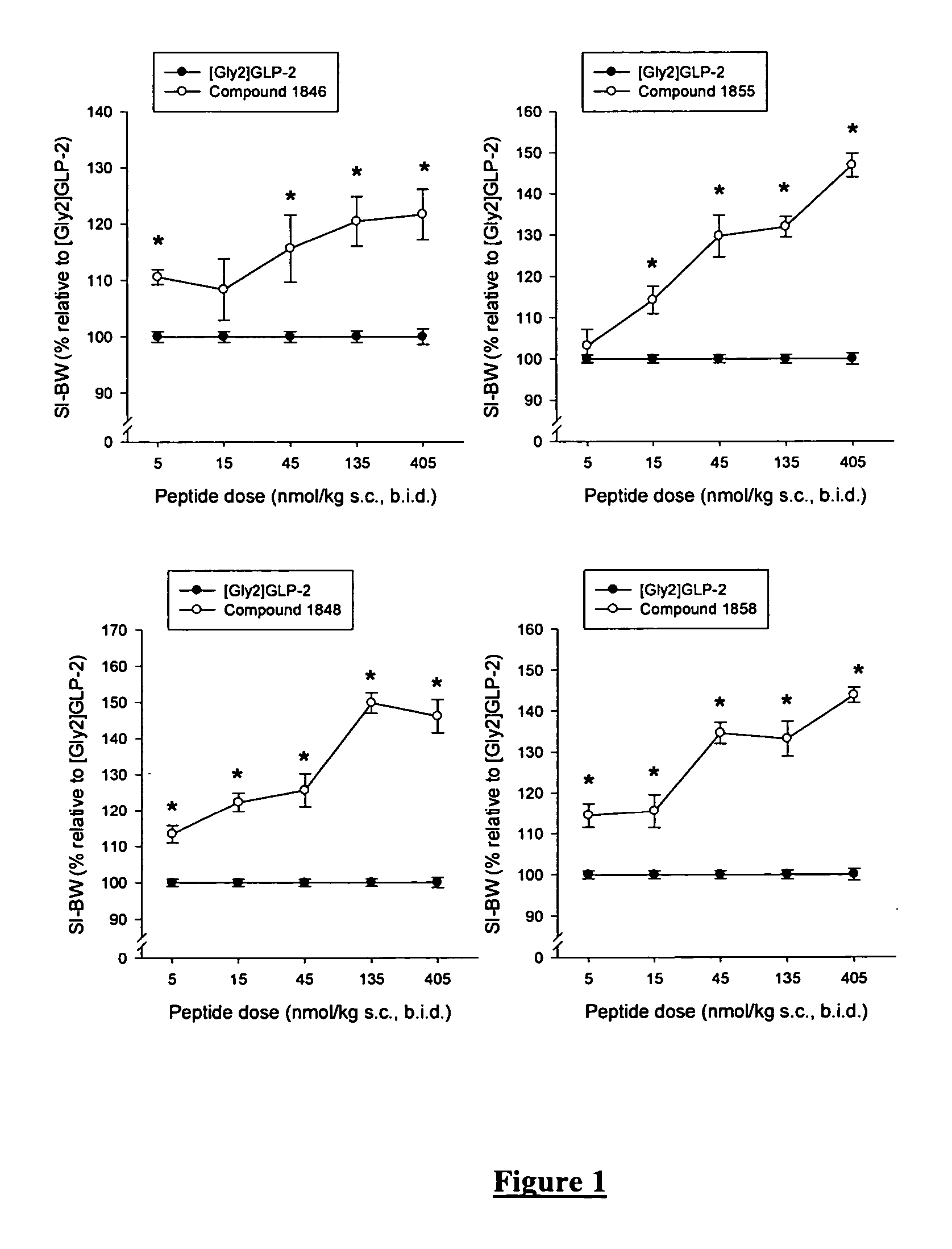
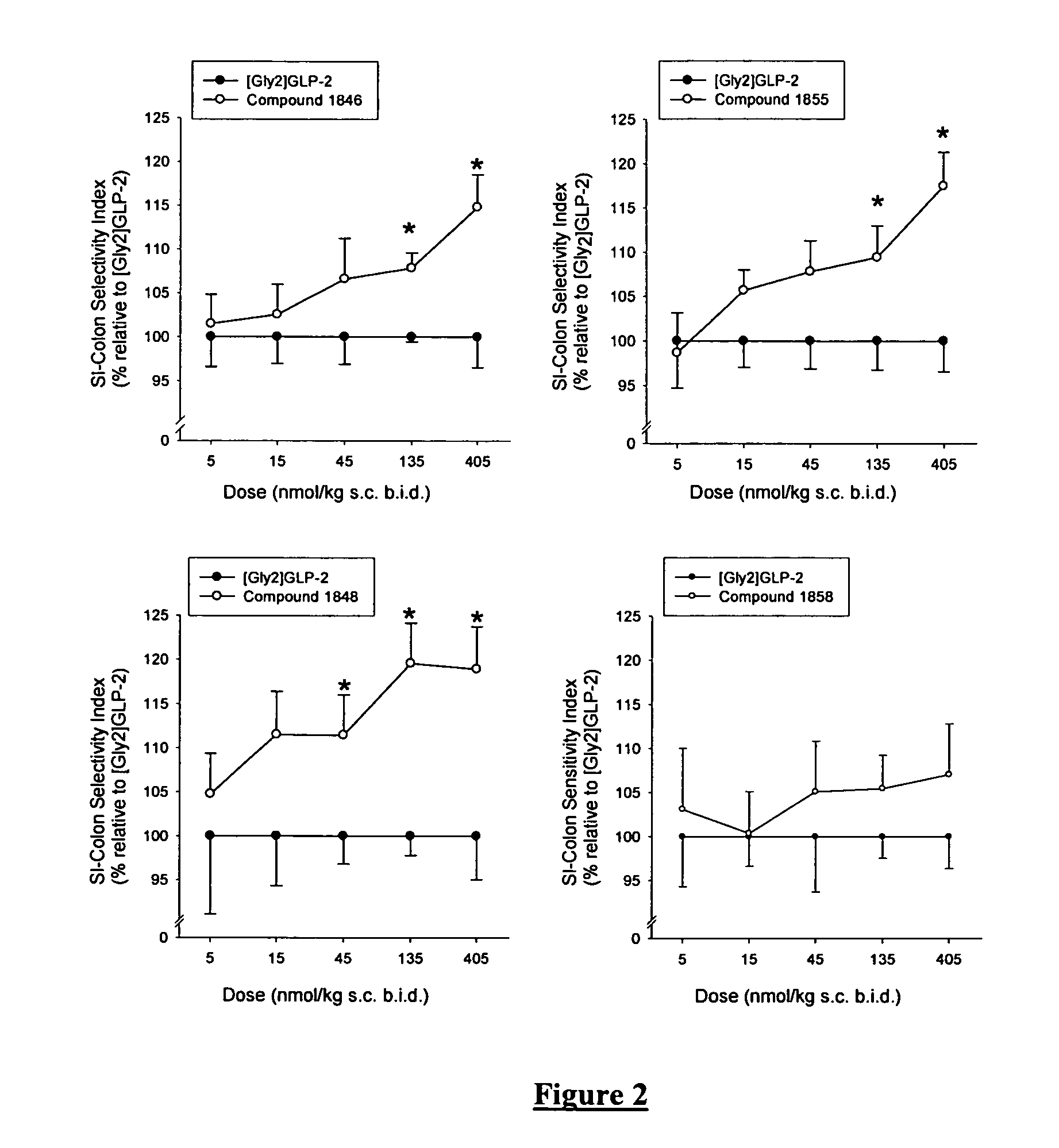
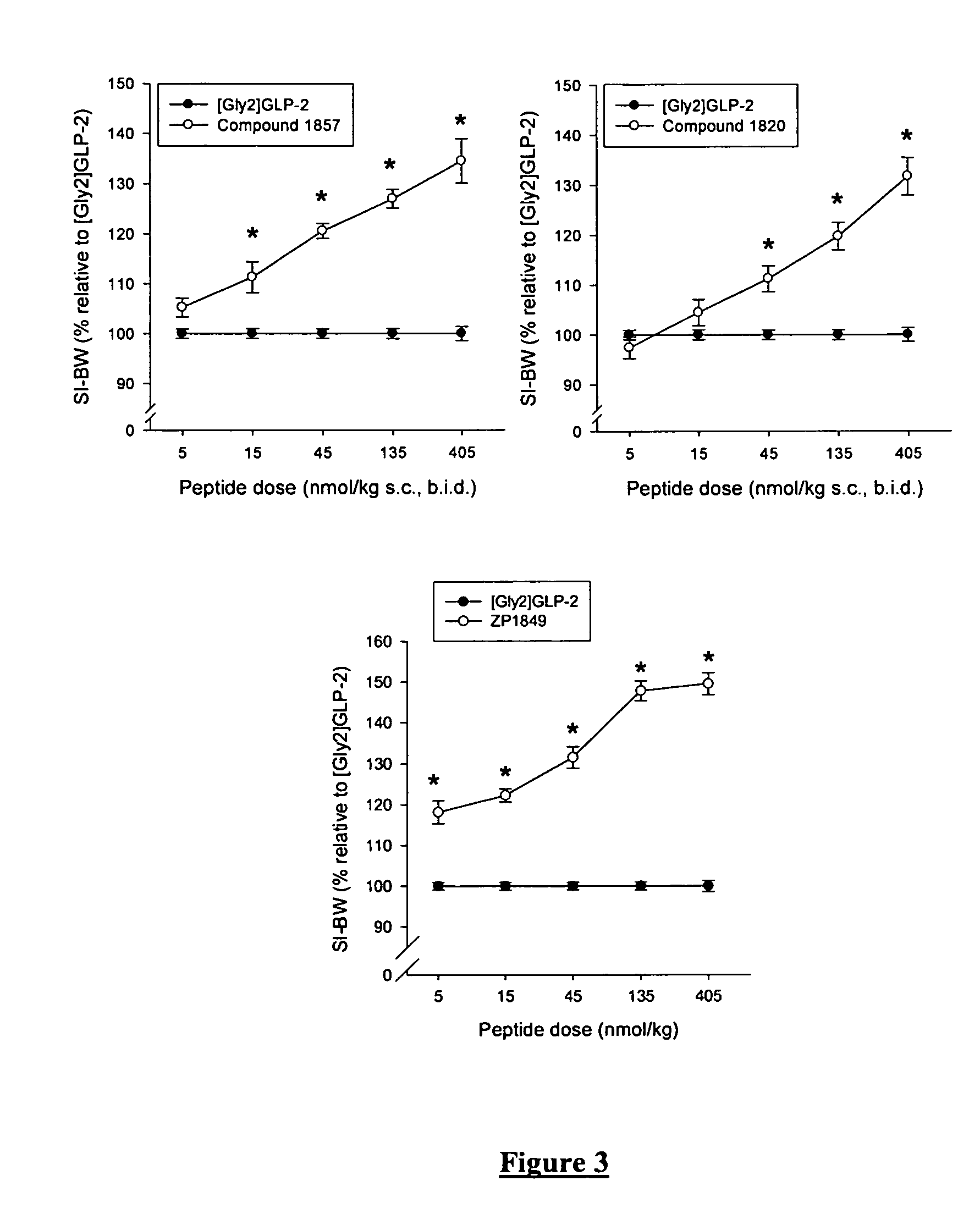
Examples
example 1
Synthesis of Compound 1846
[0431] H-His-Gly-Glu-Gly-Ser-Phe-Ser-Ser-Glu-Leu-Ser-Thr-Ile-Leu-Asp-Ala-Leu-Ala-Ala-Arg-Asp-Phe-Ile -Ala-Trp-Leu-Ile-Ala-Thr-Lys-Ile-Thr-Asp-Lys-Lys-Lys-Lys-Lys-Lys-NH2on TentaGel S RAM-Lys(Boc)Fmoc.
[0432] Dry TentaGel S RAM-Lys(Boc)Fmoc (0.24 mmol / g, 1 g) was placed in a polyethylene vessel equipped with a polypropylene filter for filtration and treated as described under “batchwise peptide synthesis on TentaGel resin” until finishing the coupling of the N-terminal Histidine. All couplings were continued over night. The acylations were checked as earlier described. After completed synthesis and deprotection of the N-terminal Fmoc group the peptide was cleaved from the resin as described above. After purification using preparative HPLC as earlier described, 28.8 mg peptide product was collected with a purity better than 90% and the identity of the peptide was confirmed by MS (found M 4315.38, calculated M 4315.41).
example 2
Synthesis of Compound 1848
[0433] H-His-Gly-Glu-Gly-Thr-Phe-Ser-Ser-Glu-Leu-Ala-Thr-Ile-Leu-Asp-Ala-Leu-Ala-Ala-Arg-Asp-Phe-Ile -Ala-Trp-Leu-Ile-Ala-Thr-Lys-Ile-Thr-Asp-Lys-Lys-Lys-Lys-Lys-Lys-NH2 on TentaGel S RAM-Lys(Boc)Fmoc. Dry TentaGel S RAM-Lys(Boc)Fmoc (0.24 mmol / g, 1 g) was placed in a polyethylene vessel equipped with a polypropylene filter for filtration and treated as described under “batchwise peptide synthesis on TentaGel resin” until finishing the coupling of the N-terminal Histidine. All couplings were continued over night. The acylations were checked as earlier described. After completed synthesis and deprotection of the N-terminal Fmoc group the peptide was cleaved from the resin as described above. After purification using preparative HPLC as earlier described, 230 mg peptide product was collected with a purity better than 90% and the identity of the peptide was confirmed by MS (found M 4313.63, calculated M 4313.43).
example 3
Synthesis of Compound 1855
[0434] H-His-Gly-Glu-Gly-Ser-Phe-Ser-Ser-Glu-Leu-Ser-Thr-Ile-Leu-Asp-Ala-Leu-Ala-Ala-Arg-Asp-Phe-Ile -Ala-Trp-Leu-Ile-Ala-Thr-Lys-Ile-Thr-Asp-NH2on TentaGel S RAM-Asp(OtBu)Fmoc.
[0435] Dry TentaGel S RAM-Asp(OtBu)Fmoc (0.2 mmol / g, 1 g) was placed in a polyethylene vessel equipped with a polypropylene filter for filtration and treated as described under “batchwise peptide synthesis on TentaGel resin” until finishing the coupling of the N-terminal Histidine. All couplings were continued over night. The acylations were checked as earlier described. After completed synthesis and deprotection of the N-terminal Fmoc group the peptide was cleaved from the resin as described above. After purification using preparative HPLC as earlier described, 27.3 mg peptide product was collected with a purity better than 96% and the identity of the peptide was confirmed by MS (found M 3547, calculated M 3546.84).
PUM
| Property | Measurement | Unit |
|---|---|---|
| Fraction | aaaaa | aaaaa |
| Temperature | aaaaa | aaaaa |
| Temperature | aaaaa | aaaaa |
Abstract
Description
Claims
Application Information
 Login to View More