
Thin film transistor, thin film transistor substrate, processes for producing the same, liquid crystal display using the same, and related devices and processes; and sputtering target, transparent electroconductive film formed by use of this,transparent electrode, and related devices and processes
a thin film transistor and substrate technology, applied in the direction of conductive materials, solid-state devices, conductive layers on insulating supports, etc., can solve the problems of generating short circuit between the electrodes, causing cell reaction, and corroding the wiring material of tfts or the lik
- Summary
- Abstract
- Description
- Claims
- Application Information
AI Technical Summary
Benefits of technology
Problems solved by technology
Method used
Image

Examples
example 1-1
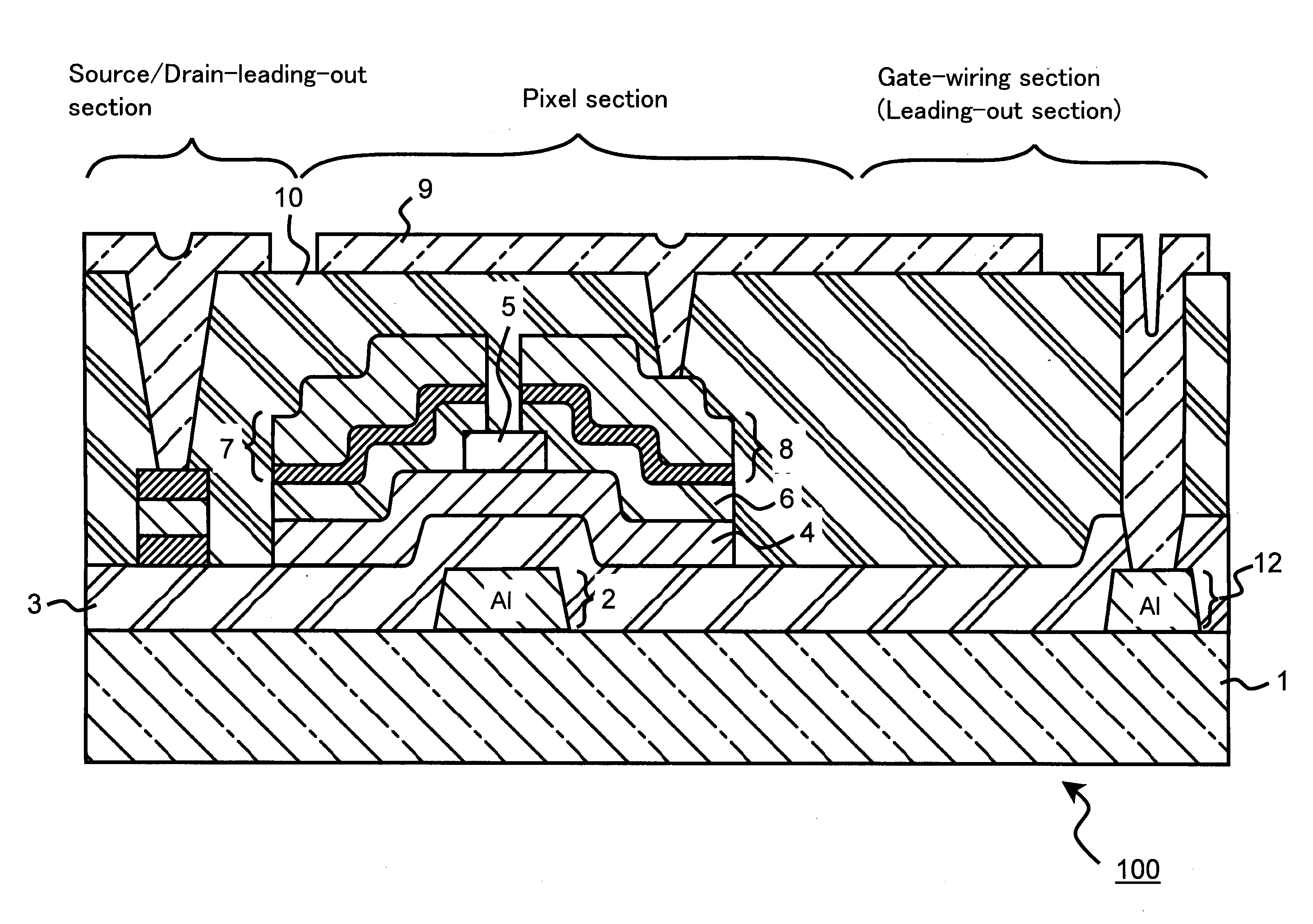
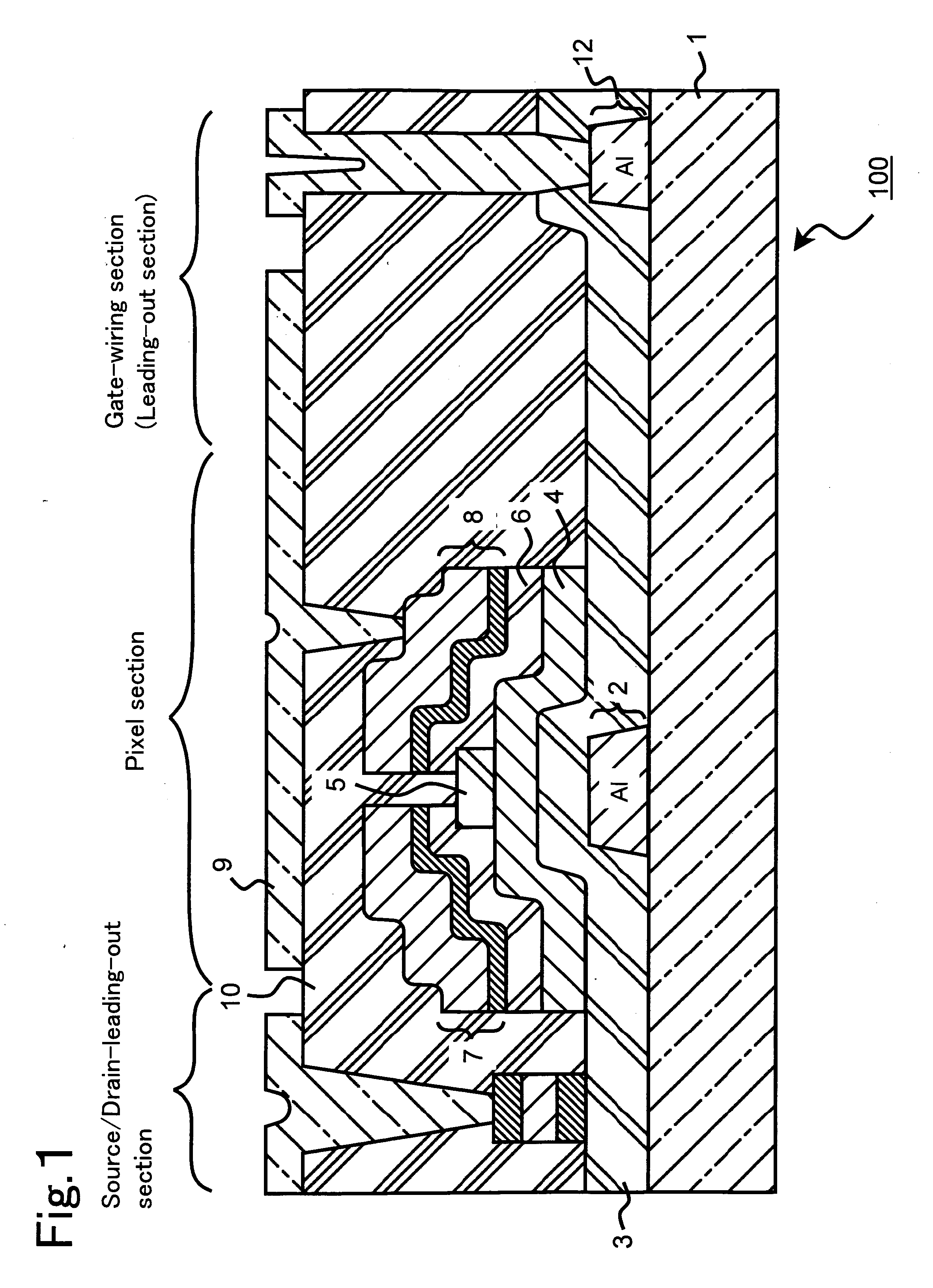
[0472]FIG. 1 illustrates a sectional view of a vicinity of an α-SiTFT (amorphous silicon thin film transistor) active matrix substrate 100 in the Example 1-1. Metallic Al was deposited onto a light-transmissible glass substrate 1 by high-frequency sputtering so as to have a film thickness of 1500 Å. This glass substrate 1 corresponds to one example of the transparent substrate described in the claims.
[0473] Next, the deposited Al was etched into a shape illustrated in FIG. 1 by photo-etching using a phosphoric acid / acetic acid / nitric acid / water (the ratio by volume=12 / 6 / 1 / 1)-based aqueous solution as an etchant to form a gate electrode 2 and a gate electrodewiring 12.
[0474] Next, a silicon nitride film (hereinafter, denoted as a SiN film in some cases), which would be a gate insulation film 3, was deposited on the glass substrate 1, the gate electrode 2 and the gate electrode wiring 12 by glow discharge CVD, so as to have a film thickness of 3000 Å. Subsequently, an α-Si:H (i) fil...
example 1-2
[0489] An α-SiTFT active matrix substrate 100 in Example 1-2 is different from the α-SiTFT active matrix substrate 100 in Example 1-1 only in the composition of the transparent electroconductive film 9, and the structure thereof is substantially the same as in FIG. 1. Accordingly, the α-SiTFT active matrix substrate 100 of Example 1-2 will also be described using FIG. 1.
[0490] As illustrated in FIG. 1, metallic Al was deposited onto a light-transmissible glass substrate 1 by high-frequency sputtering so as to have a film thickness of 1500 Å. Next, the deposited Al was etched into a shape illustrated in FIG. 1 by photo-etching using a phosphoric acid / acetic acid / nitric acid / water (the ratio by volume=12 / 6 / 1 / 1)-based aqueous solution as an etchant to form a gate electrode 2 and a gate electrode wiring 12. This glass substrate 1 corresponds to one example of the transparent substrate described in the claims.
[0491] Next, a silicon nitride film (hereinafter, denoted as a SiN film in so...
example 1-3
[0506] An α-SiTFT active matrix substrate 100 in Example 1-3 is different from the α-SiTFT active matrix substrate 100 in Examples 1-1 to 1-2 only in the composition of the transparent electroconductive film 9, and the structure thereof is substantially the same as in FIG. 1. Accordingly, the α-SiTFT active matrix substrate 100 of Example 1-3 will also be described using FIG. 1.
[0507] A metallic Al (alloy) (the composition weight %: Al / Ni=99 / 1) was deposited onto a light-transmissible glass substrate 1 by high-frequency sputtering so as to have a film thickness of 2500 Å. Next, the deposited Al was etched into the same shapes as the gate electrode 2 and the gate electrode wiring 12 in FIG. 1 by photo-etching using a phosphoric acid / acetic acid / nitric acid / water (the ratio by volume=9 / 6 / 1 / 2)-based aqueous solution as an etchant to form a gate electrode 2 and a gate electrode wiring 12. This glass substrate 1 corresponds to one example of the transparent substrate described in the cl...
PUM
| Property | Measurement | Unit |
|---|---|---|
| temperature | aaaaa | aaaaa |
| temperature | aaaaa | aaaaa |
| temperature | aaaaa | aaaaa |
Abstract
Description
Claims
Application Information
 Login to View More