Epoxy Resin, Epoxy Resin Composition And Cured Product Thereof
- Summary
- Abstract
- Description
- Claims
- Application Information
AI Technical Summary
Benefits of technology
Problems solved by technology
Method used
Image

Examples
example 1
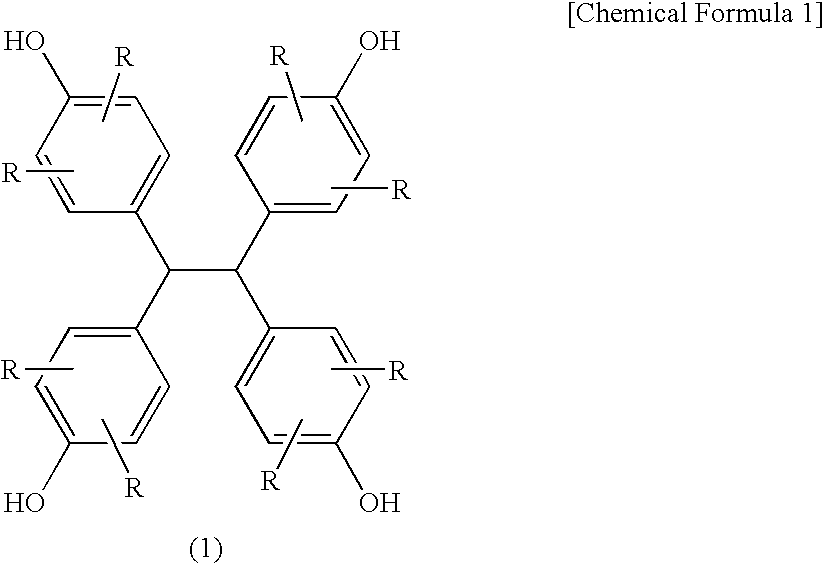
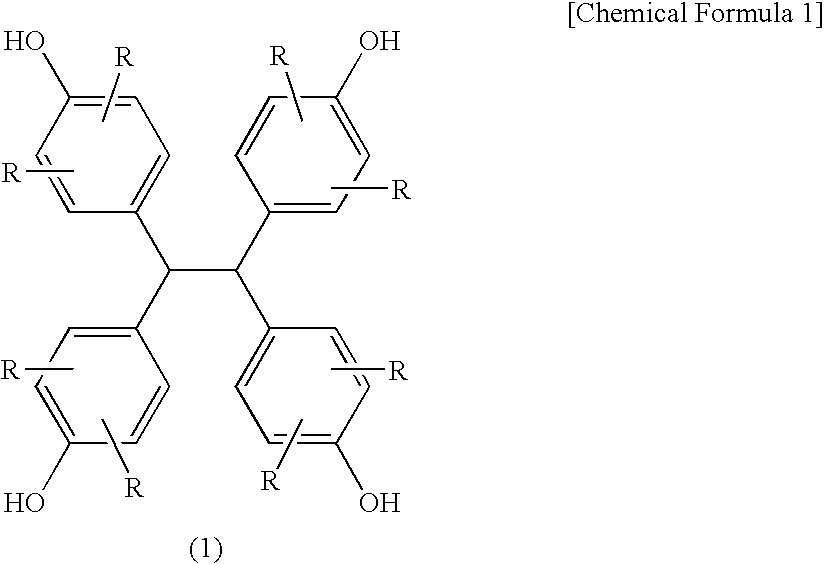
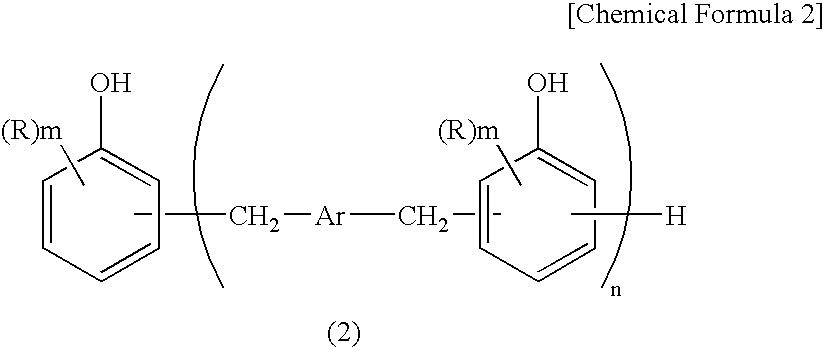
[0137] Into a flask equipped with a thermometer, a condenser and a stirrer, 90 parts of a condensate of glyoxal and phenol (TEP-DF; produced by Asahi Organic Chemicals Industry Co., Ltd., concentration of the compound of the formula (1): not less than 98% by a high performance liquid chromatography detected at 274 nm, not less than 99% by a gel permeation chromatography; hereinafter the same), 10 parts of biphenyl type phenol-aralkyl resin (Ar in the formula (2) was a biphenyl group (main component was a 4,4′-derivative), all of R were hydrogen atoms, n=1.41, hydroxyl group equivalent: 204 g / eq.) (KAYAHARD™ GPH65, produced by Nippon Kayaku Co., Ltd.), 429 parts of epichlorohydrin and 80 parts of methanol were charged and dissolved while nitrogen gas purge was carried out. The solution was heated to 70° C., and further 38 parts of flaky sodium hydroxide were added thereto in portions over 90 min., thereafter the solution was reacted at 70° C. for further 60 min. After completion of t...
example 2
[0138] Into a flask equipped with a thermometer, a condenser and a stirrer, 90 parts of a condensate of glyoxal and phenol (TEP-DF; produced by Asahi Organic Chemicals Industry Co., Ltd.), 10 parts of biphenyl type phenol-aralkyl resin (Ar in the formula (2) was a biphenyl group (main component was a 4,4′-derivative), all of were hydrogen atoms, n=1.41, hydroxyl group equivalent: 204 g / eq.), 429 parts of epichlorohydrin and 80 parts of methanol were charged and dissolved while nitrogen gas purge was carried out. The solution was heated to 70° C., and further 38 parts of flaky sodium hydroxide were added thereto in portions over 90 min., thereafter the solution was reacted at 70° C. for further 60 min. After completion of the reaction, the solution was washed with 135 parts of water twice to remove salts and the like formed. After the solution was added with 270 parts of dimethylsulfoxide, the excess epichlorohydrin and the like were distilled off under heating and reduced pressure (...
example 3
[0139] The same procedures were repeated as in Example 2 except that 80 parts of a condensate of glyoxal and phenol (TEP-DF; produced by Asahi Organic Chemicals Industry Co., Ltd.), 20 parts of biphenyl type phenol-aralkyl resin, 425 parts of epichlorohydrin and 35 parts of flaky sodium hydroxide were used, to obtain 134 parts of an epoxy resin of the present invention (EP3) (epoxy equivalent: 182 g / eq., melting point: 149° C.) as a white to pale yellow powdery crystal.
PUM
| Property | Measurement | Unit |
|---|---|---|
| Fraction | aaaaa | aaaaa |
| Percent by mass | aaaaa | aaaaa |
| Percent by mass | aaaaa | aaaaa |
Abstract
Description
Claims
Application Information
 Login to View More