
Rapid acting and long acting insulin combination formulations
a technology of insulin and formulation, which is applied in the direction of peptide/protein ingredients, peptide sources, metabolic disorders, etc., can solve the problems that edta is not effective with all acids, and achieve the effects of optimizing association, preserving bioactivity, and speeding up absorption and absorption
- Summary
- Abstract
- Description
- Claims
- Application Information
AI Technical Summary
Benefits of technology
Problems solved by technology
Method used
Image

Examples
example 1
Effect of EDTA on Insulin Absorption Through an Epithelial Cell Multilayer
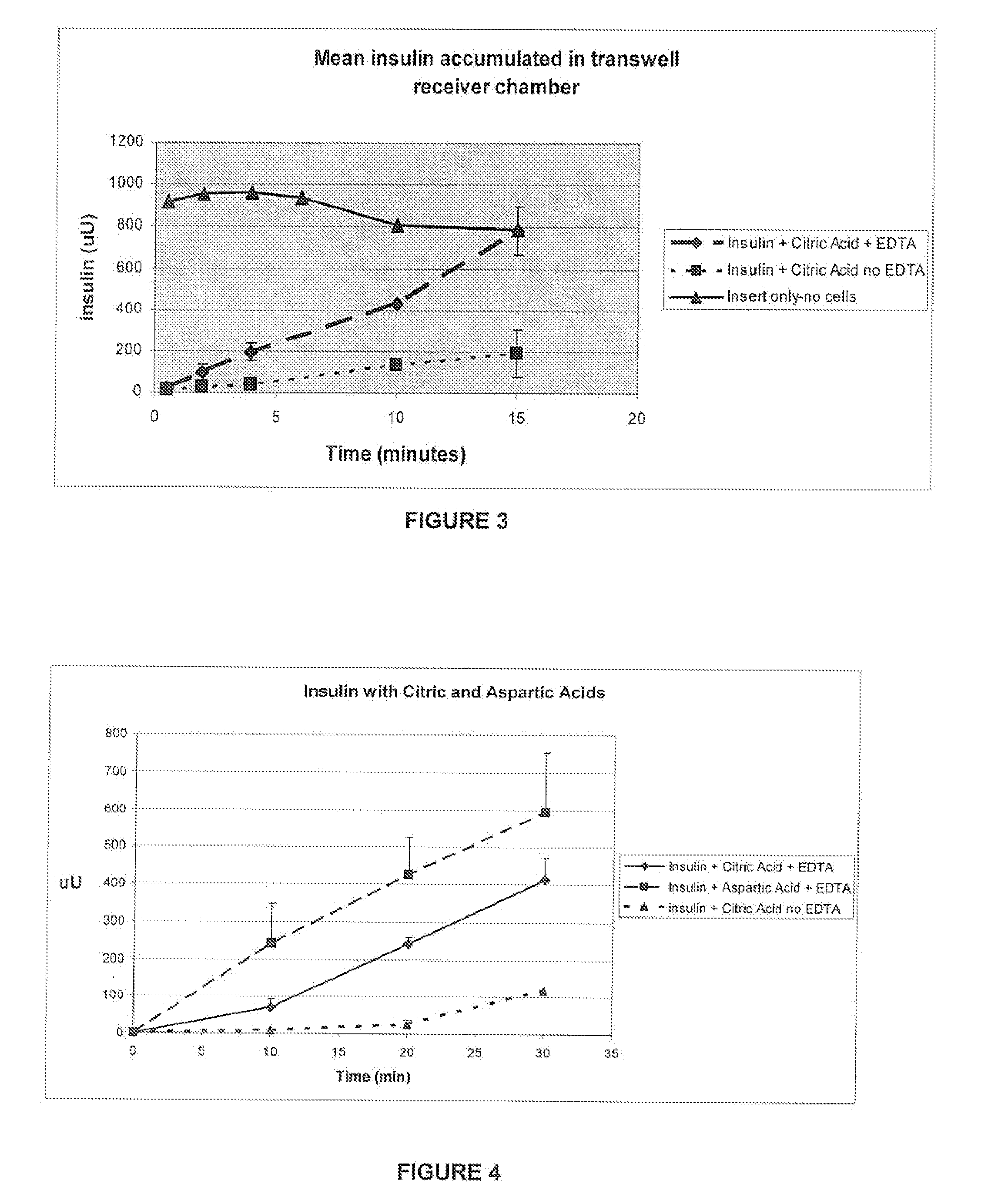
[0060]Purpose: To demonstrate in vitro the effect of EDTA in the presence of citric acid on absorption of insulin through an epithelial cell multilayer.
Materials and Methods:
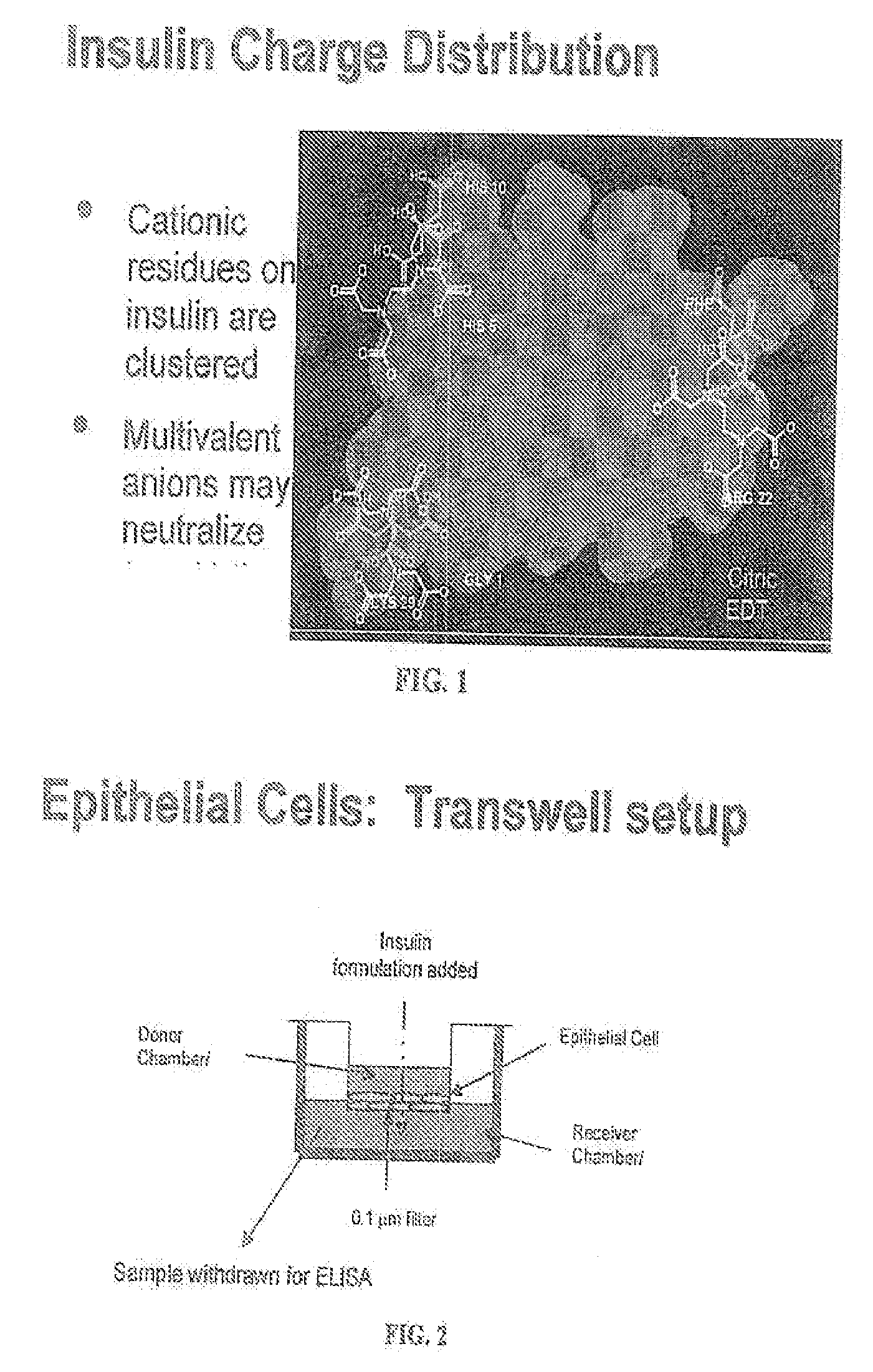
[0061]Two saline solutions were mixed containing 1 mg / ml insulin, 2 mg / ml EDTA and 2 mg / ml citric acid (“solution 1”) or 1 mg / ml insulin and 2 mg / ml citric acid (“solution 2”). The control (no cells) contained EDTA, citric acid and insulin. Immortalized human epithelial cell line cultures were seeded on transwell plates (FIG. 2). Cells were grown to confluence and tested for membrane integrity using trans-epithelial resistance. At time zero, the fluid in the top chambers of the transwell plates was replaced with 0.5 ml of insulin solution (i.e. solution 1 or solution 2). Two plates with solution 1, two plates with solution 2 and one plate with the control solution (no cells) were tested simultaneously. The lower chamber of each plate conta...
example 2
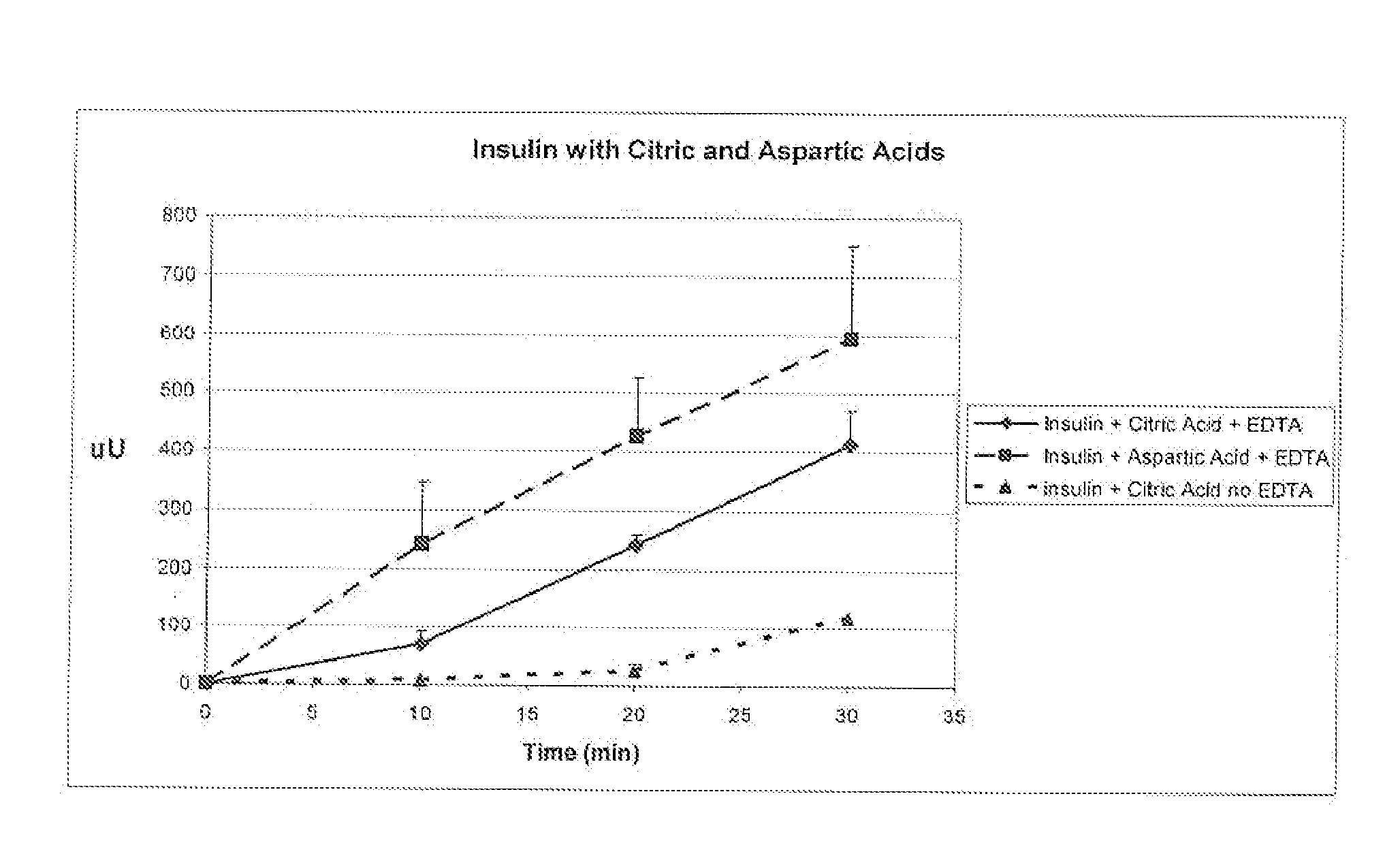
Effect of Aspartic and Citric Acid on Absorption of Insulin Through an Epithelial Cell Multilayer.
[0064]Purpose: Demonstrate that polyacids have different affinities for insulin with EDTA as shown by an increase in absorption through cells.
Methods and Materials:
[0065]Oral epithelial cells that have been seeded on transwell plates were used to determine the rate of absorption through the cell multilayer, as described in example 1. Insulin (1 mg / ml) was dissolved in either aspartic (0.2 mg / mL) or citric acid (2 mg / ml) and EDTA (2 mg / ml) was added to both. Insulin with citric acid (no EDTA) was used as a control. The pH of the solution was approximately 3.5 to 4, and physiological saline was present to provide an isotonic environment for the cells (0.85% NaCl, sufficient to produce a range of 280-310 mOsm as measured by freezing point depression, Microsmette, Precision systems, Natick, Mass.). Samples were taken from the receiver chamber and assayed by ELISA (Linco Corp.) for human rec...
example 3
Comparison of Effect of Citric Acid, Glutamic Acid, Adipic Acid and Oxalic Acid on Insulin Absorption Through an Epithelial Cell Multilayer
Materials and Methods:
[0068]Transwell plates seeded with oral epithelial cells were used for these experiments. The effect of EDTA was monitored by the amount of insulin that came through the lower chamber of the transwell plate.
[0069]Oral epithelial cells were grown on transwell inserts for 2 weeks until multiple (4-5) cell layers had formed. Transport studies were conducted by adding the appropriate solution (all contained 1 mg / ml human insulin) to the donor well and removing samples from the receiver well after 10 minutes. Insulin amounts in the receiver wells were assayed using ELISA. Apparent Permeability was calculated using the formula: Apparent Permeability=Q / A(C)t where Q=total amount permeated during incubation time in μg, A=area of insert in cm2, C=initial concentration in donor well in μg / cm3 and t=total time of experiment in sec.
[007...
PUM
| Property | Measurement | Unit |
|---|---|---|
| pH | aaaaa | aaaaa |
| pH | aaaaa | aaaaa |
| median time | aaaaa | aaaaa |
Abstract
Description
Claims
Application Information
 Login to View More