[0177]Advantageously, insulin derivatives according to the invention are soluble at physiological pH values, have a
potency which is comparable to that of
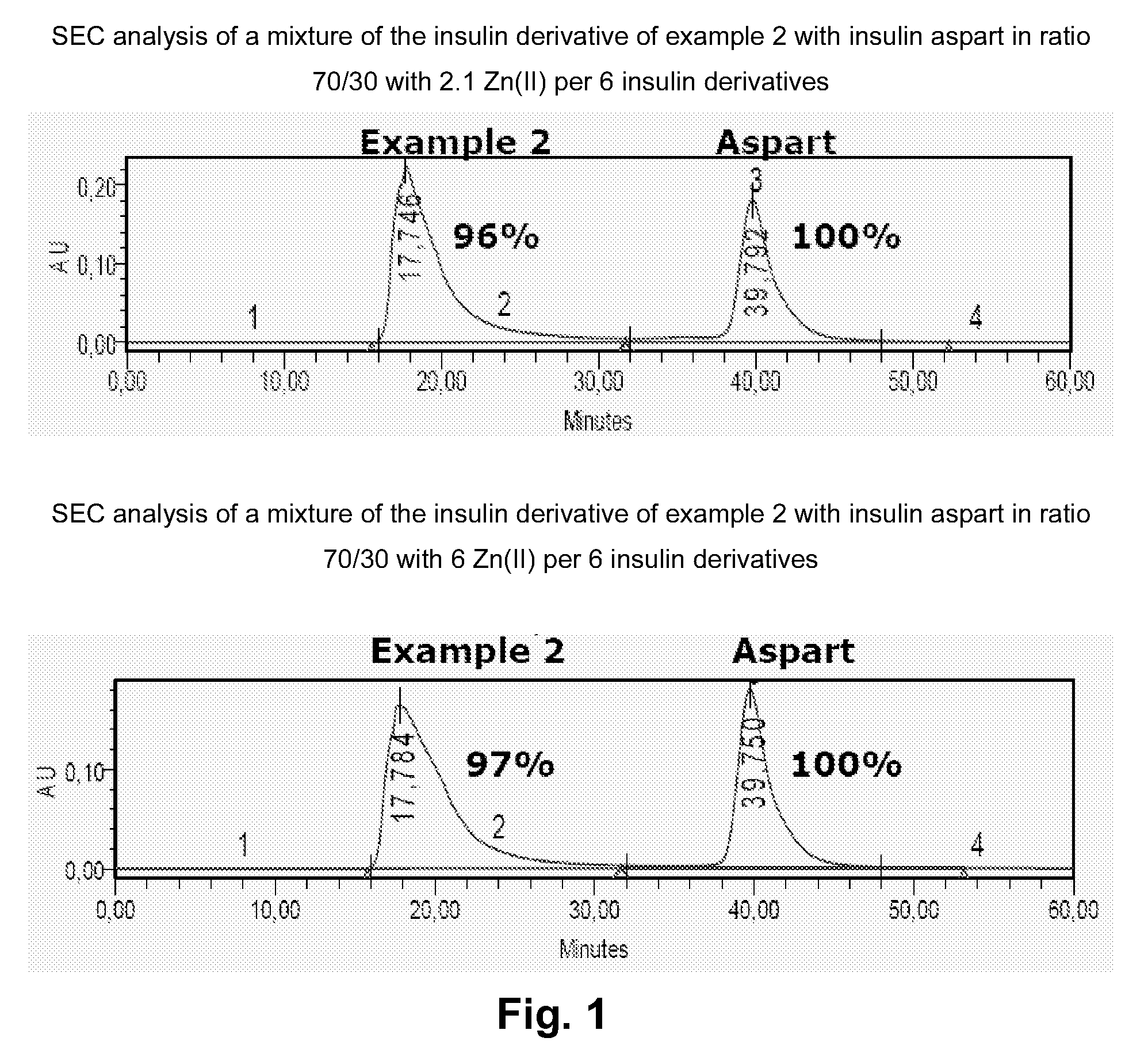
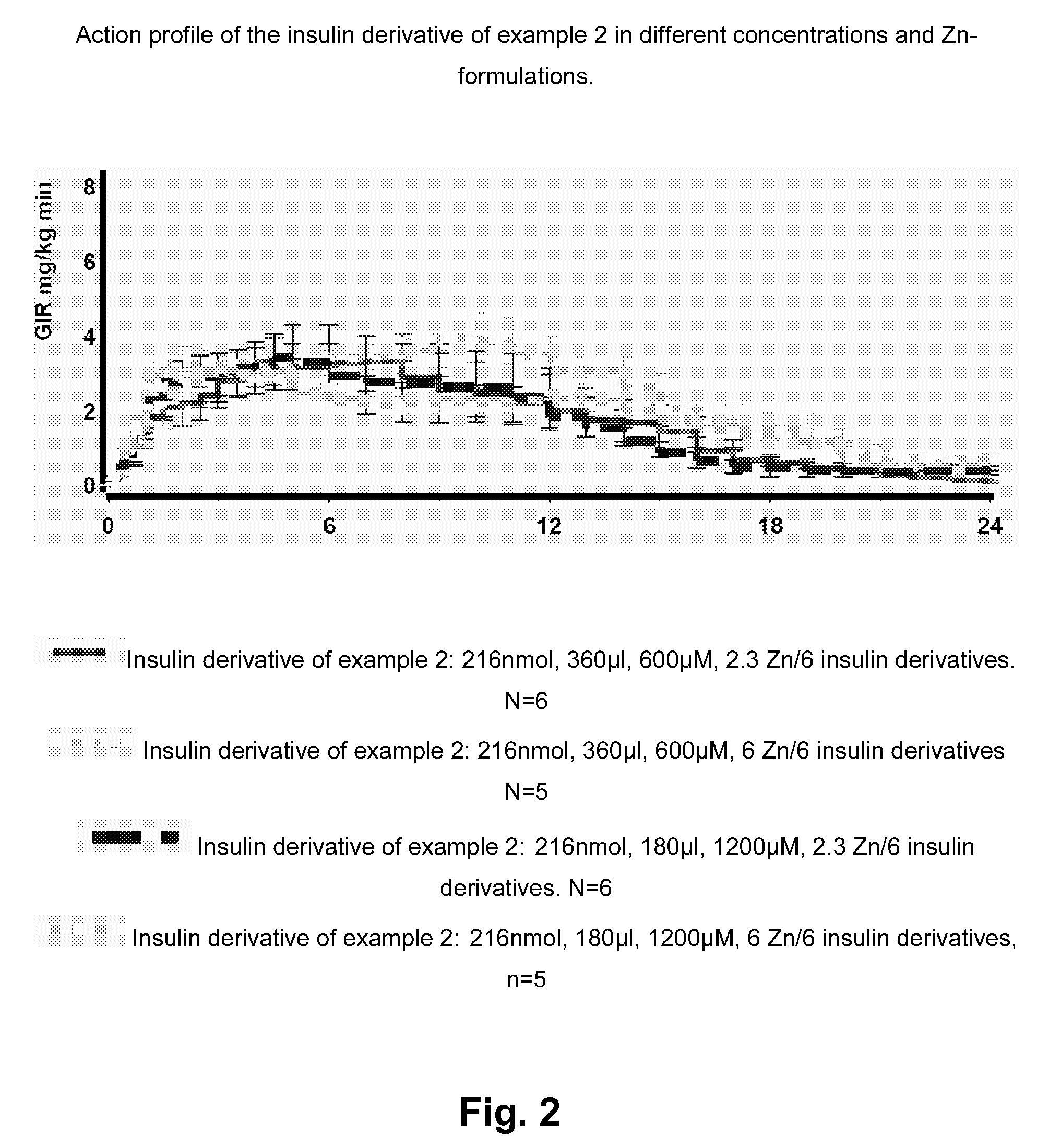
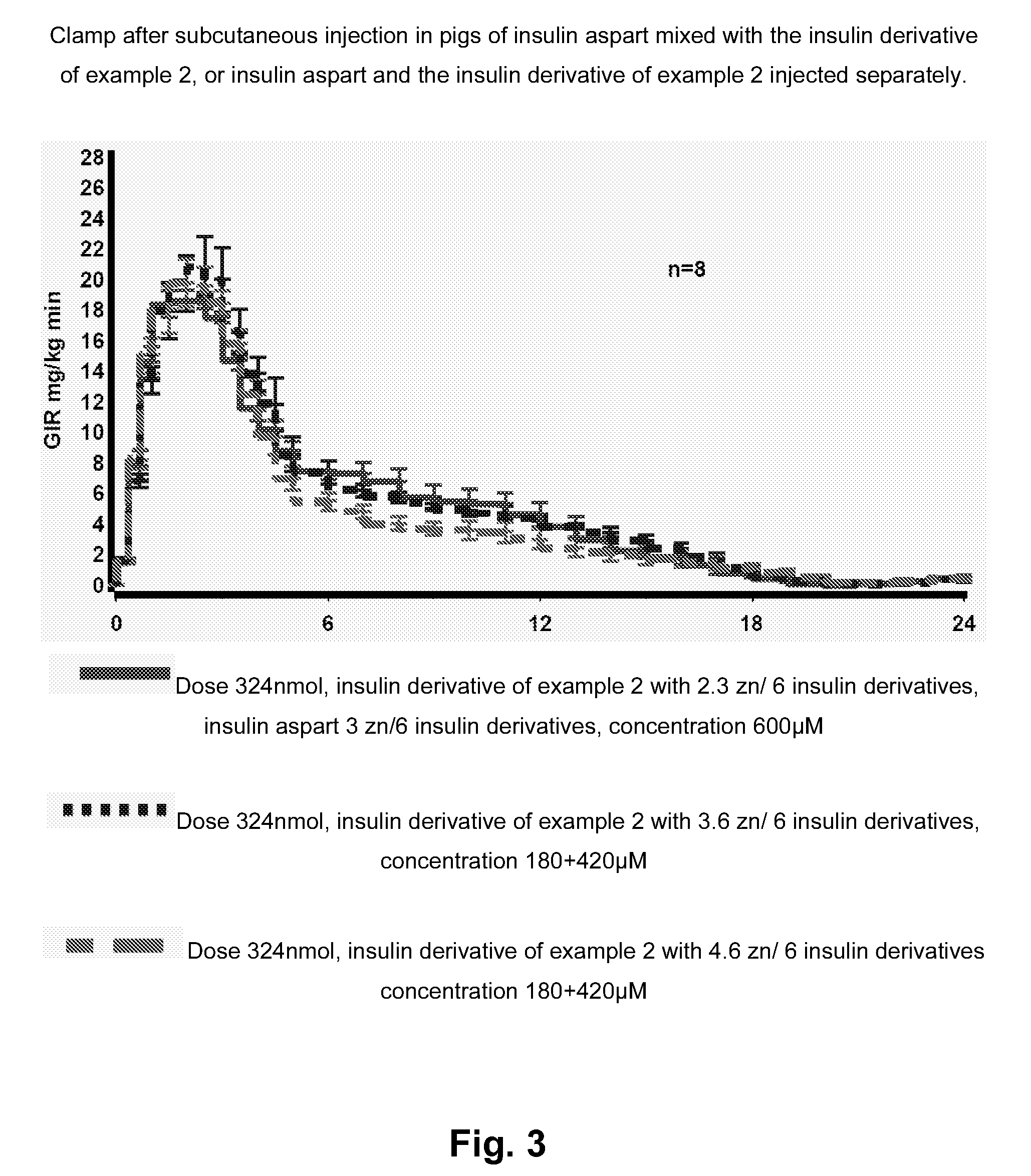
human insulin, and are mixable with fast-acting insulins with no blunting. The individual profiles of action of mixed basal and bolus insulins are retained in formulations containing Zn(II) concentrations of up to or less than approximately 3 Zn(II) per insulin hexamer which limits the risk of precipitations in the formulation, compared to formulations containing more than 3 Zn (II) per insulin hexamer.
[0996]As those skilled in the art will recognize, the formulation of insulin derivative of this invention, the quantity of the formulation delivered, and the duration of administration of a single
dose depend on the type of
inhalation device employed. For some
aerosol delivery systems, such as nebulizers, the frequency of administration and length of time for which the
system is activated will depend mainly on the concentration of insulin conjugate in the
aerosol. For example, shorter periods of administration can be used at higher concentrations of insulin conjugate in the
nebulizer solution. Devices such as metered
dose inhalers can produce higher
aerosol concentrations, and can be operated for shorter periods to deliver the desired amount of insulin conjugate. Devices such as
powder inhalers deliver
active agent until a given charge of agent is expelled from the device. In this type of
inhaler, the amount of insulin derivative of this invention in a given quantity of the
powder determines the
dose delivered in a
single administration.
[1000]Formulations of insulin derivatives of this invention for administration from a
dry powder inhaler typically include a finely divided
dry powder containing the derivative, but the
powder can also include a bulking agent, carrier,
excipient, another additive, or the like. Additives can be included in a
dry powder formulation of insulin conjugate, for example, to dilute the powder as required for delivery from the particular
powder inhaler, to facilitate
processing of the formulation, to provide advantageous powder properties to the formulation, to facilitate dispersion of the powder from the
inhalation device, to stabilize the formulation (for example, antioxidants or buffers), to provide taste to the formulation, or the like. Advantageously, the additive does not adversely affect the patient's airways. The insulin derivative can be mixed with an additive at a
molecular level or the
solid formulation can include particles of the insulin conjugate mixed with or coated on particles of the additive. Typical additives include mono-, di-, and polysaccharides;
sugar alcohols and other polyols, such as, for example,
lactose, glucose,
raffinose, melezitose,
lactitol,
maltitol,
trehalose,
sucrose,
mannitol,
starch, or combinations thereof; surfactants, such as sorbitols, diphosphatidyl
choline, or
lecithin; or the like. Typically an additive, such as a bulking agent, is present in an amount effective for a purpose described above, often at about 50% to about 90% by weight of the formulation. Additional agents known in the art for formulation of a
protein such as
insulin analogue protein can also be included in the formulation.
[1002]Formulations of insulin derivatives of this invention suitable for use with a
sprayer will typically include the insulin derivative in an
aqueous solution at a concentration of about 1 mg to about 20 mg of insulin conjugate per ml of solution. The formulation can include agents such as an
excipient, a buffer, an isotonicity agent, a
preservative, a surfactant, and, for example
zinc. The formulation can also include an
excipient or agent for stabilization of the insulin derivative, such as a buffer, a
reducing agent, a bulk
protein, or a
carbohydrate. Bulk proteins useful in formulating insulin conjugates include
albumin,
protamine, or the like. Typical carbohydrates useful in formulating insulin conjugates include
sucrose,
mannitol,
lactose,
trehalose, glucose, or the like. The insulin derivative formulation can also include a surfactant, which can reduce or prevent surface-induced aggregation of the insulin conjugate caused by atomization of the solution in forming an aerosol. Various conventional surfactants can be employed, such as polyoxyethylene
fatty acid esters and alcohols, and polyoxyethylene
sorbitol fatty acid esters. Amounts will generally range between about 0.001 and about 4% by weight of the formulation.


 Login to View More