[0007]The primary object of the present invention is to provide a method and an apparatus of photon logic gates based on quantum switching phenomenon. The photon logic gates should overcome limitations of the conventional
optical logic gates in operational speed and size. The main feature of the photon logic gates is using
quantum optics of EIT and quantum switch for multiple gate function in one physical gate composed of three (four)-color lasers interacting with a
nonlinear optical medium via optical waveguides or
free space. As shown in the quantum switch (Ham, U.S. Pat. No. 6,628,453), the operational bandwidth of the present photon logic gates is not limited by the
population relaxation time or carrier's lifetime. Main
advantage of the present invention is not only for all-optical digital
processing but also for quantum interface in a
quantum network composed of quantum computers. Briefly described, a
system of the photon logic gates of the present invention is provided by a single or multiply connected quantum switches composed of
nonlinear optical medium and at least four coherent
laser beams. The nonlinear
optical medium of the quantum switch is composed of at least four-energy levels. Three of them should be closely spaced on the ground states, and the last one should be an
excited state. The frequencies of the
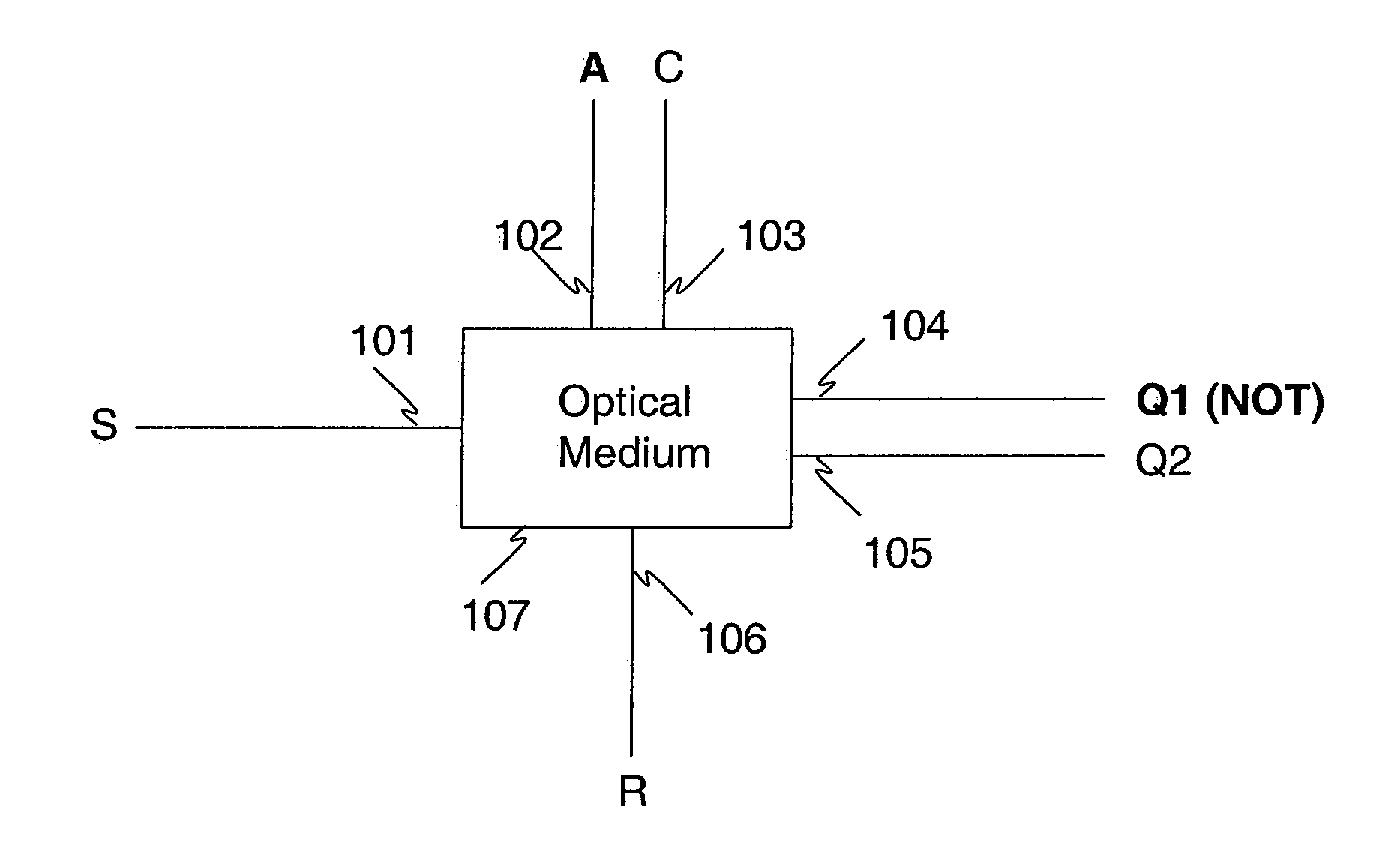
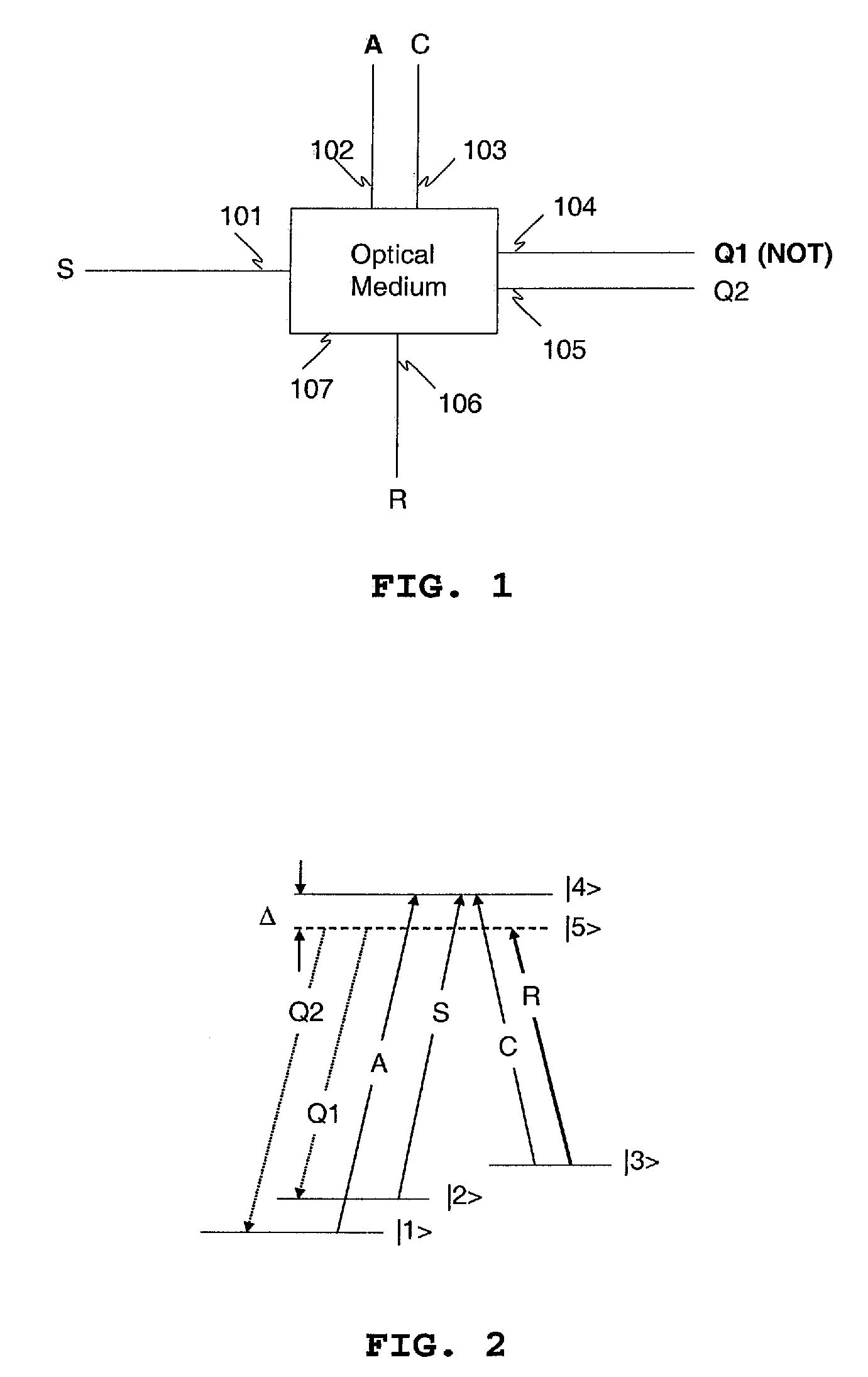
laser beams of A, C, and S are resonant respectively to the transitions from the three ground states |1>, |2>, and |3> to the
excited state |4> of the nonlinear
optical medium: see FIGS. 1 and 2. The
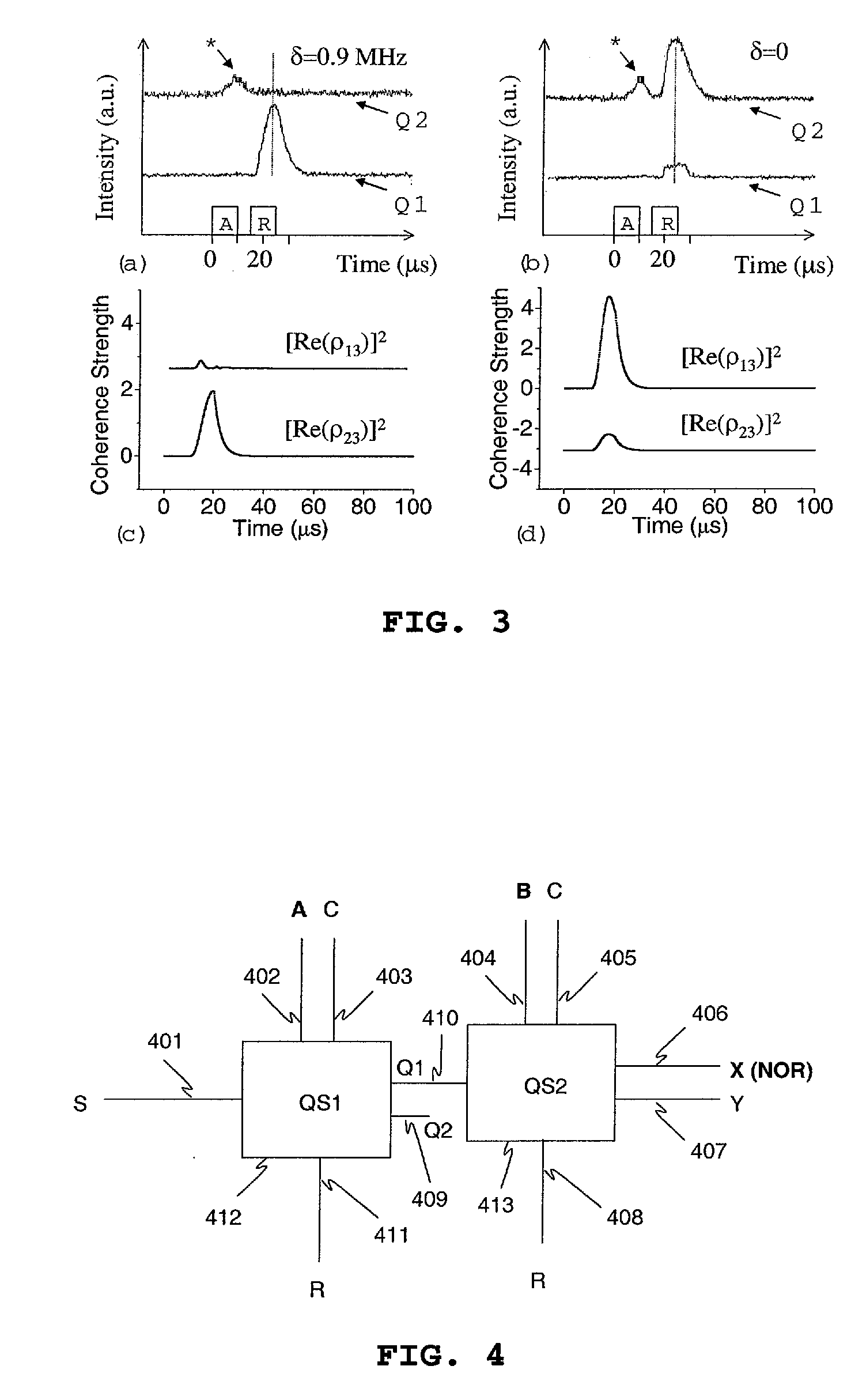
laser beam R is used as a probe for nondegenerate four-wave mixing processes to generate the outputs Q1 or Q2. The nondegenerate four-wave mixing output Q1 and / or Q2 can be used as an input(s) to the second / third
nonlinear medium to configure a photon logic gate. The output direction of the Q1 and Q2 is physically separated, so that the quantum switch acts as an
optical router: Ham, Applied
Physics Letters Vol. 85, pp. 893-895 (2004). Each laser beam can be guided by an optical
waveguide made of hetero-structured quantum wells,
photonic bandgap crystals,
silicon on insulator, or
surface plasmon. The optical
waveguide is not part of the current invention. By connecting two quantum switches in series or in parallel it performs the Boolean logic: NOT, NAND, AND, OR, XOR, and NOR. The photon logic gates can be extended for
scalability purposes by an optical
waveguide, and the traveling time between two photon logic gates is negligible.
is not only for all-optical digital
processing but also for quantum interface in a
quantum network composed of quantum computers. Briefly described, a
system of the photon logic gates of the present invention is provided by a single or multiply connected quantum switches composed of nonlinear
optical medium and at least four coherent
laser beams. The nonlinear optical medium of the quantum switch is composed of at least four-energy levels. Three of them should be closely spaced on the ground states, and the last one should be an excited state. The frequencies of the
laser beams of A, C, and S are resonant respectively to the transitions from the three ground states |1>, |2>, and |3> to the excited state |4> of the nonlinear optical medium: see FIGS. 1 and 2. The laser beam R is used as a probe for nondegenerate four-wave mixing processes to generate the outputs Q1 or Q2. The nondegenerate four-wave mixing output Q1 and / or Q2 can be used as an input(s) to the second / third
nonlinear medium to configure a photon logic gate. The output direction of the Q1 and Q2 is physically separated, so that the quantum switch acts as an
optical router: Ham, Applied
Physics Letters Vol. 85, pp. 893-895 (2004). Each laser beam can be guided by an optical waveguide made of hetero-structured quantum wells,
photonic bandgap crystals,
silicon on insulator, or
surface plasmon. The optical waveguide is not part of the current invention. By connecting two quantum switches in series or in parallel it performs the Boolean logic: NOT, NAND, AND, OR, XOR, and NOR. The photon logic gates can be extended for
scalability purposes by an optical waveguide, and the traveling time between two photon logic gates is negligible.


 Login to View More