Check patentability & draft patents in minutes with Patsnap Eureka AI!

Compositions And Methods For Modulating The Pharmacokinetics and Pharmacodynamics of Insulin

Inactive Publication Date: 2012-07-12
ELI LILLY & CO
View PDF4 Cites 23 Cited by
  • Summary
  • Abstract
  • Description
  • Claims
  • Application Information

AI Technical Summary

Benefits of technology

[0020]Compositions and methods for optimizing the rate of insulin absorption and time to decrease the blood glucose levels in a diabetic individual have been developed wherein the chelator form and concentration is varied to produce different absorption profiles and reduction of injection site pain.

Problems solved by technology

Diabetes is a disease characterized by abnormally high levels of blood glucose and inadequate levels of insulin.
As a result, the blood glucose level of patients with diabetes goes too high after eating, a condition known as hyperglycemia.
Hyperglycemia causes glucose to attach unnaturally to certain proteins in the blood, interfering with the proteins' ability to perform their normal function of maintaining the integrity of the small blood vessels.
With hyperglycemia occurring after each meal, the tiny blood vessels eventually break down and leak.
The long-term adverse effects of hyperglycemia include blindness, loss of kidney function, nerve damage and loss of sensation and poor circulation in the periphery, potentially requiring amputation of the extremities.
However, this occurs at the time when digestion is almost over and blood glucose levels should begin to fall.
This inordinately large amount of insulin has two detrimental effects.
First, it puts an undue extreme demand on an already compromised pancreas, which may lead to its more rapid deterioration and eventually render the pancreas unable to produce insulin.
Second, too much insulin after digestion leads to weight gain, which may further exacerbate the disease condition.
Although helpful in the short-run, treatment through diet and exercise alone is not an effective long-term solution for the vast majority of patients with Type 2 diabetes.
These treatments are limited in their ability to manage the disease effectively and generally have significant side effects, such as weight gain and hypertension.
Because of the limitations of non-insulin treatments, many patients with Type 2 diabetes deteriorate over time and eventually require insulin therapy to support their metabolism.
Although this treatment regimen is accepted as effective, it has limitations.
First, patients generally dislike injecting themselves with insulin due to the inconvenience and pain of needles.
As a result, patients tend not to comply adequately with the prescribed treatment regimens and are often improperly medicated.
More importantly, even when properly administered, insulin injections do not replicate the natural time-action profile of insulin.
However, for a variety of medical reasons, intravenous injection of insulin before each meal is not a practical therapy.
However, even with the rapid-acting insulin analogs, peak insulin levels typically occur within 50 to 70 minutes following the injection.
Because the rapid-acting insulin analogs do not adequately mimic the first-phase insulin release, diabetics using insulin therapy continue to have inadequate levels of insulin present at the initiation of a meal and too much insulin present between meals.
This lag in insulin delivery can result in hyperglycemia early after meal onset.
Furthermore, the excessive insulin between meals may result in an abnormally low level of blood glucose known as hypoglycemia.
Hypoglycemia can result in loss of mental acuity, confusion, increased heart rate, hunger, sweating and faintness.
At very low glucose levels, hypoglycemia can result in loss of consciousness, coma and even death.
Unfortunately, early clinical trials with this product showed some injection site discomfort.

Method used

the structure of the environmentally friendly knitted fabric provided by the present invention; figure 2 Flow chart of the yarn wrapping machine for environmentally friendly knitted fabrics and storage devices; image 3 Is the parameter map of the yarn covering machine
View more

Image

Smart Image Click on the blue labels to locate them in the text.
Viewing Examples
Smart Image
  • Compositions And Methods For Modulating The Pharmacokinetics and Pharmacodynamics of Insulin
  • Compositions And Methods For Modulating The Pharmacokinetics and Pharmacodynamics of Insulin
  • Compositions And Methods For Modulating The Pharmacokinetics and Pharmacodynamics of Insulin

Examples

Experimental program
Comparison scheme
Effect test

example 1

Comparison of Different EDTA Concentrations in EDTA-Citric Acid Insulin Formulations in Diabetic Swine Study

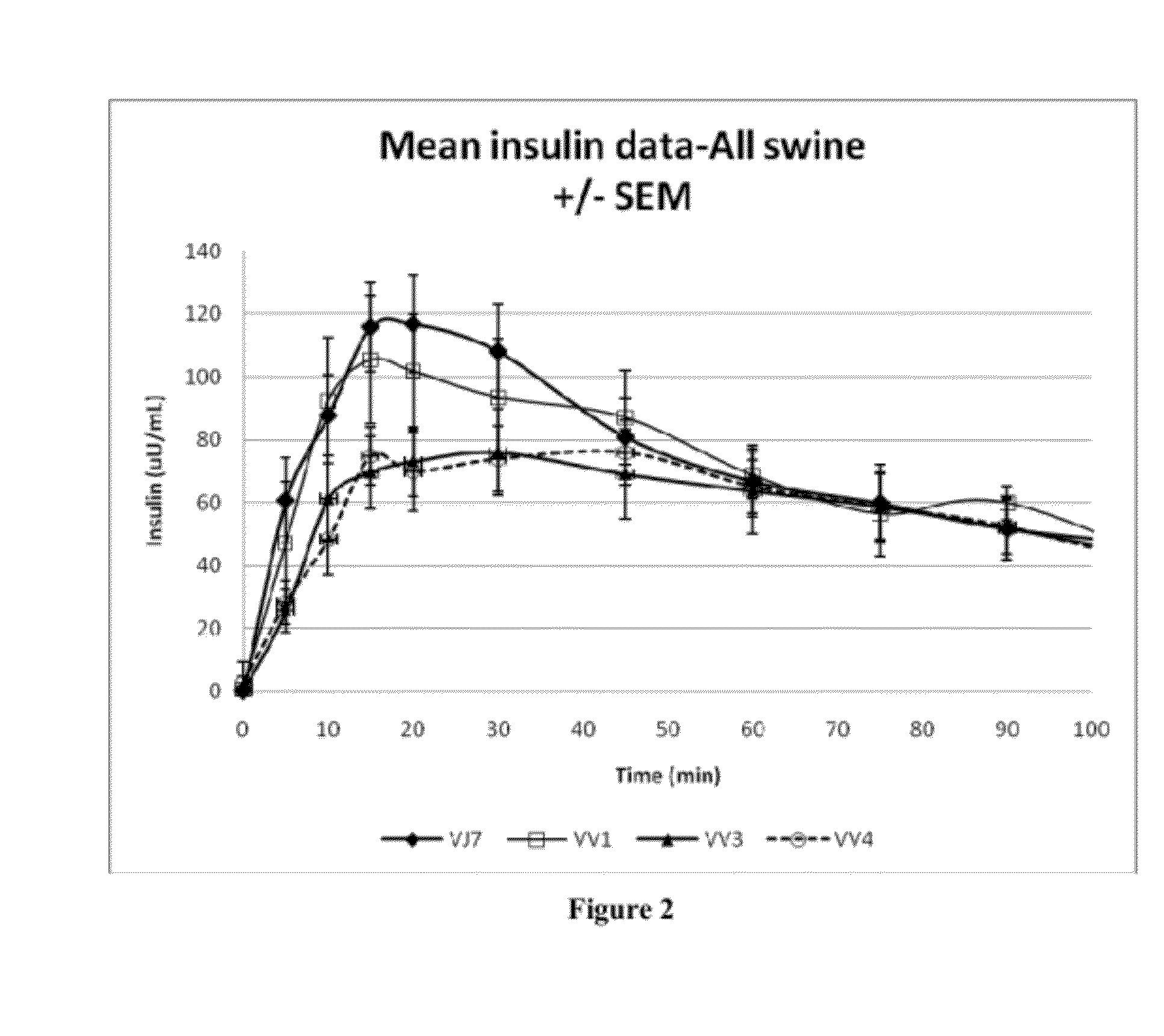
[0083]The purpose of this swine study was to further understand the importance of EDTA in VIAject®. VIAject® was formulated with different concentrations of EDTA and studied in vivo in the diabetic miniature swine model. The reduced EDTA variations were compared to the original formulation containing 1.8 mg disodium EDTA / ml in the diabetic miniature swine model. Results of this testing confirm the importance of EDTA in the formulation.

[0084]Materials and Methods

[0085]VIAject® U-100 pH 7 formulation (VJ7) includes 100 U / ml insulin, 1.8 mg / ml citric acid, glycerol and m-cresol, and either[0086](1) 1.8 mg / ml disodium EDTA (VJ7),[0087](2) 1 mg / mL disodium EDTA (VV1),[0088](3) 0.25 mg / mL disodium EDTA (VV3)[0089](4) 0.1 mg / mL disodium EDTA (VV4).

[0090]Eight diabetic miniature swine were injected in the morning with 0.25 U / kg of test formulation instead of their daily porcine insuli...

example 2

Summary of Effect of Calcium disodium EDTA Concentration on Injection Site Discomfort in Humans

[0099]Materials and Methods

[0100]Each milliliter of Viaject 7 contains 3.7 mg (100 IU) of recombinant human insulin, 1.8 mg of citric acid, 1.8 mg of disodium EDTA, 22.07 mg of glycerin, 3.0 mg of m-Cresol as a preservative, and sodium hydroxide and / or hydrochloric acid to adjust the pH to approximately 7.

[0101]Each milliliter of BIOD 102 contains 3.7 mg (100 IU) of recombinant human insulin, 1.8 mg of citric acid, 2.4 mg of calcium disodium EDTA, 15.0 mg of glycerin, 3.0 mg of m-cresol as a preservative, and sodium hydroxide and / or hydrochloric acid to adjust the pH to approximately 7.1.

[0102]Each milliliter of -BIOD 103 contains 3.7 mg (100 IU) of recombinant human insulin, 1.8 mg of citric acid, 0.25 mg of disodium EDTA, 2.0 mg of calcium disodium EDTA, 15.0 mg of glycerin, 3.0 mg of m-cresol as a preservative, and sodium hydroxide and / or hydrochloric acid to adjust the pH to approximat...

example 3

Addition of Blend of Na EDTA and CaCl2 as a Ssubstitution for Ca EDTA. Comparison of BIOD 105 and BIOD 107 to VJ7-Stability Assessment:

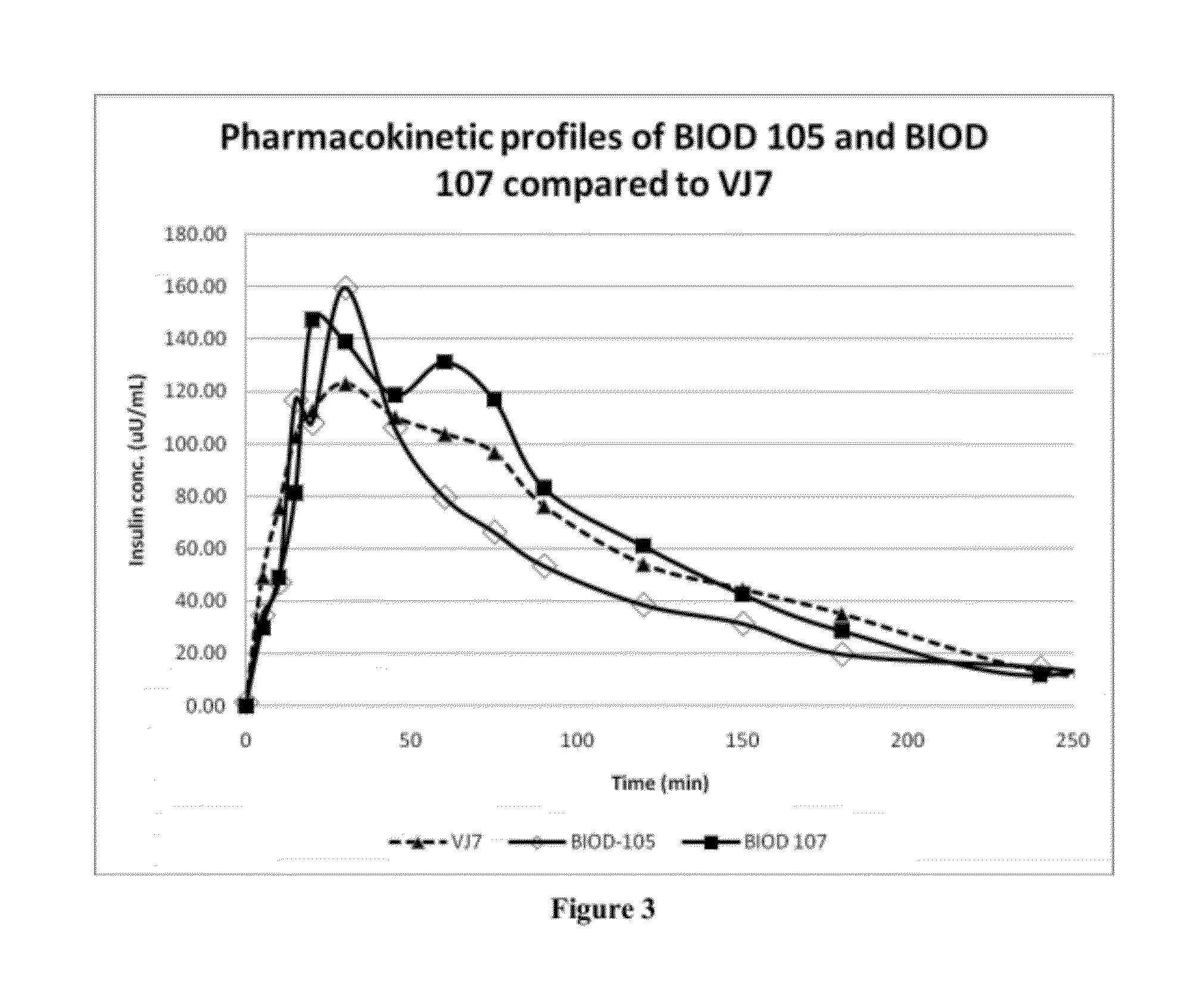
[0106]The addition of calcium EDTA to the formulation has been shown to reduce the site reaction to the injection, however, the rapid action of the formulation was somewhat delayed from this substitution. Therefore, new formulations were developed to regain the loss in timing and improve stability. Additional citric acid was added (150% compared to the original formulation, VJ 7) and a ⅓ reduction in m-cresol was also explored to enhance stability. In one new formulation, disodium EDTA and CaCl2 were added as separate excipients to achieve the calcium chelated form of EDTA (BIOD 107) and this effect was compared to the direct addition of Ca EDTA (BIOD 105). The composition of the formulations given as percents compared to the original formulation, VJ7 are given in Table 5 below.

TABLE 5Compositions of Na and Ca EDTA formulations:Composition (vs VJ 7)A...

the structure of the environmentally friendly knitted fabric provided by the present invention; figure 2 Flow chart of the yarn wrapping machine for environmentally friendly knitted fabrics and storage devices; image 3 Is the parameter map of the yarn covering machine
Login to View More

PUM

PropertyMeasurementUnit
Molar densityaaaaaaaaaa
Login to View More

Abstract

Compositions and methods for modulating the pharmacokinetics and pharmacodynamics of rapid acting injectable insulin formulations are described herein. In the preferred embodiment, the formulations are administered via subcutaneous injection. The formulations contain insulin in combination with a zinc chelator such as ethylenediaminetetraacetic acid (“EDTA”) and a dissolution / stabilization agent, and optionally additional excipients. Calcium disodium EDTA is less likely to remove calcium from the body, and typically has less pain on injection in the subcutaneous tissue. Modulating the type and quantity of EDTA can change the insulin absorption profile. Increasing the quantity of citrate can further enhance absorption and chemically stabilize the formulation. In the preferred embodiment, the formulation contains human insulin, calcium disodium EDTA and a dissolution / stabilization agent such as citric acid or sodium citrate. These formulations are rapidly absorbed into the blood stream when administered by subcutaneous injection.

Description

CROSS REFERENCE TO RELATED APPLICATIONS[0001]This application claims benefit of and priority to U.S. Ser. No. 61 / 361,980 filed Jul. 7, 2010; U.S. Ser. No. 61 / 381,492 filed Sep. 10, 2010; U.S. Ser. No. 61 / 433,080 filed Jan. 14, 2011; and U.S. Ser. No. 61 / 494,553 filed May 10, 2011, all of which are incorporated herein by reference in their entirety.FIELD OF THE INVENTION[0002]The invention is in the general field of injectable rapid acting drug delivery insulin formulations and methods of their use and reduction of pain on injection.BACKGROUND OF THE INVENTION[0003]Diabetes Overview[0004]Glucose is a simple sugar used by all the cells of the body to produce energy and support life. Humans need a minimum level of glucose in their blood at all times to stay alive. The primary manner in which the body produces blood glucose is through the digestion of food. When a person is not getting this glucose from food digestion, glucose is produced from stores in the tissue and released by the li...

Claims

the structure of the environmentally friendly knitted fabric provided by the present invention; figure 2 Flow chart of the yarn wrapping machine for environmentally friendly knitted fabrics and storage devices; image 3 Is the parameter map of the yarn covering machine
Login to View More

Application Information

Patent Timeline
no application Login to View More
IPC IPC(8): A61K38/28A61P25/00A61P3/10
CPCA61K9/0019C07K14/62A61K47/183A61K38/28A61P3/10A61P25/00
Inventor POHL, RODERIKESTEINER, SOLOMONHAUSER, ROBERTSEIBERT, RICHARDLI, MING
Owner ELI LILLY & CO
Features
  • R&D
  • Intellectual Property
  • Life Sciences
  • Materials
  • Tech Scout
Why Patsnap Eureka
  • Unparalleled Data Quality
  • Higher Quality Content
  • 60% Fewer Hallucinations
Social media
Patsnap Eureka Blog
Learn More