[0006]Disclosed herein are systems and methods that may be implemented in a power device communication topology (e.g., such as a
sideband / power device subsystem topology that is separate and different from a host /
BIOS subsystem) to provide an arbitration and communication scheme between shared non-volatile
random access memory (NVRAM) (e.g., a single consolidated NVRAM memory device such as
EPROM,
Flash memory,
EEPROM, etc.) and multiple discrete power controller devices in a manner that provides data protection and the ability to update the full NVRAM content when needed. The disclosed systems and methods may be implemented in one exemplary embodiment to provide a centralized NVRAM digital
voltage regulation scheme for power controller devices of an
information handling system (e.g., such as a computer
server) by using an arbitration and communication scheme for a common NVRAM that is relatively inexpensive and that saves board real estate compared to distributed NVRAM digital
voltage regulation configurations. In this embodiment, each of multiple power controller devices have direct read access so as to read from common shared NVRAM, e.g., without the
baseboard management controller (BMC) or other separate component acting therebetween. Due to the reduced cost and
space requirements that may be achieved using the consolidated NVRAM digital
voltage regulation architecture of this embodiment,
digitization of additional digitally controlled
voltage regulation components for a given information
handling system may be allowed, i.e., as compared to the number of digitally controlled
voltage regulation components normally possible for an information
handling system that employs a conventional distributed NVRAM
voltage regulation configuration.
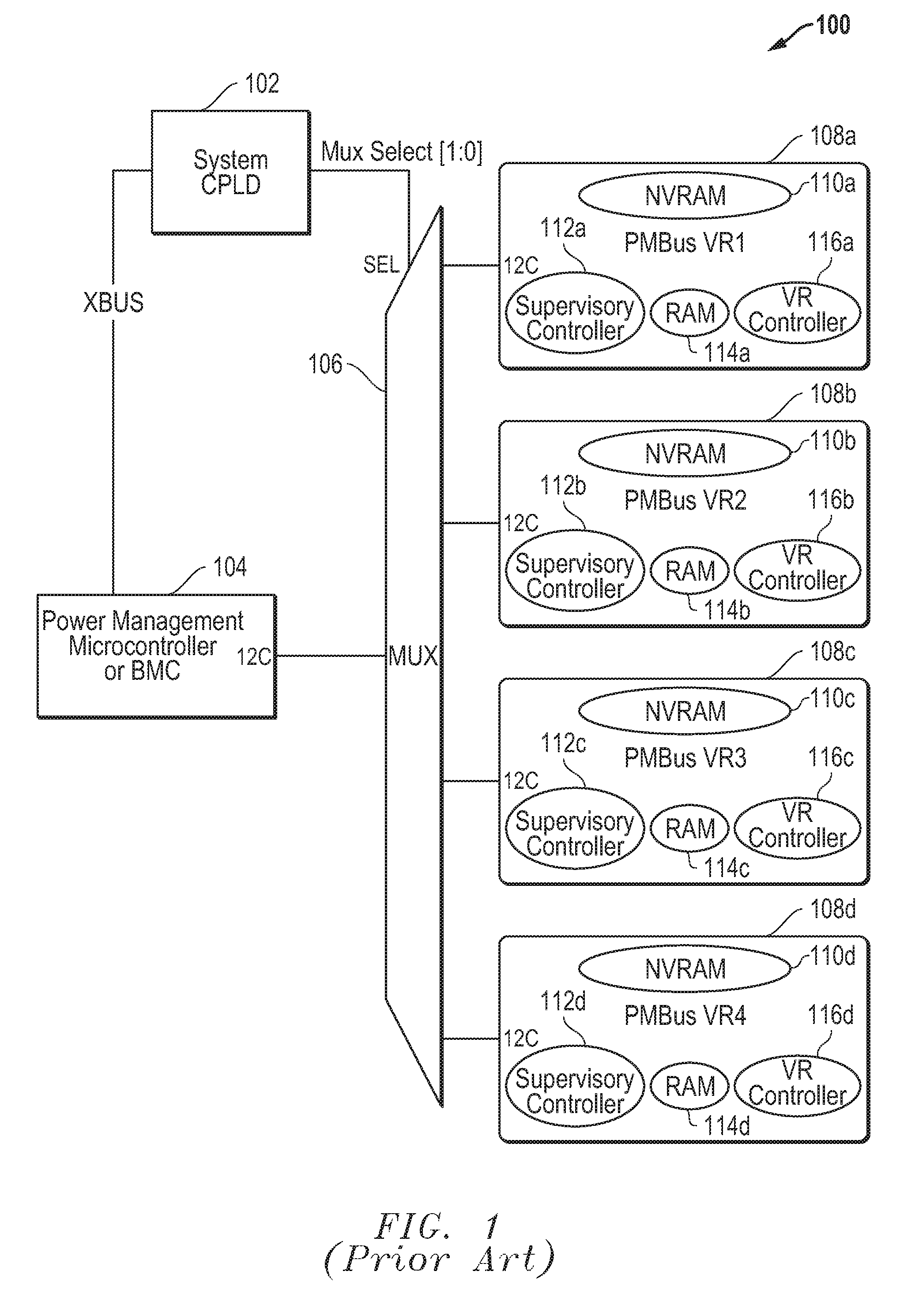
[0008]The disclosed systems and methods may be implemented to consolidate and reduce the number of NVRAM devices required for a given number of multiple power controller devices, and also do not require that NVRAM be integrated into each digital power controller device in the conventional manner. The disclosed systems and methods may therefore be implemented to improve and enhance advantages made possible with digital power controller devices by reducing the
silicon area required to implement NVRAM with a digital power controller device, thus facilitating the transition from analog interfaces to digital interfaces for information
handling system power controller devices such as voltage regulators. Because the cost for implementing individual NVRAM on each digital power controller device in the conventional manner substantially adds to the total
system bill of material (e.g., a 50% cost
adder to the total
silicon cost budget), addition of digital power controller devices with integrated NVRAM in many circumstances outweighs the benefit of migrating most of the remaining power controller devices of an information handling
system to a
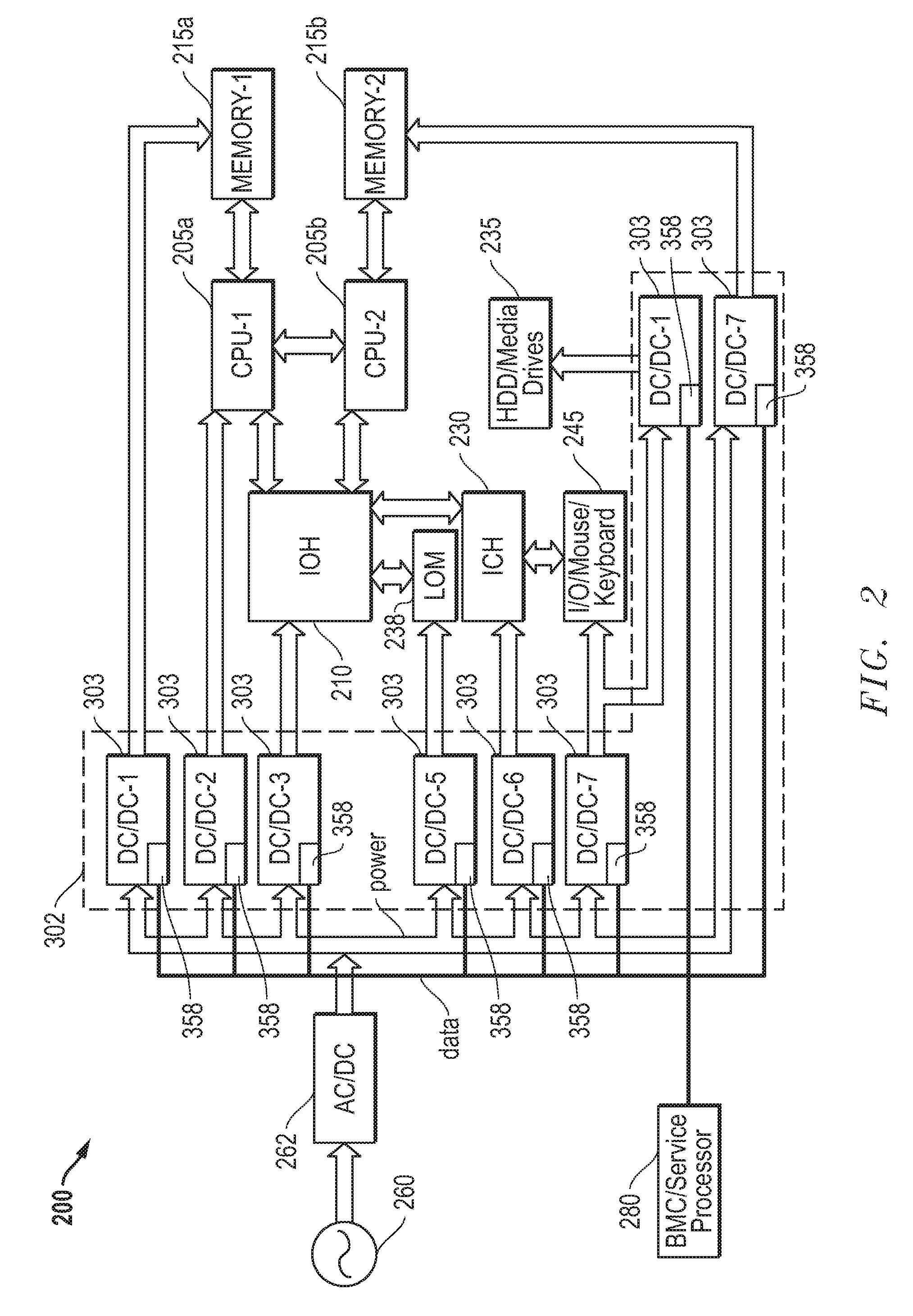
digital interface architecture. In contrast, the disclosed systems and methods may be implemented to provide a cost effective way to configure all or substantially all voltage regulators of an information handling system (such as a computer
server) as digital power controller devices.
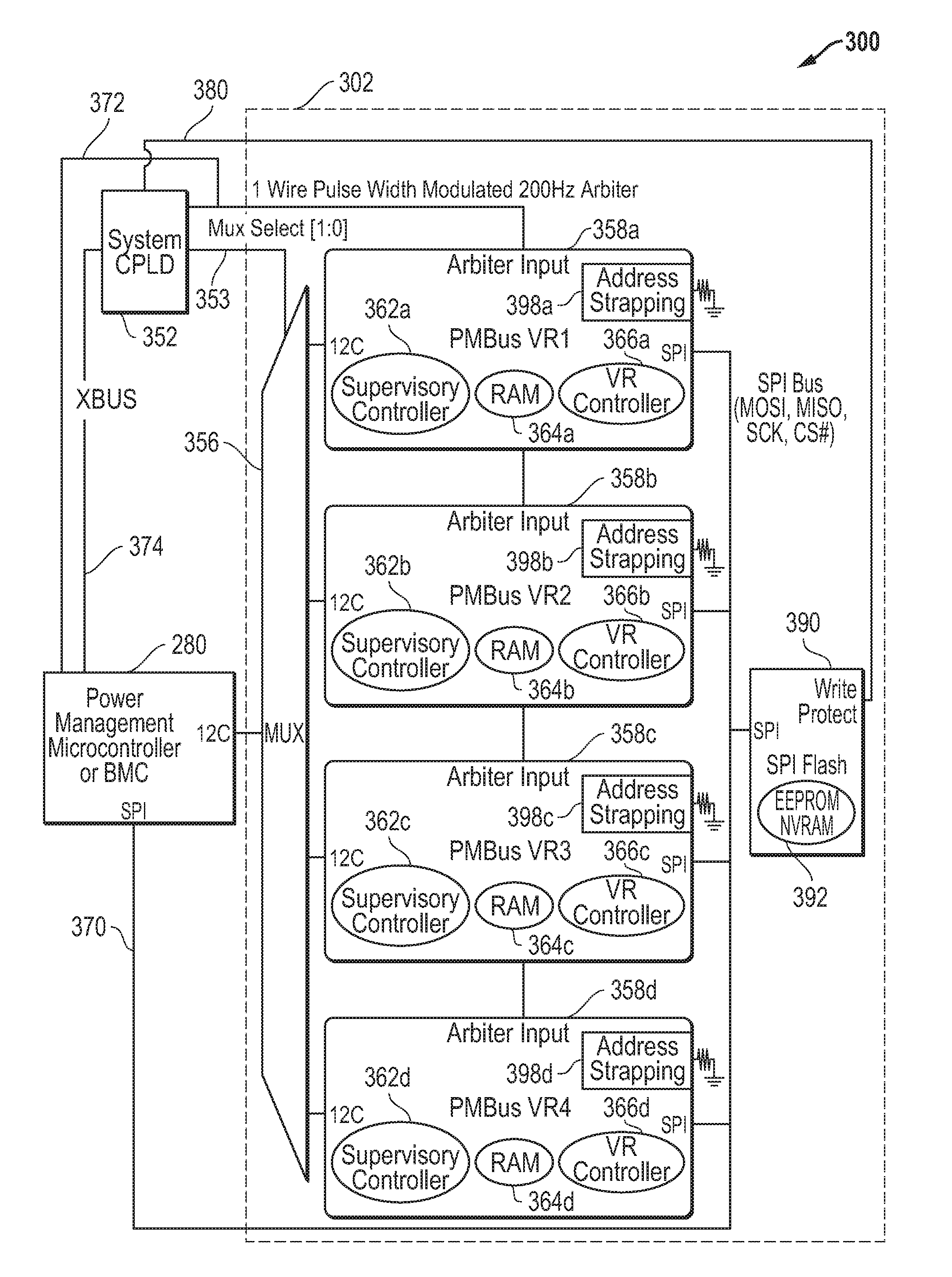
[0010]In one exemplary embodiment, an information handling system (e.g., such as a computer
server) having multiple digital power controller devices may be implemented using a single commodity NVRAM device that is used for all digital power controller devices, thus reducing digital power controller cost. A shared serial
peripheral interface (SPI)
bus may be provided with multi master support (e.g., including each power controller device and a BMC or
power management microcontroller or other suitable
processing device) and single slave (e.g., a SPI Flash NVRAM). A
pulse width modulated arbitration sequence or pattern may be implemented with a
complex programmable logic device (CPLD) that drives a single-wire
arbiter signal (i.e., that is duty-cycle based) and that provides direction for time-domain multiplexed SPI Flash owner to each digital power controller device as well as the
Baseboard Management Controller. In this exemplary embodiment, each digital power controller device has read-only access to the single SPI Flash NVRAM, and is assigned a corresponding dedicated
private address space (or offset) within the SPI Flash NVRAM with the private memory space for a given digital power controller device being determined within the SPI Flash by the address
strapping of the corresponding given power controller device. Public
address space may also be provided at the top address range (e.g., remaining space in SPI Flash NVRAM) for common storage (e.g., such as for
System ID, etc.). As so implemented, increased security may be provided in one embodiment for the power
firmware (i.e., having only one programmable NVRAM with only one agent having write access to the NVRAM). Further, the customer image update process may be simplified in one embodiment by providing a consolidated update method for all digital controllers vs. many discrete steps.


 Login to View More
  Login to View More