Lithium salt-graphene-containing composite material and preparation method thereof
Inactive Publication Date: 2013-06-20
OCEANS KING LIGHTING SCI&TECH CO LTD
View PDF1 Cites 30 Cited by
Summary
Abstract
Description
Claims
Application Information
AI Technical Summary
This helps you quickly interpret patents by identifying the three key elements:
Problems solved by technology
Method used
Benefits of technology
Benefits of technology
The present invention provides a new composite material containing lithium salt, graphene, and carbon nanoparticles that solves issues of low electrical conductivity and unstable structure in prior art. The material has high conductivity, specific capacitance, and stable structure and performance, making it useful in various applications. The method of preparation is simple and low-cost, making it suitable for industrial production.
Problems solved by technology
In the process of deintercalation, lithium ions cross the phase interface of LiFePO4 / FePO4 at a low migration speed, in the process of lithium intercalation, the area of LiFePO4 phase continuously decreases, thus, in the case of high currents density discharge, the amount of lithium ions passing through the phase interface is insufficient to sustain large current, resulting in reduction in reversible capacity.
But many methods fail to solve the problem of low conductivity in LiFePO4.
Similarly, other lithium salts such as lithium manganate, lithium vanadate, and lithium metaloxide salts are also have the same problem, the conductivity is relatively low, and needs to be improved.
Currently, most of the lithium salt materials have the problem of low conductivity, which seriously affect the performance of the products.
But in general, the improvement of the conductivity is limited, or to increase the conductivity, but bringing with other properties of the material, such as low material stability, etc.
Method used
the structure of the environmentally friendly knitted fabric provided by the present invention; figure 2 Flow chart of the yarn wrapping machine for environmentally friendly knitted fabrics and storage devices; image 3 Is the parameter map of the yarn covering machine
View more
Image
Smart Image Click on the blue labels to locate them in the text.
Viewing Examples
Smart Image
Click on the blue label to locate the original text in one second.
Reading with bidirectional positioning of images and text.
Smart Image
Examples
Experimental program
Comparison scheme
Effect test
example 1
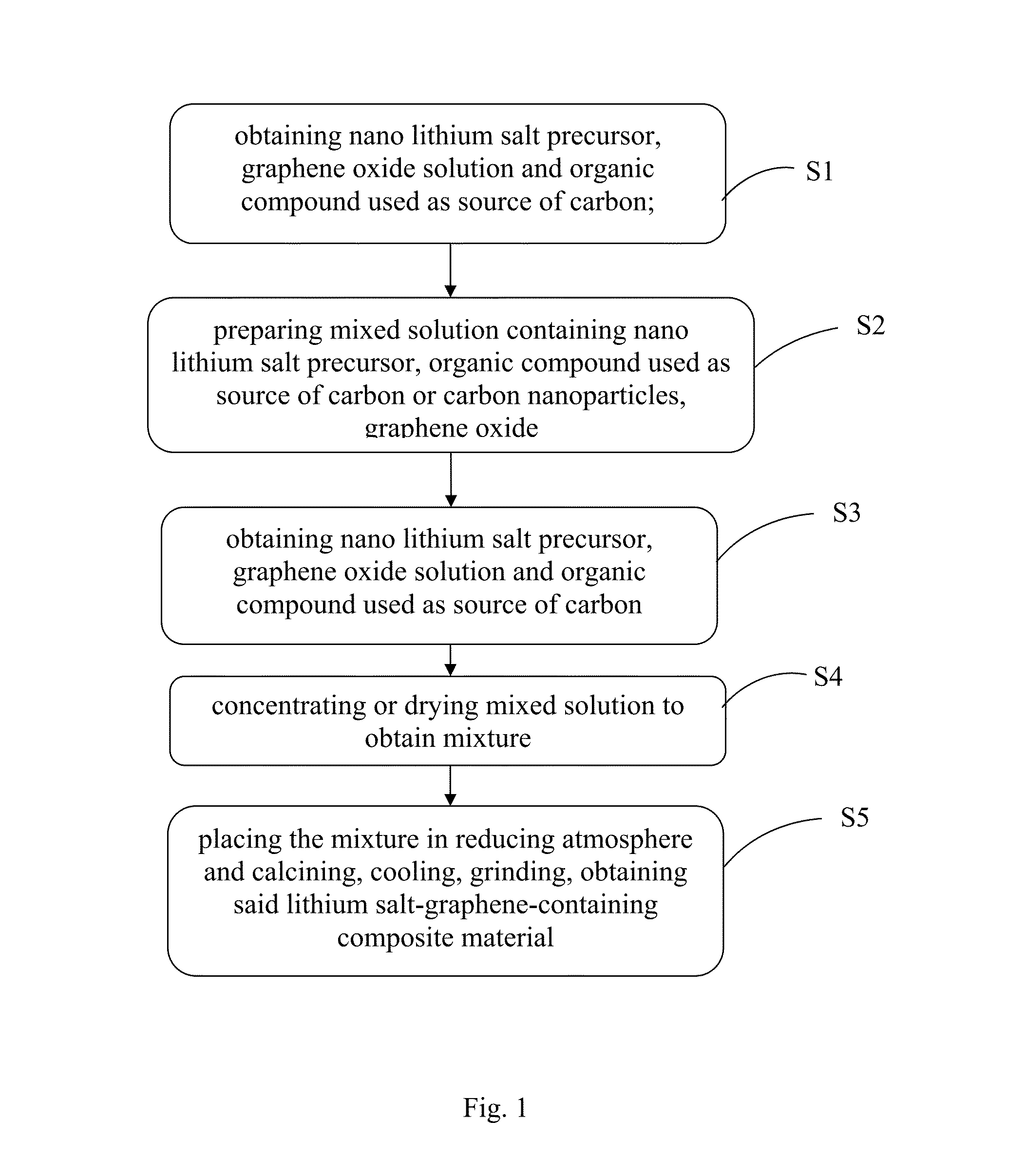
[0050]The preparation method of nano-scaled LiFePO4 lithium salt crystals-graphene composite coated with carbon, comprising:
[0051](1) preparation of nano lithium salt precursor: dissolving 1 mol of NH4H2PO4 and 1 mol of FeSO4.7H2O in deionized water to form 0.5 mol / L mixture having homogeneous distribution, adding slowly 1 mol of LiOH solution into the mixture while stirring, and supplying nitrogen as protection gas to prevent iron ion in the +2-valent state from oxidizing, grey precipitates are obtained, after the addition, continue to stir for 5 h, centrifuging and rinsing, collecting precipitates for later use.
[0052](2) graphene oxide-water system: the preparation method of graphene oxide is based on the improved hummers method (J. Am. Chem. Soc., 1958, 80 (6), 1339-1339, Preparation of Graphitic Oxide), then preparing 1 g / mL of aqueous solution of graphene oxide to obtain brown solution system;
[0053](3) nano lithium salt precursor-graphene oxide system: then mixing 100 g of lith...
example 2
[0062]The preparation method of nano-scaled LiFePO4 lithium salt nanocrystals-graphene composite coated with carbon, comprising:
[0063](1) preparation of nano iron lithium phosphate coated with carbon material: dissolving 1 mol of NH4H2PO4 and 1 mol of FeSO4.7H2O in deionized water to form 0.5 mol / L mixture having homogeneous distribution, adding slowly 1 mol of LiOH solution into the mixture while stirring, and supplying nitrogen as protection gas to prevent iron ion in the +2-valent state from oxidizing, grey precipitates are obtained, after the addition, continue to stir for 5 h, rinsing with water and filtering, after filtering, adding the aforementioned organic compound used as source of carbon into precipitates, mixing well, calcining at 500° to 800° C. in inertatmosphere for 20 h, iron lithium phosphate coated with carbon material is obtained.
[0064](2) preparation of graphene oxide-water system: the same as step (2) of Example 1;
[0065](3) preparation of lithium salt-graphene ...
example 3
[0068]The preparation method of nano-scaled Li3V2(PO4)3 lithium salt nanocrystals-graphene composite coated with carbon, comprising:
[0069](1) preparation of nano lithium salt precursor: dissolving 1.5 mol of NH4H2PO4 and 1 mol of NH4VO3 in deionized water to form 0.5 mol / L mixture having homogeneous distribution, adding slowly 1.5 mol of LiOH solution into the mixture while stirring, grey precipitates are obtained, after the addition, centrifuging and rinsing, collecting precipitates for later use.
[0070](2) graphene oxide-water system: the preparation method of graphene oxide is based on the improved hummers method (J. Am. Chem. Soc., 1958, 80 (6), 1339-1339, Preparation of Graphitic Oxide), then dissolving 10 g of graphene oxide in 10 mL of water to form 1 g / mL of water-soluble liquid, obtaining brown solution system;
[0071](3) nano lithium salt precursor-graphene oxide system: then mixing 100 g of lithium salt precursor, 10 g of phenol, 20 g of m-dihydroxybenzene and graphene oxide...
the structure of the environmentally friendly knitted fabric provided by the present invention; figure 2 Flow chart of the yarn wrapping machine for environmentally friendly knitted fabrics and storage devices; image 3 Is the parameter map of the yarn covering machine
Login to View More
PUM
Login to View More
Abstract
A lithium salt-graphene-containing composite material and its preparation method are provided. The composite material has the microstructure which comprises carbon nanoparticles, lithium salt nanocrystals and graphene, wherein the surface of lithium salt nanocrystals is coated with carbon nanoparticles and graphene. The preparation method comprises concentrating and drying a mixed solution, then calcinating the solid. The lithium salt-graphene-containing composite material has excellent electric performance and stability since the problem of low electric performance resulted from carbon coating on the surface of lithium salt or coating imperfection resulted from graphene coating on the surface of lithium salt is effectively solved. For the more uniform and compacted combination between graphene and lithium salt nanocrystals, the graphene will not fall off and the composite material has a high capacity ratio, energy density and conductivity. Furthermore, particle agglomeration and growing up are reduced in the process of calcination.
Description
FIELD OF THE INVENTION[0001]The present invention relates to electrodematerial technology, more particularly, relates to a lithium salt-graphene-containing composite material and preparation method thereof.BACKGROUND OF THE INVENTION[0002]Since Andre K. Geim and co-workers at Manchester University in the United Kingdom successfully produced graphene material in 2004, graphene material has attracted considerable attention owing to its unique structure and photoelectrical properties.[0003]In 1997, with the help of Professor. J. B. Goodenough at Texas State University in the United States of America, A. K. Padhi studied synthesis and electrochemical performance of some kinds of lithium transition metalphosphatesystem material, discovered that olivine LiFePO4 can be used as lithium batterycathode material, because of the capability of deintercalating lithium ions reversibly. This discovery quickly attracted considerable attention of people in the international electrochemistry commu...
Claims
the structure of the environmentally friendly knitted fabric provided by the present invention; figure 2 Flow chart of the yarn wrapping machine for environmentally friendly knitted fabrics and storage devices; image 3 Is the parameter map of the yarn covering machine
Login to View More
Application Information
Patent Timeline
Application Date:The date an application was filed.
Publication Date:The date a patent or application was officially published.
First Publication Date:The earliest publication date of a patent with the same application number.
Issue Date:Publication date of the patent grant document.
PCT Entry Date:The Entry date of PCT National Phase.
Estimated Expiry Date:The statutory expiry date of a patent right according to the Patent Law, and it is the longest term of protection that the patent right can achieve without the termination of the patent right due to other reasons(Term extension factor has been taken into account ).
Invalid Date:Actual expiry date is based on effective date or publication date of legal transaction data of invalid patent.



 Login to View More
  Login to View More