
Resist composition and patterning process
a composition and composition technology, applied in the field of resist composition and patterning process, can solve the problems of reducing the resolution and focus margin of hole and trench pattern, lwr degradation, and becoming a serious problem, so as to prevent the resolution from declining, reduce the acid diffusion, and reduce the atomic weight of iodin
- Summary
- Abstract
- Description
- Claims
- Application Information
AI Technical Summary
Benefits of technology
Problems solved by technology
Method used
Image

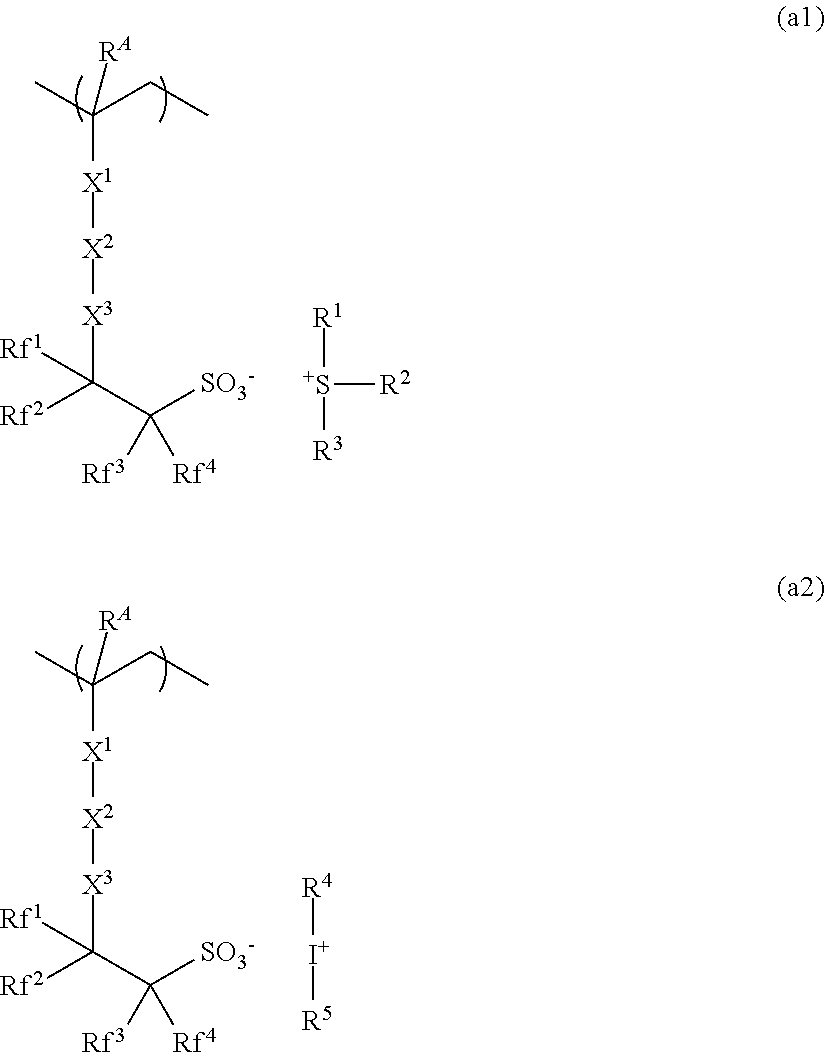
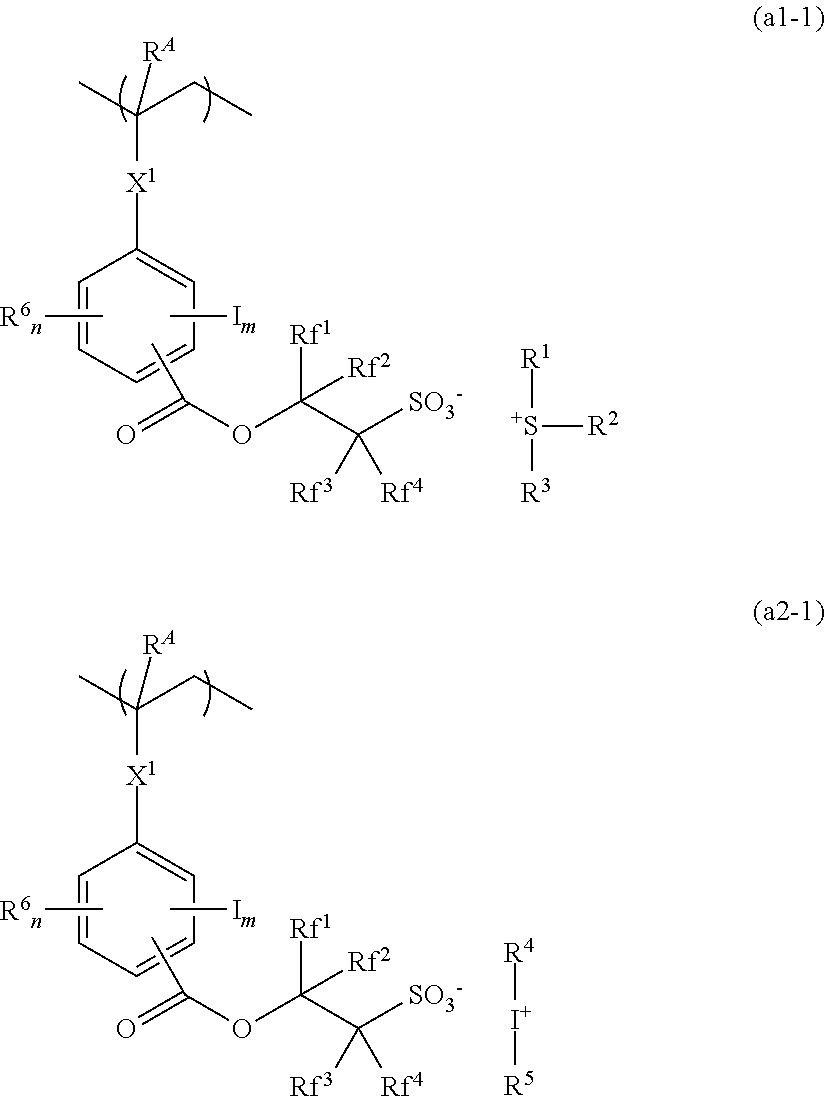
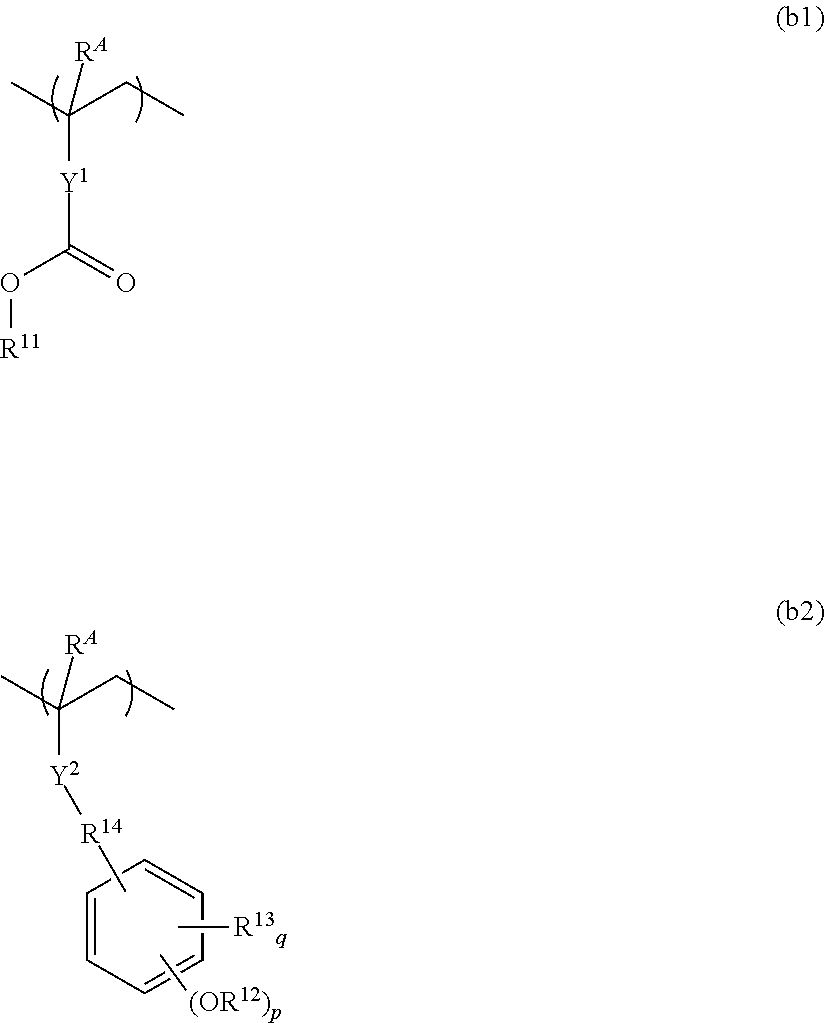
Examples
synthesis example 1
Synthesis of Polymer 1
[0132]A 2-L flask was charged with 8.4 g of 1-methyl-1-cyclopentyl methacrylate, 3.6 g of 4-hydroxyphenyl methacrylate, 4.5 g of 3-oxo-2,7-dioxatricyclo[4.2.1.04,8]nonan-9-yl methacrylate, 8.1 g of PAG Monomer 1, and 40 g of THF as solvent. The reactor was cooled at −70° C. in nitrogen atmosphere, after which vacuum pumping and nitrogen blow were repeated three times. The reactor was warmed up to room temperature, whereupon 1.2 g of azobisisobutyronitrile (AIBN) as polymerization initiator was added. The reactor was heated at 60° C., whereupon reaction ran for 15 hours. The reaction solution was poured to into 1 L of isopropyl alcohol for precipitation. The white solid precipitate was collected by filtration and dried in vacuum at 60° C., yielding Polymer 1 in white solid form. Polymer 1 was analyzed for composition by 13C- and 1H-NMR and for Mw and Mw / Mn by GPC.
synthesis example 2
[0133]Synthesis of Polymer 2
[0134]Polymer 2 was obtained in white solid form by the same procedure as in Synthesis Example 1 aside from using 10.3 g of PAG Monomer 2 instead of PAG Monomer 1. Polymer 2 was analyzed for composition by 13C- and 1H-NMR and for Mw and Mw / Mn by GPC.
synthesis example 3
Synthesis of Polymer 3
[0135]Polymer 3 was obtained in white solid form by the same procedure as in Synthesis Example 1 aside from using 10.3 g of PAG Monomer 3 instead of PAG Monomer 1. Polymer 3 was analyzed for composition by 13C- and 1H-NMR and for Mw and Mw / Mn by GPC.
PUM
| Property | Measurement | Unit |
|---|---|---|
| wavelength | aaaaa | aaaaa |
| wavelength | aaaaa | aaaaa |
| of wavelength | aaaaa | aaaaa |
Abstract
Description
Claims
Application Information
 Login to View More