Check patentability & draft patents in minutes with Patsnap Eureka AI!

Phase-inversion polymer composite material, fabricating methods and applications of same

a composite material and phase-inversion technology, applied in the field of materials, can solve the problems of compromising mechanical integrity, low wettability towards, and imposing limits on the performance of lib cells

Pending Publication Date: 2022-08-04
NORTHWESTERN UNIV
View PDF1 Cites 1 Cited by
  • Summary
  • Abstract
  • Description
  • Claims
  • Application Information

AI Technical Summary

Benefits of technology

This patent describes a new type of material made from carbon-coated hexagonal boron nitride nanosheets and polymers like polyvinylidene fluoride. This material has high porosity, is easy to wet with liquid electrolytes, and is stable at high temperatures. When used in batteries, it allows for better performance and is safe to operate at high temperatures. This material can be made into flexible composite separators for batteries. The unique chemical composition of the carbon-coated hexagonal boron nitride nanosheets makes it easy for the material to wet with liquid electrolytes and conduct ions. Overall, this new material has improved performance and safety compared to existing separators.

Problems solved by technology

Despite their high chemical and mechanical stability and relatively low cost, these conventional polymer membranes have inherent drawbacks including low wettability towards polar liquid electrolytes, which imposes limits on the performance of LIB cells.
In addition, polyolefin separators possess relatively low glass transition temperatures that result in shrinkage and compromised mechanical integrity, which ultimately leads to internal electrical shorting and catastrophic LIB failure modes at elevated temperatures.
However, these ceramic particle coatings require the use of organic binders that still limit the maximum safe operating temperature while also lowering membrane porosity.
Moreover, due to relatively weak interactions with the polymer host and membrane swelling upon exposure to the electrolyte, coating delamination often occurs during electrochemical cycling, which limits battery cycle life.
Non-woven separators based on natural and synthetic fibers have also been reported including the use of electro spun thermosetting polymers that provide improved thermal stability, but these structures lack uniform pore size distribution due to macroscale porosity.
Therefore, a heretofore unaddressed need exists in the art to address the aforementioned deficiencies and inadequacies.

Method used

the structure of the environmentally friendly knitted fabric provided by the present invention; figure 2 Flow chart of the yarn wrapping machine for environmentally friendly knitted fabrics and storage devices; image 3 Is the parameter map of the yarn covering machine
View more

Image

Smart Image Click on the blue labels to locate them in the text.
Viewing Examples
Smart Image
  • Phase-inversion polymer composite material, fabricating methods and applications of same
  • Phase-inversion polymer composite material, fabricating methods and applications of same
  • Phase-inversion polymer composite material, fabricating methods and applications of same

Examples

Experimental program
Comparison scheme
Effect test

example

Phase-Inversion Polymer Composite Separators Based on Hexagonal Boron Nitride Nanosheets for High-Temperature Lithium-Ion Batteries

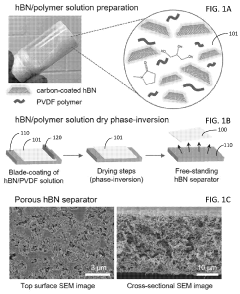
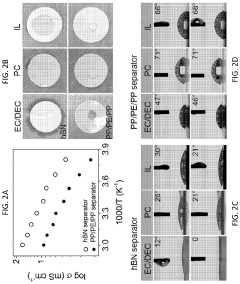
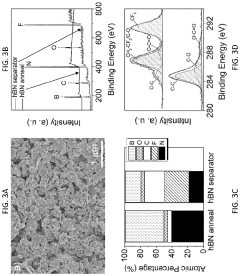
[0112]This exemplary example demonstrates the fabrication of highly porous lithium-ion battery composite separators based on exfoliated hBN nanosheets and PVDF polymers with superlative electrolyte wettability, ionic conductivity, and thermal stability. The hBN nanosheets are exfoliated using a liquid-phase process based on EC as a polymer stabilizer that results in a carbon coating upon thermal pyrolysis, which promotes strong interfacial interactions with the polymer matrix and enhances wettability for a range of battery electrolytes. By employing phase-inversion during the membrane formation process, a highly porous microstructure is achieved in which the hBN nanosheets are uniformly dispersed within the polymer matrix. Importantly, this processing method is free of plasticizers as pore formation agents and does not require additional processing steps...

the structure of the environmentally friendly knitted fabric provided by the present invention; figure 2 Flow chart of the yarn wrapping machine for environmentally friendly knitted fabrics and storage devices; image 3 Is the parameter map of the yarn covering machine
Login to View More

PUM

PropertyMeasurementUnit
porosityaaaaaaaaaa
temperatureaaaaaaaaaa
Login to View More

Abstract

A composite film usable as a separator of an electrochemical device includes hBN nanosheets and at least one polymer. The hBN nanosheets are uniformly dispersed within a matrix of said least one polymer to achieve a highly porous microstructure. Said at least one polymer comprises one or more electrically insulating and electrochemically inert polymers.

Description

CROSS-REFERENCE TO RELATED PATENT APPLICATION[0001]This application claims priority to and the benefit of U.S. Provisional Application No. 62 / 878,946, filed Jul. 26, 2019, which is incorporated herein in its entirety by reference.STATEMENT AS TO RIGHTS UNDER FEDERALLY-SPONSORED RESEARCH[0002]This invention was made with government support under 1720139 awarded by the National Science Foundation, and DE-AC02-06CH11357 awarded by the Department of Energy. The government has certain rights in the invention.FIELD OF THE INVENTION[0003]The present invention relates generally to materials, and more particularly to phase-inversion polymer composite battery separators based on two-dimensional insulators, fabricating methods and applications of the same.BACKGROUND OF THE INVENTION[0004]The background description provided herein is for the purpose of generally presenting the context of the invention. The subject matter discussed in the background of the invention section should not be assumed...

Claims

the structure of the environmentally friendly knitted fabric provided by the present invention; figure 2 Flow chart of the yarn wrapping machine for environmentally friendly knitted fabrics and storage devices; image 3 Is the parameter map of the yarn covering machine
Login to View More

Application Information

Patent Timeline
no application Login to View More
Patent Type & Authority Applications(United States)
IPC IPC(8): C08K9/02C08K3/04C08K3/38
CPCC08K9/02C08K2003/385C08K3/38C08K3/04C08J5/18C08J2327/16H01M10/0525H01M2300/0085H01M50/449H01M50/426H01M50/431
Inventor HERSAM, MARK C.MAZARIN DE MORAES, ANA CAROLINA
Owner NORTHWESTERN UNIV
Features
  • R&D
  • Intellectual Property
  • Life Sciences
  • Materials
  • Tech Scout
Why Patsnap Eureka
  • Unparalleled Data Quality
  • Higher Quality Content
  • 60% Fewer Hallucinations
Social media
Patsnap Eureka Blog
Learn More