[0027]The system and methods of the present invention avoid obligatory shortening of the AV and PV
delay settings, which may have undesirable effects in some patients, during
automatic threshold testing and evoked
response sensitivity testing. Providing programmable AV and PV delay settings during evoked
response sensitivity testing further allows the clinician to better assess the actual behavior of the cardiac stimulation device based on its daily function.
[0028]By measuring the evoked
response amplitude under conditions similar to the operating conditions selected for
daily operation, a more accurate evoked response sensitivity setting may be determined, minimizing the likelihood of false loss of capture detections precipitating back-up stimulation and threshold testing. By allowing threshold test measurements and data storage to be performed according to clinician-programmed frequencies or variable frequencies, the clinician can better monitor lead stability or impending clinical problems revealed through atypical fluctuations in capture threshold. Intervals of time in which frequent threshold fluctuations were recorded may be displayed on an expanding time scale to allow more careful inspection.
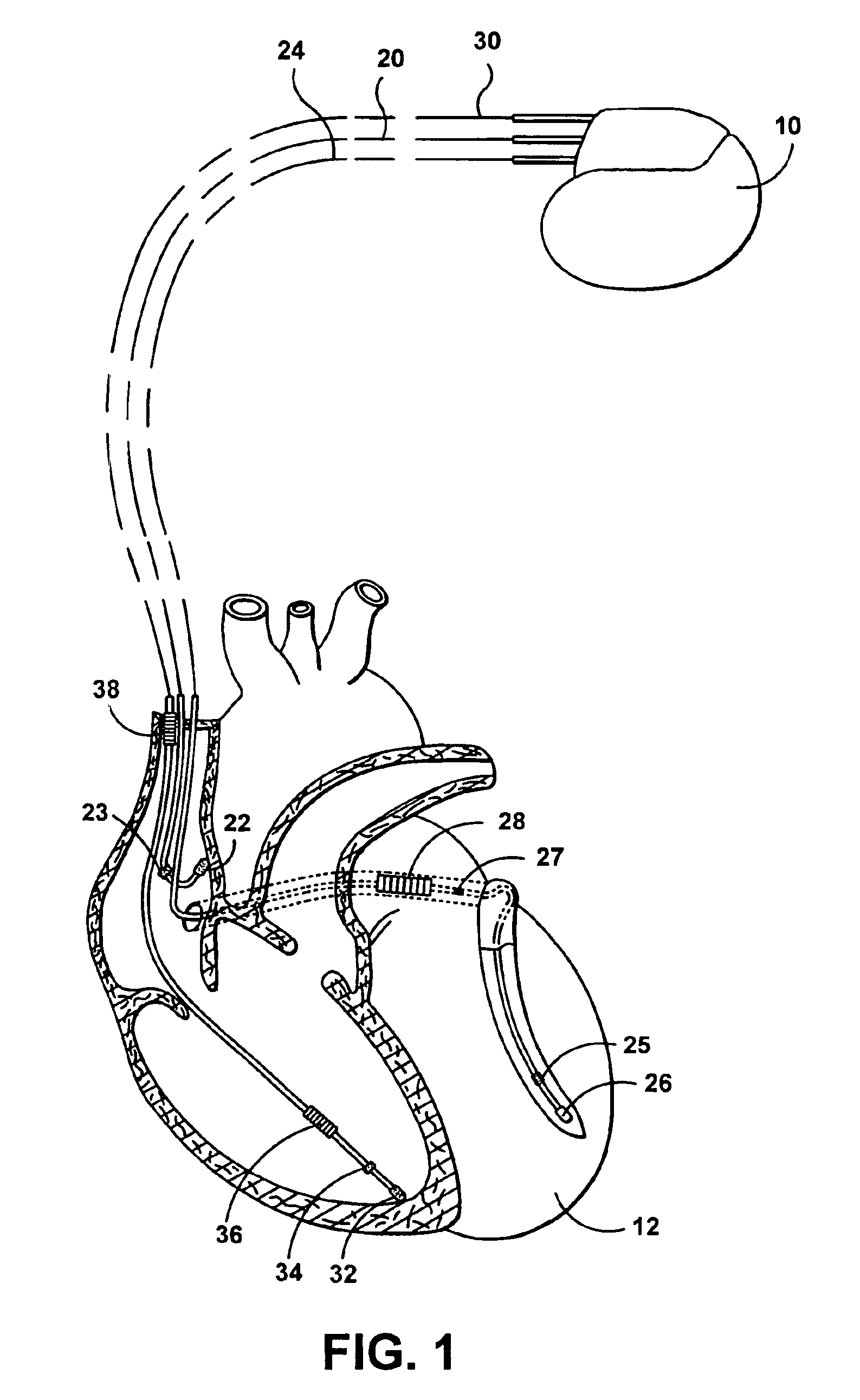
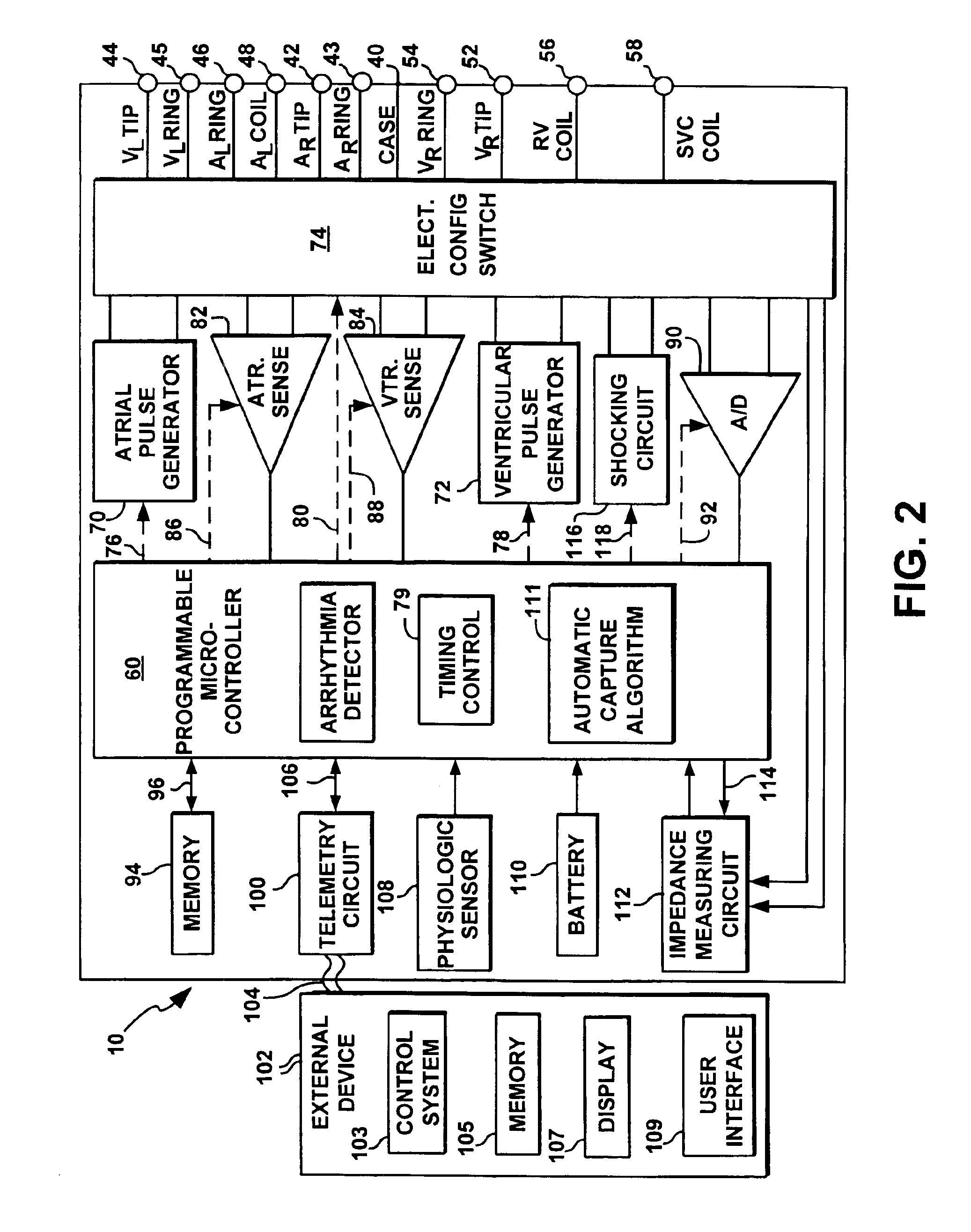
[0032]In a preferred embodiment, the implanted stimulation device performs an evoked response
sensitivity test by controlling the delivery of stimulation pulses by the
implanted device and making the appropriate signal measurements. A
telemetry wand placed over the
implanted device allows for transmission of operating parameters and
receipt of cardiac signal data.
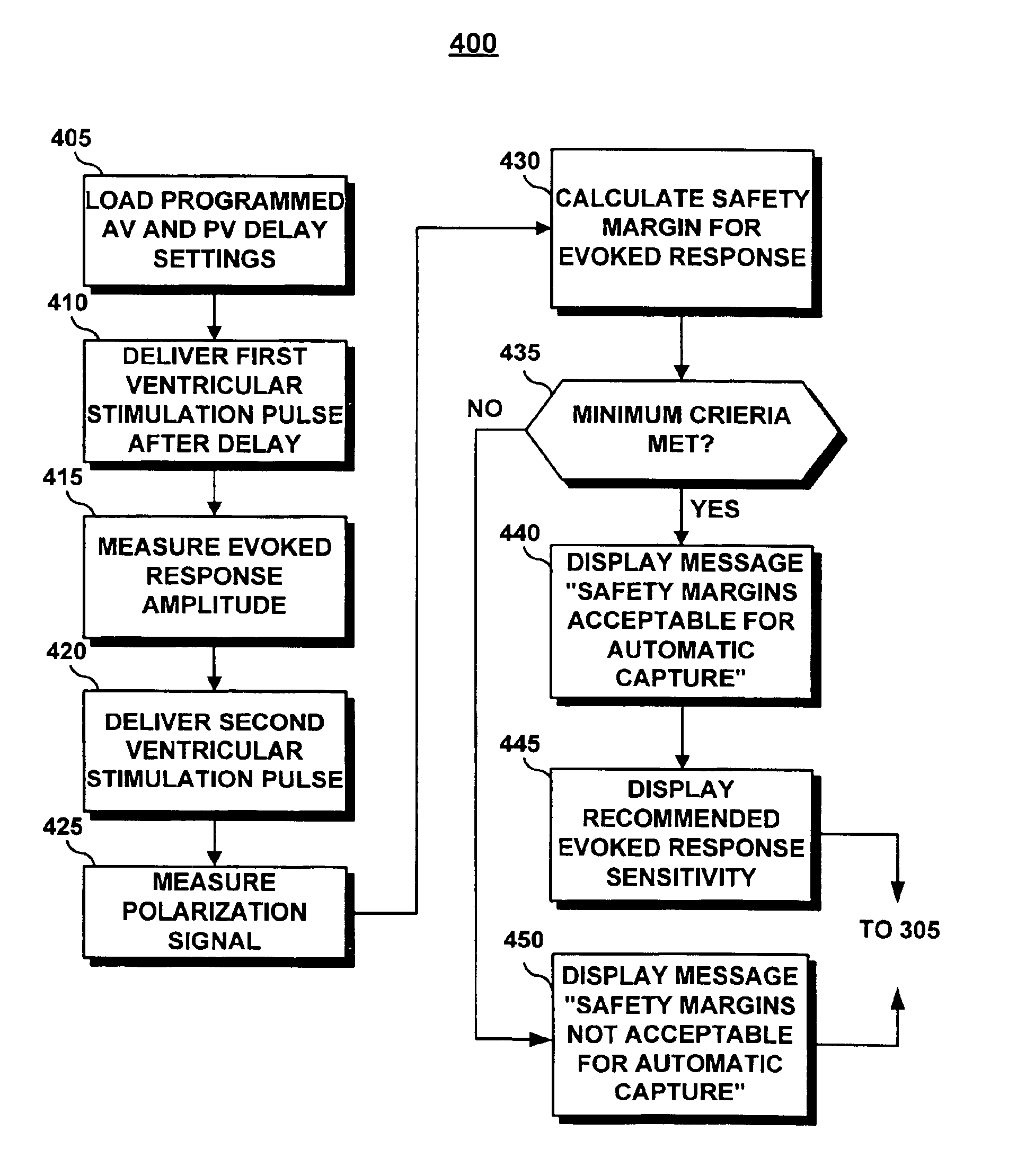
Ventricular stimulation pulses of sufficient energy to ensure ventricular capture are delivered at programmed AV and PV delays. The AV and PV delays may be advantageously selected to be equal to the AV and PV delay settings that will be selected for the day-to-day function of the
implanted device. Based on the results of the evoked response
sensitivity test, at the desired AV and PV delay settings, the clinician can make appropriate decisions in enabling the automatic capture feature and in selecting the evoked response sensitivity setting.
[0033]With automatic capture enabled, threshold testing will be invoked whenever loss of capture, defined as loss of capture on two consecutive primary pulses, occurs. In the preferred embodiment, the AV and PV delay settings during threshold testing are programmable by the user. In this way, the AV and PV delay settings can be tailored to individual
patient need rather than automatically shortened to a required test setting. In patients whom experience negative hemodynamic affects during short AV or PV delay stimulation (25 to 50 msec) and who are not likely to experience frequent fusion or pseudofusion events, the clinician can select a more physiologic delay setting (e.g., 100 msec). For patients in whom the programmed AV and PV delays will result in consistent ventricular fusion, the evoked response signal amplitudes can be measured in the real-
life situation to allow for identification and
programming of the appropriate evoked response sensitivity value.
[0035]The implantable device is preferably capable of storing large amounts of data. Threshold data may be compressed as necessary to allow additional data to be stored. Stable threshold measurements may be overwritten by new data or compressed to a single
data point with an appropriate
time duration index. Preferably, abrupt changes in threshold, such as a change of more than 25% within 24 hours, are stored permanently in memory, with the corresponding date and time, until intentionally cleared from memory by a user. Stored threshold data may be downloaded to the external
programmer at any time and displayed graphically for interpretation by a clinician. A variable, expanding time scale allows periods of fluctuating threshold to be examined more closely.
[0036]The system and method of the present invention thus improve the performance of dual chamber or multichamber cardiac stimulation systems possessing automatic capture by allowing greater flexibility in the operating parameters, specifically AV and PV delay, that control the threshold testing and evoked response
sensitivity testing functions. AV and PV delay settings that are safe and appropriate for an individual patient may be selected by the user. Furthermore, evoked response
sensitivity testing results will more accurately reflect the actual operating conditions of the implanted device. In addition, improved threshold measurement storage and display methods provided by the present invention provides the clinician valuable information in monitoring lead stability or other causes of threshold fluctuation.


 Login to View More
  Login to View More