Unlock instant, AI-driven research and patent intelligence for your innovation.

Target specific screening and its use for identifying target binders

Inactive Publication Date: 2006-06-06
ANTYRA
View PDF5 Cites 9 Cited by
  • Summary
  • Abstract
  • Description
  • Claims
  • Application Information

AI Technical Summary

Benefits of technology

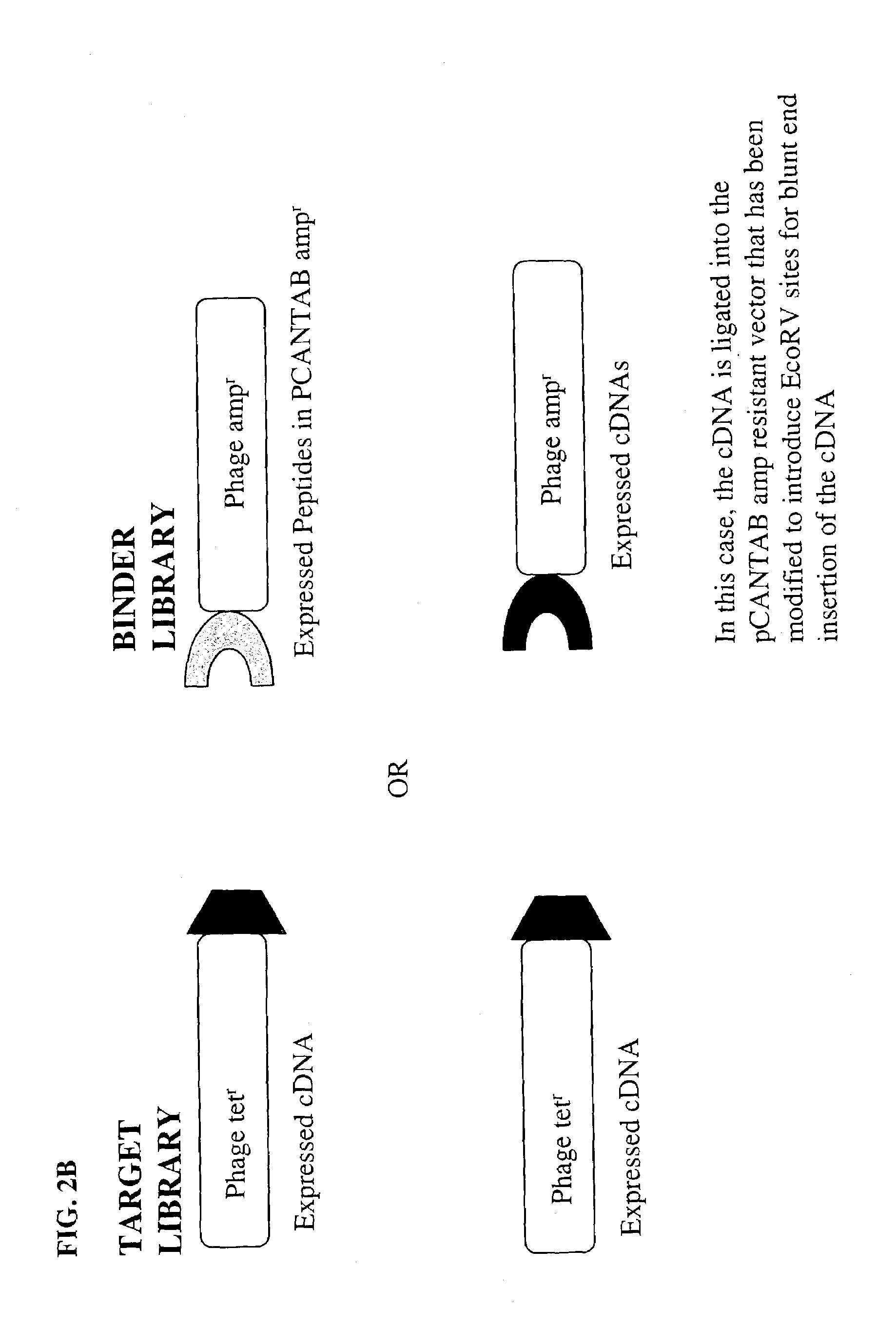
[0064]In one aspect of the invention, target cDNA phage libraries may be used. Of the numerous methods for constructing cDNA libraries, the approach based on methods described in Gene, 25:263 (1983) is the most widely used. Approaches to achieve enrichment of specific sequences include subtractive cDNA libraries (Trends Genet., 9:70 (1993)) and normalized cDNA libraries (Genome Res., 6:791 (1996)). While subtractive and normalized libraries are generally not full-length cDNAs, the frequency of full-length cDNAs has been increased by RecA-mediated triple-strand formation in a subtractive cDNA library (Nucleic Acid Res., 24:3478 (1996). An advantage of the invention is that only very small amounts of the protein targets are needed, i.e., amounts sufficient for their presentation on phage coat proteins, where gene III is preferably present in 3–5 copies per phage. By using a natural process of protein generation, e.g. bacterial, to make a protein of unknown function and characteristics, large percentages of protein populations from cDNA libraries can be produced at one time for investigation.

Problems solved by technology

However, formats that require only a protein target generate a high frequency of false positives, i.e., compounds that bind but do not cause a change in target activity.
However, two-hybrid systems have several disadvantages, including high levels of false positives, incompatibility with certain targets (e.g., RNAs and membrane bound proteins cannot be used), and problems with postranslational modifications.
Moreover, approaches based on two-hybrid systems are not easily applied to a large number of genes of unknown function.
The purification of active target is a cumbersome step made much more difficult when the protein under investigation does not yet have a known function needed to monitor the production of active protein.
As such methodology does not afford the investigator a means for identifying large populations of unknown proteins such as those found to be differentially expressed in one cell versus another, or under some disease related condition at a time.

Method used

the structure of the environmentally friendly knitted fabric provided by the present invention; figure 2 Flow chart of the yarn wrapping machine for environmentally friendly knitted fabrics and storage devices; image 3 Is the parameter map of the yarn covering machine
View more

Image

Smart Image Click on the blue labels to locate them in the text.
Viewing Examples
Smart Image
  • Target specific screening and its use for identifying target binders
  • Target specific screening and its use for identifying target binders
  • Target specific screening and its use for identifying target binders

Examples

Experimental program
Comparison scheme
Effect test

example 1

Construction of DGI-2-GeneIII Fusion Proteins in pCANTAB5E

Creation of pCANTAB 5E Tetracycline Resistant Plasmid

[0187]pCANTAB 5E with 2 kb LacZ stuffer (DGI vector for RAPIDLIB) and pBR322 (Promega; Madison, Wis.), carrying the genes for tetracycline (Tet) and ampicillin (Amp) resistance were used to construct the pCANTAB5E Tet resistant plasmid. pCANTAB (5 μg) was cut with Aat II (Base 65) and filled in with Pfu polymerase, followed by ScaT cleavage at base 505. This removed the first 300 bases of the Amp resistance gene and its entire promoter. The vector was purified on Low Melt agarose.

[0188]pBR322 (5 μg) was cut with Ava I (base 1425) and filled in with Pfu polymerase. and then cut with Aat II at base 4284. This removed 1500 bases containing the entire Tet resistance gene. The fragment was purified on Low Melt agarose.

[0189]The fragment and vector were ligated and plated on Tet (10 μg / ml) plates. Colonies were picked and replica plated on both Amp and Tet plates.

[0190]Five colon...

example 2

Construction of a Blunt-Ended cDNA Library in Tetracycline Phage

[0191]Liver tumor HepG2 (hepatome) Lambda Uni_Zap XR (Stratagene, Cat. No. 937261) was used for constructing a cDNA library in a modified pCANTAB 5E Tet resistant vector. The library mass (350–1500 bp) was excised and cut with EcoRV and SmaI, creating two sets of blunt end fragments. The Tet vector was modified by inserting a PCR fragment with SfiI and NotI ends. The PCR fragment created EcoRV sites inside of the SfiI and NotI sites. The modified vector was cut with EcoRV and gel purified using low melt agarose. The mass of the excised blunt end fragments was less than 1 KB cut out of the gel and purified. The insert was ligated to the blunt ended Tet phage vector. Additional guidance is commonly known in the art (Savinov and Austin. Comb. Chem. High Throughput Screen, 4:593–7, 2001; Zucconi, et al. J. Mol. Biol. 307:1329–39, 2001; Crameri and Kodzius. Comb. Chem. High Throughput Screen. 4:145–55, 2001; Mazzarelli and R...

example 3

Production of Target Phage

[0193]Phage rescue was carried out to produce phage with displayed target protein. Overnight cultures of TGI cells (F′ traD36 laclq Δ(lacZ)M15 proAB) / supE Δ(hsdM-mcrB)5 rk−mk−McrB−) thi Δ(lac-proAB) harboring the target protein-gene III gene fusion plasmids (2×YT-TG) were inoculated 1:100 into 10 ml of 2×YT-TG media. The cultures were grown to an OD600 0.5 in 2×YT-TG at 30° C. with shaking (250 rpm). M13K07 helper phage was then added [Multiplicity of Infection (MOI)=15], and the cells were incubated for 1 hr at 37° C. with shaking (250 rpm). Following infection, cells were pelleted and the supernatant containing the helper phage was discarded. The cell pellet was resuspended in the initial culture volume of 2×YT without glucose and containing tetracycline and 50 mg / mL kanamycin (2×YT-TK) and grown overnight at 30° C. with shaking (250 rpm). The cells from the overnight culture were pelleted at 3000×g for 30 min at 4° C. and the supernatant containing the p...

the structure of the environmentally friendly knitted fabric provided by the present invention; figure 2 Flow chart of the yarn wrapping machine for environmentally friendly knitted fabrics and storage devices; image 3 Is the parameter map of the yarn covering machine
Login to View More

PUM

No PUM Login to View More

Abstract

The invention relates to a modified phage display method for detecting and identifying target and target binders. The modified methods involve transforming host cells with two separate phages of a target or target library and a target-binder library, and selecting to eliminate the non-paired targets and binders. The invention also relates to antibodies that bind to complexes of target and target binders; nucleic acids encoding target and target binders peptides; and the use of sequence information inherent in the targets and target binders for target validation using in silico approaches. The invention further relates to diagnostics and therapeutics employing the disclosed target and target binder peptides or polynucletides and their use in small molecule drug discovery; diagnostic and therapeutic applications directed to cancers and similar disorders; and site directed assays for high throughput drug screening.

Description

[0001]This application claims priority to Provisional Application Ser. No. 60 / 345,471 filed Oct. 24, 2001, hereby incorporated by reference.FIELD OF THE INVENTION[0002]This invention is in the general field of functional genomics through identification of biological molecules, including nucleic acids, protein, and the like, more particularly, the identification of targets and their specific binders.BACKGROUND OF THE INVENTION[0003]A concerted international effort has lead to the deciphering of the human genome. Originally, it was estimated that greater than 100,000 genes would be encoded within the genome. However, research indicated that the >3.2 billion DNA units comprising the genome “only” coded for 30,000–50,000 genes (Human Genome Sequencing Consortium and Celera Genomics). Despite rapid progress in identifying genes, progress in identifying the activity and function of the gene products lags significantly behind. There is additional evidence that the actual number of prote...

Claims

the structure of the environmentally friendly knitted fabric provided by the present invention; figure 2 Flow chart of the yarn wrapping machine for environmentally friendly knitted fabrics and storage devices; image 3 Is the parameter map of the yarn covering machine
Login to View More

Application Information

Patent Timeline
no application Login to View More
IPC IPC(8): G01N33/53C40B40/08C12N1/21C12N15/10C40B30/04C40B40/02G01N33/543G01N33/68
CPCC12N15/1037C40B30/04G01N33/6845C40B40/02G01N2333/71
Inventor PILLUTLA, RENUKABRISSETTE, RENEESPRUYT, MICHAELDEDOVA, OLGABLUME, ARTHURPRENDERGAST, JOHNGOLDSTEIN, NEIL
Owner ANTYRA