Method for increasing density of aligned carbon nanotubes
a carbon nanotube and density technology, applied in the field of nanoscale electronic devices manufacturing, can solve the problems of low density, low density, and inability to produce high-quality high-density aligned carbon nanotubes, and achieve the effect of increasing the density of carbon nanotubes
- Summary
- Abstract
- Description
- Claims
- Application Information
AI Technical Summary
Benefits of technology
Problems solved by technology
Method used
Image

Examples
implementation example 1
[0046]PDMS is used as a stretchable material.
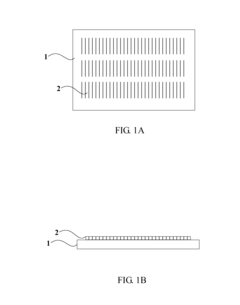
[0047]1. An array of parallel aligned carbon nanotubes 2 is grown on a quartz substrate 1 using CVD (as shown in FIGS. 1A and 1B). Examples of catalysts used in CVD include CuCl2 solution, FeCl3 solution, and iron deposited by electron beam evaporation. Common sources of carbon include CH4, C3H7OH, etc.
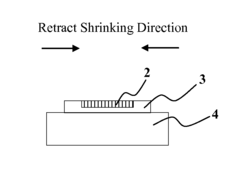
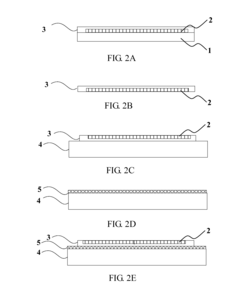
[0048]2. The array of nanotube array is transferred to PDMS (FIGS. 2A-2E). (1) PMMA 600K 3 is spin-coated on the array of parallel aligned carbon nanotubes 2 grown on the quartz substrate 1 at a rotation speed at 2000 rad / s (as shown in FIG. 2A). After PMMA dries naturally, the composite is immersed in a HF buffer (7:1) solution for about 48 hours to etch the quartz substrate 1. A composite of a PMMA film 3 and the carbon nanotubes 2 is obtained (as shown in FIG. 2B). (2) The composite is then immersed in deionized water for 10 minutes to remove residual HF remained on the PMMA film 3. Then the PMMA film 3 is attached to a stretched PDMS fi...
implementation example 2
[0053]A shape memory alloy is used as stretchable material.
[0054]1. A shape memory alloy with critical temperature higher than PMMA's glass transition temperature is selected. Suitable materials include TiNi base shape memory alloy, etc. The shape memory alloy is stretched at room temperature.
[0055]2. Same as step 1 in Implementation Example 1, an array of aligned carbon nanotubes 2 is grown on a quartz substrate 1 as shown in FIGS. 1A and 1B.
[0056]3. The array of aligned carbon nanotubes is transferred onto a shape memory alloy: (1) an electron-beam resist PMMA 3 600K is spin-coated on the carbon nanotubes 2 grown on the quartz substrate 1 at a rotation speed of 2000 rad / s. After drying, the resulting composite (shown in FIG. 2A) is immersed into a HF buffer solution for 48 hours to dissolve the quartz substrate 1. A composite of a PMMA film 3 and carbon nanotubes 2 is obtained as shown in FIG. 2B. (2) The composite is immersed in deionized water for 10 minutes to remove residual H...
PUM
| Property | Measurement | Unit |
|---|---|---|
| thickness | aaaaa | aaaaa |
| density | aaaaa | aaaaa |
| temperature | aaaaa | aaaaa |
Abstract
Description
Claims
Application Information
 Login to View More