
Process for producing coating material for improving capability of PVC sheet material
A coating material and performance technology, which is applied in the field of coating material preparation to improve the hydrophilicity and antistatic performance of the PVC sheet surface. Low strength and other problems, to achieve the effect of improved hydrophilicity and significant anti-static effect
- Summary
- Abstract
- Description
- Claims
- Application Information
AI Technical Summary
Problems solved by technology
Method used
Image

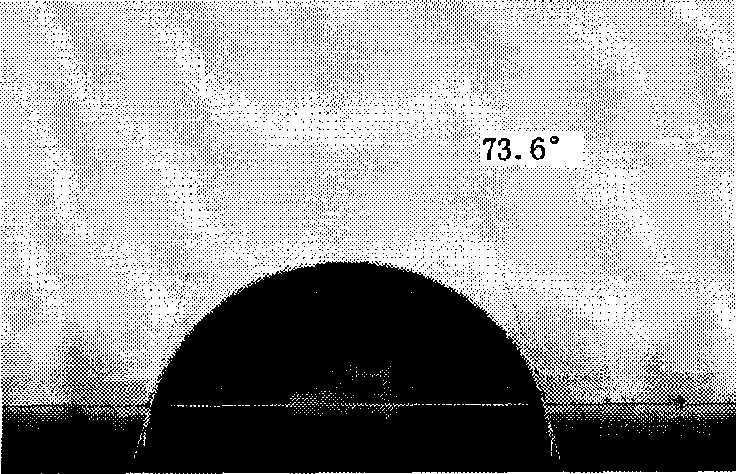

Examples
Embodiment 1
[0023] At room temperature, in a 50ml round bottom flask, add 8.32g tetraethyl orthosilicate (TEOS), 10g absolute ethanol, 2.78g H 2 O and 0.2g coupling agent (KH-560), mix well, add dropwise concentrated nitric acid with a mass fraction of 65%, adjust the pH value of the system to between 2-4, seal the magnetic stirring reaction at room temperature for 2.5 hours, and then seal Stratified for 5 days to obtain organically modified nano-SiO 2 Ethanol dispersion colloidal solution, nano-SiO 2 Solid content and coupling agent dosage are respectively 20% and 1% (such as Figure 5 shown).
[0024] Among them, TEOS is used as the precursor, absolute ethanol is used as the medium, and concentrated nitric acid with a mass fraction of 65% is used to adjust the pH value of the system to the sol-gel method; during the sol-gel method, a coupling agent with condensation polymerization functional groups KH-560 is a co-condensation polymerization method; any one of KH-550 or KH-560 or KH-5...
Embodiment 2
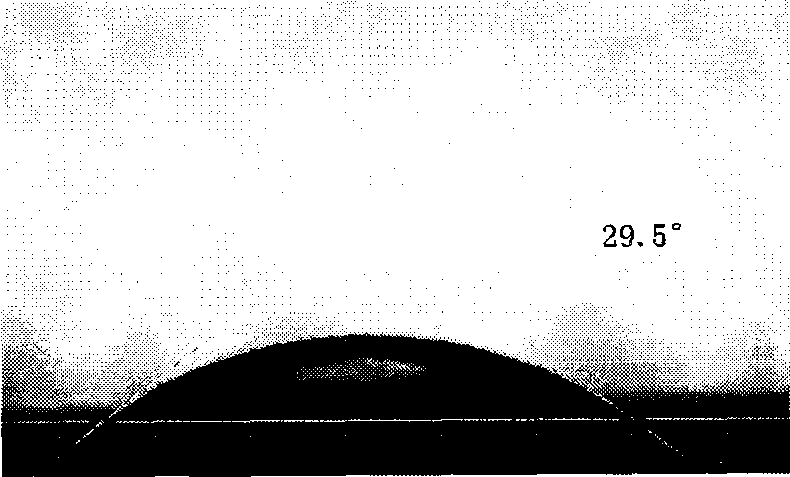
[0029] Change the THF solvent to 7.43g, organically modified nano-SiO 2 Ethanol dispersion colloidal solution is changed into 0.714g, and the remainder is the same as in Example 1. See the results Figure 5 As shown, nano-SiO 2 Solid content, amount of coupling agent, PMMA and SiO 2 The weight ratio and the water contact angle and surface resistance after coating PVC were 20%, 1%, 87.5:12.5, 29.5° and 1.3×10 10 Ω.
Embodiment 3
[0031] Change the THF solvent to 10.0g, organically modified nano-SiO 2 The ethanol dispersion colloidal solution is changed into 1.667g, and the remainder is the same as in Example 1. See the results Figure 5 As shown, nano-SiO 2 Solid content, amount of coupling agent, PMMA and SiO 2 The weight ratio and the water contact angle and surface resistance after coating PVC were 20%, 1%, 75:25, 46.5° and 1.2×10 9 Ω.
PUM
 Login to View More
 Abstract
Description
Claims
Application Information
 Login to View More