Check patentability & draft patents in minutes with Patsnap Eureka AI!

Method for directly producing sodium stannate from flue dust and tin containing chemical engineering sludge

A technology for the production of sodium stannate and chemical sludge, applied in chemical instruments and methods, tin compounds, inorganic chemistry, etc., can solve the problems of wasting precious resources, environment, pollution, etc., and achieve the reduction of production process, simple process, and reduction of production The effect of steps

Inactive Publication Date: 2009-09-30
上饶旭日冶炼厂
View PDF1 Cites 0 Cited by
  • Summary
  • Abstract
  • Description
  • Claims
  • Application Information

AI Technical Summary

Problems solved by technology

Flue dust and tin-containing chemical sludge with a tin content of about 10% are still unusable. my country is a large producer and user of non-ferrous metals, and a large amount of tin-containing smoke is produced every year in production and use. If road ash and chemical sludge such as silver slag cannot be effectively utilized, it will not only waste a lot of precious resources but also cause environmental pollution

Method used

the structure of the environmentally friendly knitted fabric provided by the present invention; figure 2 Flow chart of the yarn wrapping machine for environmentally friendly knitted fabrics and storage devices; image 3 Is the parameter map of the yarn covering machine
View more

Image

Smart Image Click on the blue labels to locate them in the text.
Viewing Examples
Smart Image
  • Method for directly producing sodium stannate from flue dust and tin containing chemical engineering sludge

Examples

Experimental program
Comparison scheme
Effect test

Embodiment Construction

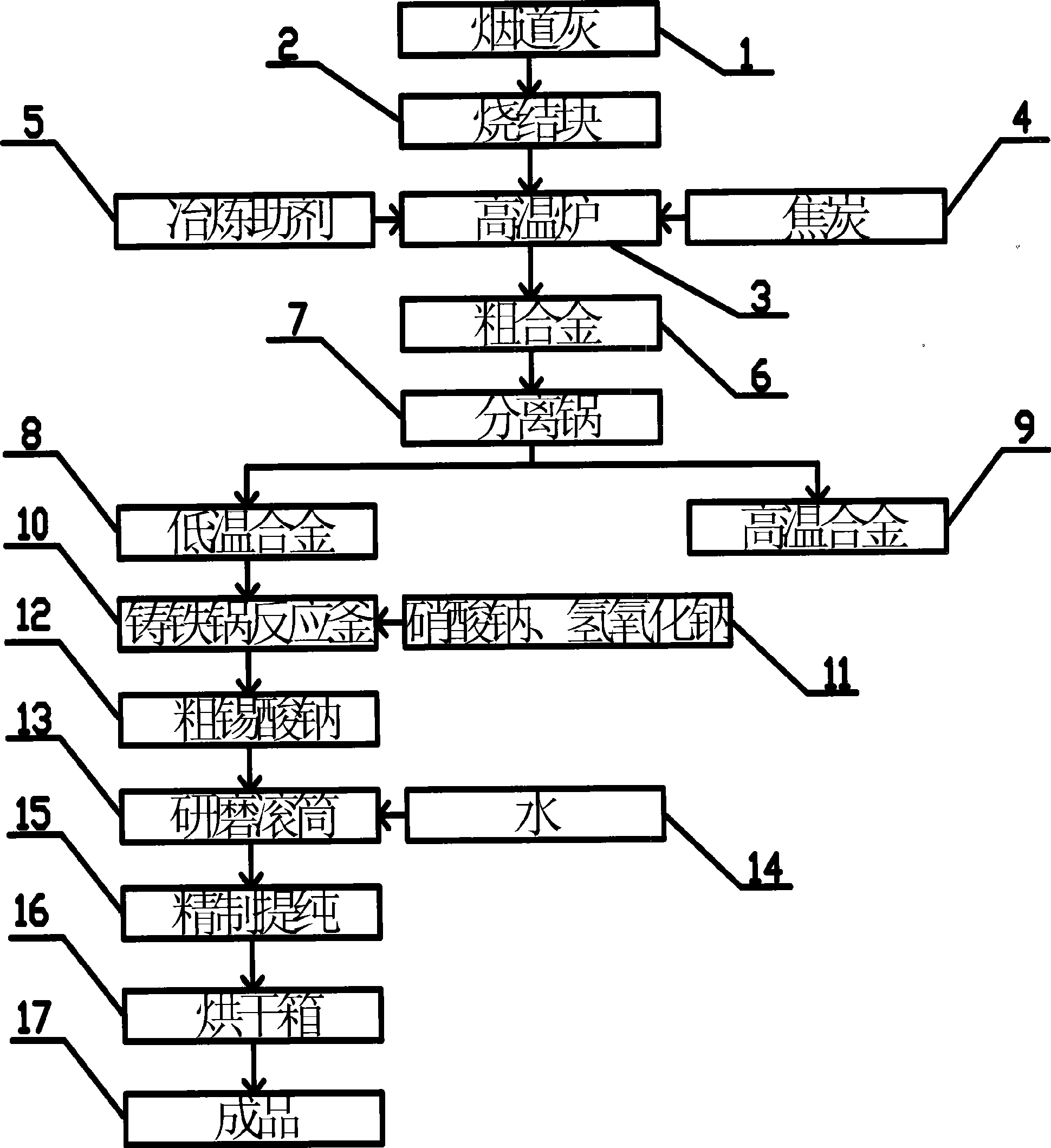
[0016] refer to figure 1 , figure 1 It is a process flow diagram of an embodiment of a method for directly producing sodium stannate by using flue ash and tin-containing chemical sludge provided by the present invention: the chemical composition from a waste copper recovery plant is: Pb30%, Sb20% , Sn10%, Si15%, Ag2500g / t, Au20g / t, Zn16%, Cu9% flue ash 1 is made into agglomerated block with a press or artificially, and then fired to make agglomerate 2; The agglomerate 2, coke 4 and smelting auxiliary agent 5 are put into the high temperature furnace 3 for smelting, the smelting auxiliary agent 5 described here is limestone and fluorite, and the consumption of the smelting auxiliary agent 5 is 6% of the sintering agglomerate 2; After the liquid metal is produced in the high temperature furnace 3, the crude alloy 6 is released from the high temperature furnace 3. The obtained crude alloy 6 is placed in the separation pot 7, and the low-temperature alloy 8 in it flows out from ...

the structure of the environmentally friendly knitted fabric provided by the present invention; figure 2 Flow chart of the yarn wrapping machine for environmentally friendly knitted fabrics and storage devices; image 3 Is the parameter map of the yarn covering machine
Login to View More

PUM

No PUM Login to View More

Abstract

The invention discloses a method for directly producing sodium stannate from flue dust and tin containing chemical engineering sludge. The method comprises the following steps that: (1) the flue dust is processed into a lumpy form block; (2) the form block and coke is smelted in a high-temperature furnace to prepare crude alloy; (3) the crude alloy is heated to a temperature of between 300 and 450 DEG C for separation in a high-temperature heating container so as to obtain high-temperature alloy and low-temperature alloy, the tin containing low-temperature alloy can flow out of the crude alloy at the temperature, and the high-temperature alloy cannot flow out because the melting point of the high-temperature alloy is not reached, so that the high-temperature alloy and the low-temperature alloy are separated; (4) the separated low-temperature alloy is reacted with sodium hydroxide and an oxidant in a reaction kettle at a temperature of between 300 and 550 DEG C to obtain crude sodium stannate; and (5) the crude sodium stannate is dissolved in water, and the obtained dissolving solution is refined and purified to obtain the finished product of the sodium stannate. The method is used for preparing sodium stannate product by abstracting tin from the flue dust and the tin containing chemical engineering sludge, thereby avoiding waste of resources and reducing environmental pollution.

Description

technical field [0001] The invention relates to a method for producing inorganic salts, in particular to a method for directly producing sodium stannate by utilizing flue dust and tin-containing chemical sludge. technical background [0002] At present, the production of sodium stannate at home and abroad is based on refined tin as raw material to produce tin salt, which is a kind of reverse processing. It must use tin concentrate to go through the processes of reduction refining and electrolytic refining, and then use the resulting refined tin to react with alkali in the presence of an oxidant to convert it into crude sodium stannate, and then go through processes such as leaching, impurity removal, concentration, and crystallization. To obtain sodium stannate, this production process makes energy and chemical materials waste due to the existence of reverse processing. At the same time, when using refined tin as a raw material to produce sodium stannate, because the melting...

Claims

the structure of the environmentally friendly knitted fabric provided by the present invention; figure 2 Flow chart of the yarn wrapping machine for environmentally friendly knitted fabrics and storage devices; image 3 Is the parameter map of the yarn covering machine
Login to View More

Application Information

Patent Timeline
no application Login to View More
IPC IPC(8): C01G19/00B09B3/00
Inventor 李震彬
Owner 上饶旭日冶炼厂
Features
  • R&D
  • Intellectual Property
  • Life Sciences
  • Materials
  • Tech Scout
Why Patsnap Eureka
  • Unparalleled Data Quality
  • Higher Quality Content
  • 60% Fewer Hallucinations
Social media
Patsnap Eureka Blog
Learn More