
Method for preparing polychlorinated ferric sulfate water purifying agent from iron-containing wastewater produced by potassium fluorotitanate
A technology of ferric chloride ferric sulfate and potassium fluorotitanate, which is applied in chemical instruments and methods, multi-stage water/sewage treatment, neutralized water/sewage treatment, etc., can solve problems such as iron-containing wastewater pollution and simplify the treatment process , the effect of high production efficiency and low reaction conditions
- Summary
- Abstract
- Description
- Claims
- Application Information
AI Technical Summary
Problems solved by technology
Method used
Image


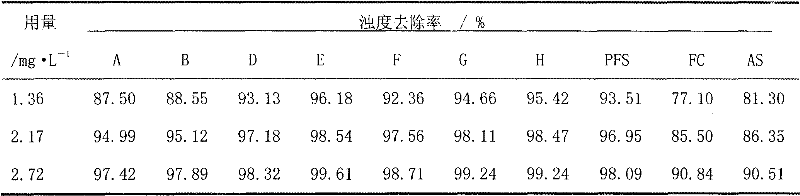
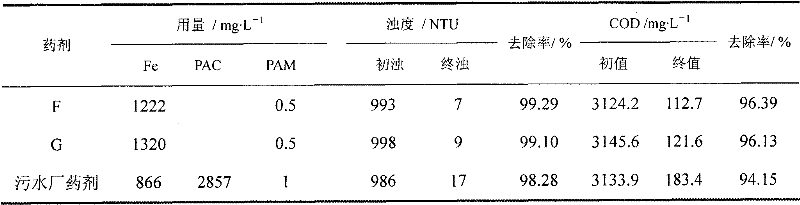
Examples
Embodiment 1
[0032] (1) Add 75L of iron-containing waste water produced by filtered potassium fluotitanate into a 150L corrosion-resistant reactor, add 62kg of vitriol and 3.84L of industrial sulfuric acid with a concentration of 98% by mass, and then add dihydrogen phosphate Sodium-sodium tartrate composite stabilizer (the mol ratio of sodium tartrate and phosphorus is 0.1: 1) 4.60kg, be warming up to 50 ℃ of dissolvings and make solution;
[0033] (2) Slowly add a saturated solution containing 4.72kg of sodium chlorate dropwise to the above solution, and react at 60-70°C for 1 hour to obtain a dark red transparent viscous liquid, and measure its T Fe=10.52%, B=7.11%, density ρ=1.41g / cm 3 (20°C), sample A, that is, water purifying agent.
Embodiment 2
[0035] (1) Add 75L of iron-containing waste water produced by filtered potassium fluotitanate into a 150L corrosion-resistant reactor, add 62kg of vitriol and 3.38L of industrial sulfuric acid with a concentration of 98% by mass, and then add dihydrogen phosphate Sodium-sodium tartrate composite stabilizer (the mol ratio of sodium tartrate and phosphorus is 0.126: 1) 5.02kg, be warming up to 60 ℃ of dissolvings and make solution;
[0036] (2) Slowly add a saturated solution containing 4.82kg of sodium chlorate dropwise to the above solution, and react at 70-80°C for 1 hour to obtain a dark red transparent viscous liquid, and measure its T Fe =10.67%, B=8.41%, density ρ=1.42g / cm 3 (20°C), sample B, that is, water purifying agent.
Embodiment 3
[0038] (1) Add 75L of iron-containing waste water produced by filtered potassium fluotitanate into a 150L corrosion-resistant reactor, add 62kg of vitriol and 3.14L of industrial sulfuric acid with a concentration of 98% by mass, and then add dihydrogen phosphate Sodium-sodium tartrate composite stabilizer (the mol ratio of sodium tartrate and phosphorus is 0.15: 1) 5.34kg, be warming up to 70 ℃ of dissolvings and make solution;
[0039] (2) Slowly add a saturated solution containing 4.96kg of sodium chlorate dropwise to the above solution, and react at 70-80°C for 1 hour to obtain a dark red transparent viscous liquid, and measure its T Fe =11.34%, B=9.03%, density ρ=1.43g / cm 3 (20°C), sample C, that is, water purifying agent.
PUM
| Property | Measurement | Unit |
|---|---|---|
| density | aaaaa | aaaaa |
Abstract
Description
Claims
Application Information
 Login to View More