Penicillium strain producing cellulase and application in cellulose enzymatic hydrolysis thereof
What is AI technical title?
AI technical title is built by Patsnap AI team. It summarizes the technical point description of the patent document.
A technology of cellulase and Penicillium, applied in the field of microorganisms, can solve the problem of limited ability of Penicillium to hydrolyze cellulose, and achieve the effect of improving activity and high activity
Active Publication Date: 2013-04-17
JINAN SHENGQUAN GROUP SHARE HLDG
View PDF3 Cites 10 Cited by
Summary
Abstract
Description
Claims
Application Information
AI Technical Summary
This helps you quickly interpret patents by identifying the three key elements:
Problems solved by technology
Method used
Benefits of technology
Problems solved by technology
[0008] For this reason, the technical problem to be solved by the present invention lies in the limited problem of Penicillium cellulose hydrolyzing ability in the prior art, and then provides a kind of Penicillium strain that can produce highly efficient hydrolyzing cellulase
Method used
the structure of the environmentally friendly knitted fabric provided by the present invention; figure 2 Flow chart of the yarn wrapping machine for environmentally friendly knitted fabrics and storage devices; image 3 Is the parameter map of the yarn covering machine
View more
Image
Smart Image Click on the blue labels to locate them in the text.
Viewing Examples
Smart Image
Click on the blue label to locate the original text in one second.
Reading with bidirectional positioning of images and text.
Smart Image
Examples
Experimental program
Comparison scheme
Effect test
Embodiment 1
[0037] Embodiment 1: the cultivation of departure bacterial strain
[0038] The Penicillium strain with cellulase production ability was subcultured, and after continuous activation for 3 times, it was inserted into the liquid medium and cultured with shaking at 30°C overnight.
[0039] The components and dosage in the medium are: bran 100g / L, glucose 10g / L, and the rest is water.
Embodiment 2
[0040] Embodiment 2: the pretreatment of bacterial classification
[0041] Centrifuge the bacterium solution obtained in Example 1 to remove the culture medium, resuspend the obtained bacterium with physiological saline to configure the bacterium suspension, and connect it to a sterilized Erlenmeyer flask covered with glass beads, at room temperature Shake for 5 minutes to disperse the bacterial cells, filter with sterilized gauze, serially dilute, count until the cell concentration is 106-107 / ml, and set aside.
[0043] Turn on the UV lamp 20 minutes in advance to stabilize the light wave.
[0044] Get the bacterium suspension 5-6ml that embodiment 2 makes and join in the 9cm petri dish, guarantee the bacterium liquid thickness 2-3cm, put the petri dish on the magnetic stirrer, put into the aseptic stirrer in the petri dish.
[0045] Open the lid of the petri dish, 20-30cm away from the UV lamp, and irradiate for 30, 60, 90, 120, 150, 180s respectively while stirring.
[0046] Select 0.1ml of the bacterial suspension that has been irradiated by ultravioletradiation for different periods of time, add it to 0.9ml sterile normal saline to dilute, and put it in an ice bath for 1-2h.
[0047] Take 0.1ml of the ice-bathed bacterial suspension and spread it on a flat plate containing 100g / L bran juice and 1-5g / L lithiumchloride for preliminary screening and separation, and cultivate at 30°C for 3 days.
[0048] Select about 200 colonies of different s...
the structure of the environmentally friendly knitted fabric provided by the present invention; figure 2 Flow chart of the yarn wrapping machine for environmentally friendly knitted fabrics and storage devices; image 3 Is the parameter map of the yarn covering machine
Login to View More
PUM
Login to View More
Abstract
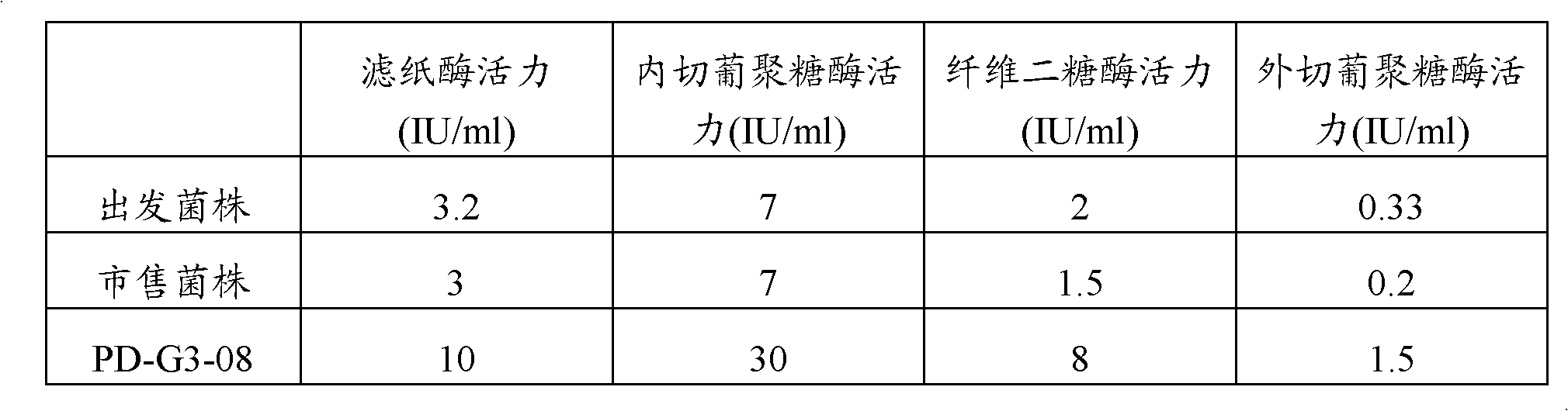
The invention belongs to the field of microorganism, and particularly relates to a microorganismpenicillium strain producing high-activity cellulase. The penicillium strain has a classification name of Penicillium decumbens PD-G3-08, and is preserved in Wuhan University China Center for Type Culture Collection with a preservation number of CCTCC M2011195. The invention also provides an application of the strain in celluloseenzymatic hydrolysis. Through mutation breeding, the penicillium strain producing high-activity cellulase is bred; cellulase crude enzyme liquid is obtained through fermentation of the strain, which has filter paperenzyme activity of up to 10 IU / ml, endoglucanase activity of up to 30 IU / ml, exoglucanase activity of up to 1.5 IU / ml and beta-glucosidase activity of up to 8 IU / ml, respectively being 3 times, 4 times, 4.5 times, and 4 times higher than the activities of an original strain; when the strain is applied to enzymatic hydrolysis of cellulose raw materials, the cellulose conversion rate in 3 days is up to more than 80%, and the cellulase has extremely high activity.
Description
technical field [0001] The invention belongs to the field of microorganisms, and in particular relates to a high-activity cellulase-producing microorganismPenicillium strain and the application of the enzymatic cellulose hydrolysis. Background technique [0002] With the increasing depletion of global oil reserves, the shortage of liquid fuels will seriously restrict the development of human beings. Finding renewable alternative resources has become an urgent task to maintain the sustainable development of human society. Vigorously developing new renewable resources is also a prerequisite for China to maintain sustainable development in the 21st century. The production of bioenergy and bio-based chemicals using the most abundant renewable resource on earth-plant cellulose as a raw material has attracted widespread attention at home and abroad, and is considered to be one of the best ways to deal with the depletion of fossil resources in the 21st century. Cellulose is a lin...
Claims
the structure of the environmentally friendly knitted fabric provided by the present invention; figure 2 Flow chart of the yarn wrapping machine for environmentally friendly knitted fabrics and storage devices; image 3 Is the parameter map of the yarn covering machine
Login to View More
Application Information
Patent Timeline
Application Date:The date an application was filed.
Publication Date:The date a patent or application was officially published.
First Publication Date:The earliest publication date of a patent with the same application number.
Issue Date:Publication date of the patent grant document.
PCT Entry Date:The Entry date of PCT National Phase.
Estimated Expiry Date:The statutory expiry date of a patent right according to the Patent Law, and it is the longest term of protection that the patent right can achieve without the termination of the patent right due to other reasons(Term extension factor has been taken into account ).
Invalid Date:Actual expiry date is based on effective date or publication date of legal transaction data of invalid patent.



 Login to View More
  Login to View More