Bridged dinuclear metallocene compound for sPP as well as preparation method and application thereof
A technology of metallocene compounds and compounds, applied in metallocenes, chemical instruments and methods, organic chemistry, etc., can solve problems such as molecular weight reduction, achieve stable steric configuration, increase complex yield, and high activity
- Summary
- Abstract
- Description
- Claims
- Application Information
AI Technical Summary
Problems solved by technology
Method used
Image

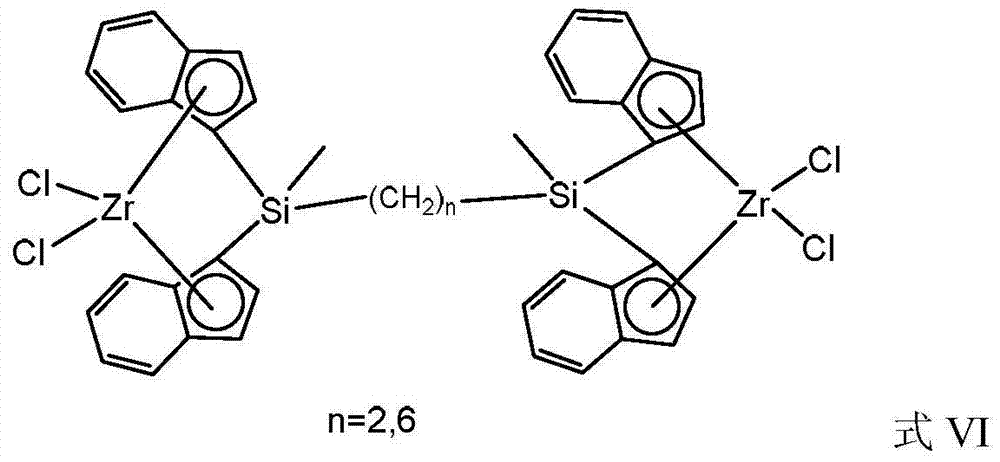
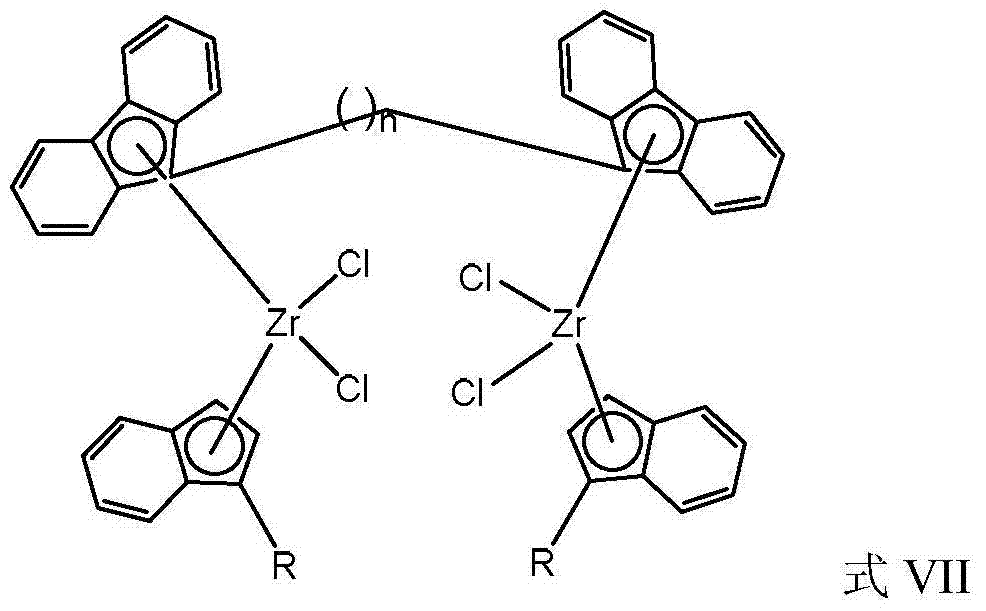
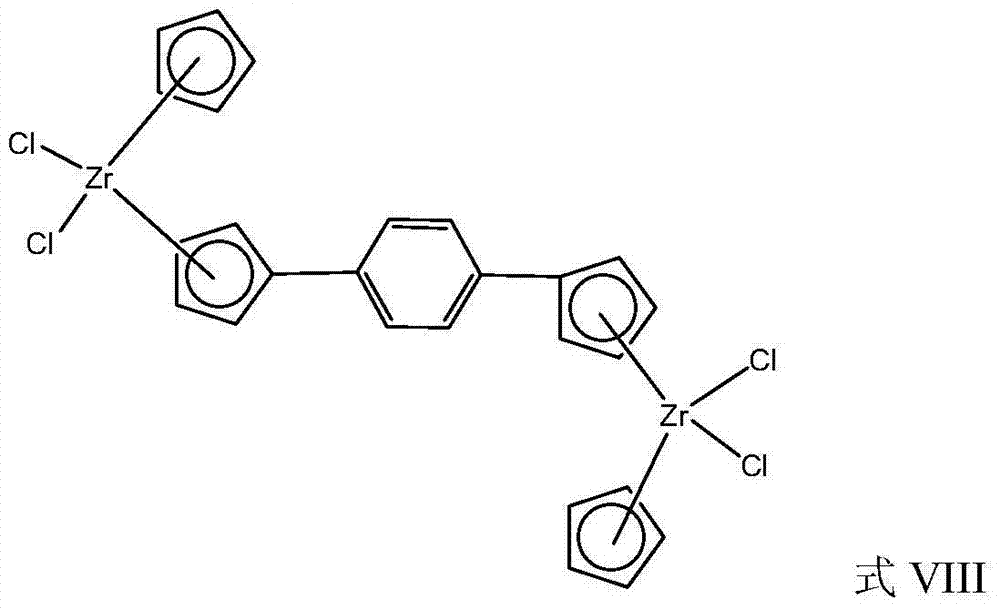
Examples
Embodiment 1
[0055] Ligand L1[(CH 3 ) 2 C(C 5 h 4 )(C 13 h 9 )] 2 (CH 2 C 6 h 4 CH 2 )Synthesis
[0056] Ligand L1[(CH 3 ) 2 C(C 5 h 4 )(C 13 h 9 )] 2 (CH 2 C 6 h 4 CH 2 ) The synthetic route is as follows:
[0057]
[0058] Under the protection of argon, with carbon tetrachloride as a solvent, p-xylene (5.04g, 47.53mmol), NBS (30g) and BPO (2g) were added to the bottle for reaction, heated, and when heated to 70°C, The solid and liquid in the bottle begin to melt, after stabilization, continue heating to 80°C, reflux for 20 hours, cool down, there is white solid in the upper layer, light yellow clear liquid in the lower layer, cool to 40°C, filter, take the filtrate, put it in the refrigerator After 24 hours, white crystals, about 5 g, were p-dibromobenzyl, and the yield was 40%.
[0059] Add fluorene (10g, 60.24mmol), 100mL of n-hexane, and 20mL of diethyl ether into a 200mL Schlenk bottle, and slowly add n BuLi (36.7mL, 1.64mol / L), a precipitate formed immedia...
Embodiment 2
[0067] Ligand L2[(C 6 h 5 ) 2 C(C 5 h 4 )(C 13 h 9 )] 2 (CH 2 C 6 h 4 CH 2 )Synthesis
[0068] At 0°C, a solution of 6,6-diphenylfulvene (11.08g, 48.18mmol) in ether (40mL) was added dropwise to a solution of FluLi (8g, 48.18mmol) in ether (80mL). After 8 hours, Precipitation appeared, and a large amount of precipitates formed after 20 hours of reaction. The solvent was removed by pressure filtration, and the solid was washed twice with ether and once with hexane, and dried to obtain 12.41 g of solid, with a yield of 65%.
[0069] The above-mentioned lithium salt (15.19mmol) of 6.18g is dissolved in 50mLTHF, and yellowish redness, under ice bath, slowly add the THF (40mL) solution (light yellow) of p-dibromide (2.01g, 7.59mmol) dropwise, rise naturally to After room temperature, the color of the solution deepened slightly, dark red to yellow, and reacted for two days. For hydrolysis, use acetic acid to adjust the pH to neutral, separate the liquids, take the organ...
Embodiment 3
[0075] Ligand L3[(CH 2 ) 5 C(C 5 h 4 )(C 13 h 9 )] 2 (CH 2 C 6 h 4 CH 2 )Synthesis
[0076] Under ice-cooling, a solution of 6,6-pentamethylenefulvene (8.89g, 48.18mmol) in ether (40mL) was added dropwise to a solution of FluLi (8g, 48.18mmol) in ether (80mL). Precipitation was formed. After about 8 hours, a precipitate appeared. After 20 hours of reaction, a large amount of precipitate was formed. The solid was washed twice with ether and once with hexane, and dried to obtain 11.49 g of solid, with a yield of 68%.
[0077] The above-mentioned lithium salt (15.19mmol) of 4.91g is dissolved in 50mLTHF, and yellowish redness, under ice bath, slowly add the THF (40mL) solution (light yellow) of p-dibromide (2.01g, 7.59mmol) dropwise, rise naturally to After room temperature, the color deepened slightly, dark red to yellowish, and reacted for 40 hours. Hydrolyze, adjust the pH to neutral with acetic acid, separate the liquids, take the organic phase, extract the aqueou...
PUM
 Login to View More
 Abstract
Description
Claims
Application Information
 Login to View More
 - R&D
- Intellectual Property
- Life Sciences
- Materials
- Tech Scout
- Unparalleled Data Quality
- Higher Quality Content
- 60% Fewer Hallucinations
Browse by: Latest US Patents, China's latest patents, Technical Efficacy Thesaurus, Application Domain, Technology Topic, Popular Technical Reports.
© 2025 PatSnap. All rights reserved.Legal|Privacy policy|Modern Slavery Act Transparency Statement|Sitemap|About US| Contact US: help@patsnap.com