
Thin film crystalline silicon perovskite heterojunction solar battery and preparation method thereof
A technology of solar cells and perovskite, applied in circuits, electrical components, electric solid devices, etc., can solve the problems of insufficient stability, large usage, and high production costs
- Summary
- Abstract
- Description
- Claims
- Application Information
AI Technical Summary
Problems solved by technology
Method used
Image

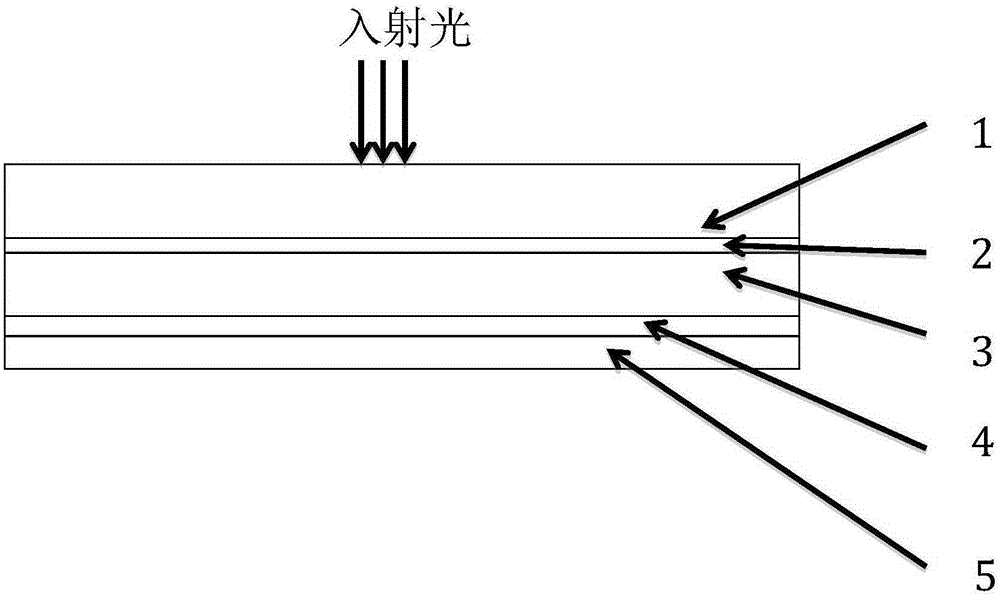
Examples
Embodiment 1
[0060] The first step is to prepare a P-type thin film crystalline silicon hole transport layer on a transparent conductive substrate:
[0061] Use a P-type single crystal silicon wafer coated with a layer of corrosion-resistant metal on the back as the anode, and use platinum as the cathode. anodic oxidation with an electric current, corrode the P-type single crystal silicon wafer by electrochemical method, and form a porous silicon structure on the surface of the single crystal silicon wafer, and then form the single crystal silicon wafer with the porous silicon structure in H 2 Annealing at 200°C to 550°C in the atmosphere, during the annealing process, the holes in the small porosity layer on the surface of the single crystal silicon wafer will gradually close to form a quasi-single crystal layer as a template for epitaxial devices. The P-type thin film crystalline silicon film is epitaxially formed on the layer, and the formed P-type crystalline silicon film is transferre...
Embodiment 2
[0081] The first step is to prepare a P-type thin film crystalline silicon hole transport layer on a transparent conductive substrate:
[0082] With a P-type single crystal silicon wafer coated with a layer of corrosion-resistant metal on the back as the anode and platinum as the cathode, in a hydrofluoric acid ethanol solution with a volume ratio of hydrofluoric acid: absolute ethanol = 1:1, the size is 4.5 The current of A is anodized, and the P-type single crystal silicon wafer is corroded by an electrochemical method to form a porous silicon structure on the surface of the single crystal silicon wafer, and then the single crystal silicon wafer with a porous silicon structure is formed in H 2 Annealing at 200°C to 550°C in the atmosphere, during the annealing process, the holes in the small porosity layer on the surface of the single crystal silicon wafer will gradually close to form a quasi-single crystal layer as a template for epitaxial devices. The P-type thin film crys...
Embodiment 3
[0102] The first step is to prepare a P-type thin film crystalline silicon hole transport layer on a transparent conductive substrate:
[0103] With a P-type single crystal silicon wafer coated with a layer of corrosion-resistant metal on the back as the anode, and platinum as the cathode, in a hydrofluoric acid ethanol solution with a volume ratio of hydrofluoric acid: absolute ethanol = 1:1, a size of 7.5 The current of A is anodized, and the P-type single crystal silicon wafer is corroded by an electrochemical method to form a porous silicon structure on the surface of the single crystal silicon wafer, and then the single crystal silicon wafer with a porous silicon structure is formed in H 2 Annealing at 200°C to 550°C in the atmosphere, during the annealing process, the holes in the small porosity layer on the surface of the single crystal silicon wafer will gradually close to form a quasi-single crystal layer as a template for epitaxial devices. The P-type thin film cryst...
PUM
| Property | Measurement | Unit |
|---|---|---|
| thickness | aaaaa | aaaaa |
| thickness | aaaaa | aaaaa |
| thickness | aaaaa | aaaaa |
Abstract
Description
Claims
Application Information
 Login to View More