
A kind of method for preparing Cu-doped indium sulfide film
A technology of indium sulfide and thin film, which is applied in semiconductor/solid-state device manufacturing, photovoltaic power generation, electrical components, etc. It can solve the problems of lower resistivity, high resistivity of thin film, unfavorable conversion efficiency of thin film solar cells, etc., and achieve easy and uniform doping , high purity, and the effect of reducing film resistivity
- Summary
- Abstract
- Description
- Claims
- Application Information
AI Technical Summary
Problems solved by technology
Method used
Image

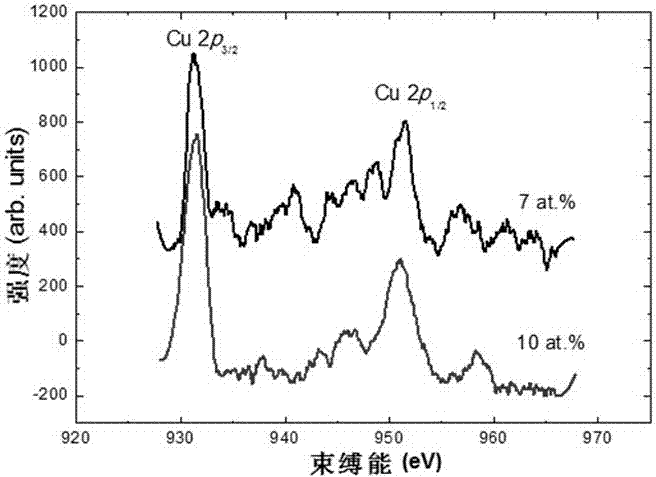
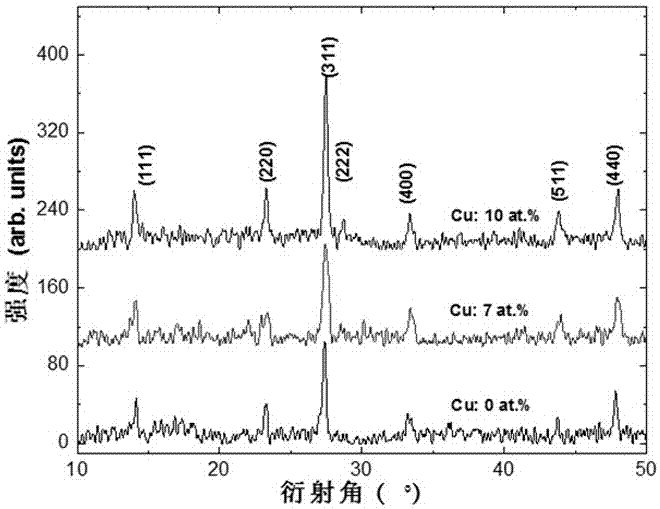
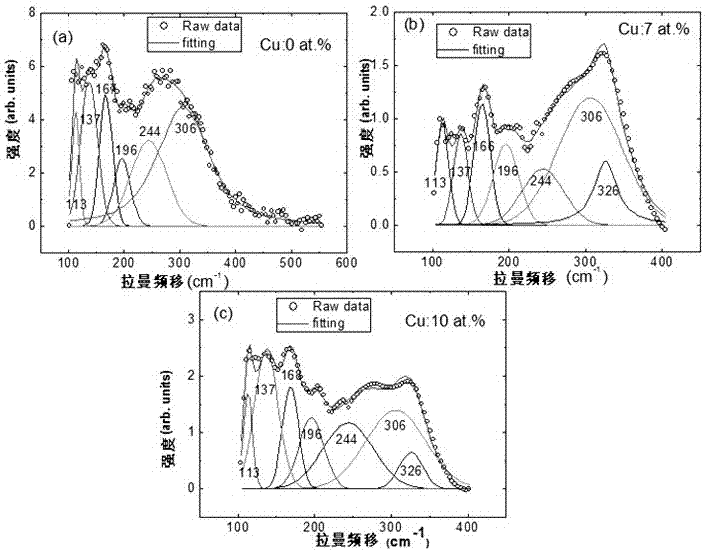
Examples
Embodiment 1
[0039] A method for preparing a Cu-doped indium sulfide film, which specifically comprises the following steps:
[0040] Step 1): Clean the transparent glass sheet, that is, ultrasonically treat the glass sheet in deionized water, acetone, and ethanol for 15 minutes, then take it out, and dry it in a high-temperature drying oven at 100°C for 30 minutes;
[0041] Step 2): Place the dried glass sheet obtained in step 1) on the sample holder of the vacuum evaporation furnace, and then put it into the evaporation chamber; put 150mg of indium sulfide powder in the evaporation boat, and then put it into the evaporation chamber; Vacuumize the evaporation chamber to 1.0×10 -3After Pa, slowly apply current at a rate of 10A / min to heat the evaporation boat. When the current reaches about 90A, the indium sulfide powder on the evaporation boat begins to evaporate onto the glass sheet, and continue to slowly apply current until the sulfide in the evaporation boat After the indium powder e...
Embodiment 2
[0047] A method for preparing a Cu-doped indium sulfide film, which specifically comprises the following steps:
[0048] Step 1): Clean the transparent glass sheet, that is, ultrasonically treat the glass sheet in deionized water, acetone, and ethanol for 15 minutes, then take it out, and dry it in a high-temperature drying oven at 100°C for 30 minutes;
[0049] Step 2): Place the dried glass sheet obtained in step 1) on the sample holder of the vacuum evaporation furnace, and then put it into the evaporation chamber; put 150mg of indium sulfide powder in the evaporation boat, and then put it into the evaporation chamber; Vacuum the evaporation chamber to 1.0×10 -3 After Pa, slowly apply current at a rate of 10A / min to heat the evaporation boat. When the current reaches about 90A, the indium sulfide powder on the evaporation boat begins to evaporate onto the glass sheet, and continue to slowly apply current until the sulfide in the evaporation boat After the indium powder eva...
Embodiment 3
[0055] A method for preparing a Cu-doped indium sulfide film, which specifically comprises the following steps:
[0056] Step 1): Clean the transparent glass sheet, that is, ultrasonically treat the glass sheet in deionized water, acetone, and ethanol for 15 minutes, then take it out, and dry it in a high-temperature drying oven at 100°C for 30 minutes;
[0057] Step 2): Place the dried glass sheet obtained in step 1) on the sample holder of the vacuum evaporation furnace, and then put it into the evaporation chamber; put 300mg of indium sulfide powder in the evaporation boat, and then put it into the evaporation chamber; Vacuum the evaporation chamber to 1.0×10 -3 After Pa, slowly apply current at a rate of 10A / min to heat the evaporation boat. When the current reaches about 90A, the indium sulfide powder on the evaporation boat begins to evaporate onto the glass sheet, and continue to slowly apply current until the sulfide in the evaporation boat After the indium powder eva...
PUM
| Property | Measurement | Unit |
|---|---|---|
| thickness | aaaaa | aaaaa |
| thickness | aaaaa | aaaaa |
| thickness | aaaaa | aaaaa |
Abstract
Description
Claims
Application Information
 Login to View More