
Preparation method of multi-dendritic colloidal gold nanoparticles with controllable particle size and high light absorption intensity
A colloidal gold, high light absorption technology, applied in the development of precious metal nanoparticles, can solve the problems of waste of manpower, material and financial resources, weak light absorption intensity of solution, low concentration of gold particles, etc., and achieves short reaction time, good monodispersity, The effect of high light absorption
- Summary
- Abstract
- Description
- Claims
- Application Information
AI Technical Summary
Problems solved by technology
Method used
Image

Examples
Embodiment 1
[0027] Example 1 The particle size is 33 ± 3nm, the preparation of high absorbing intensity polydendric colloidal gold nanoparticles
[0028] Using spherical colloidal gold nanoparticles with a particle size of 18±2nm as seeds:
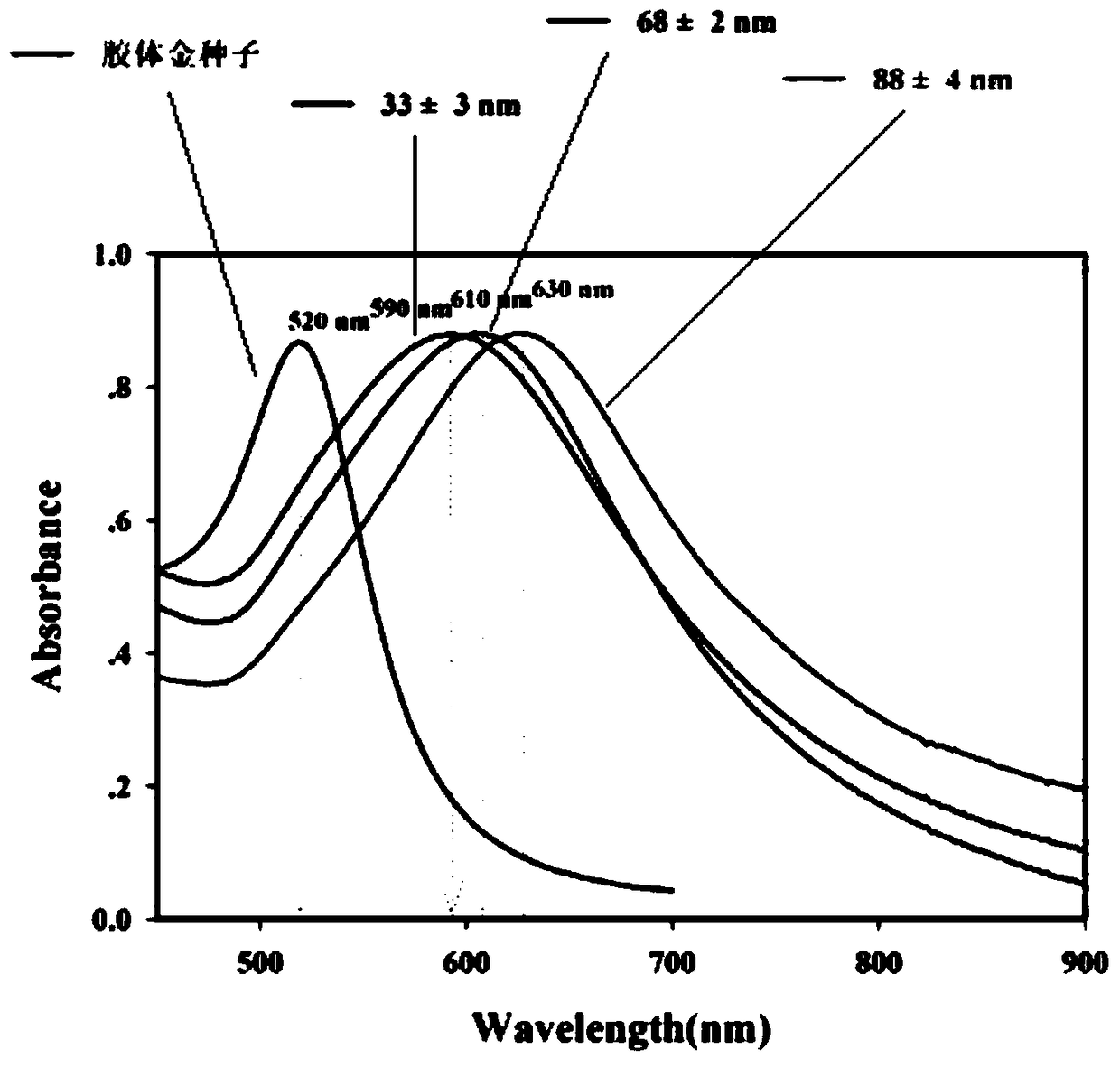
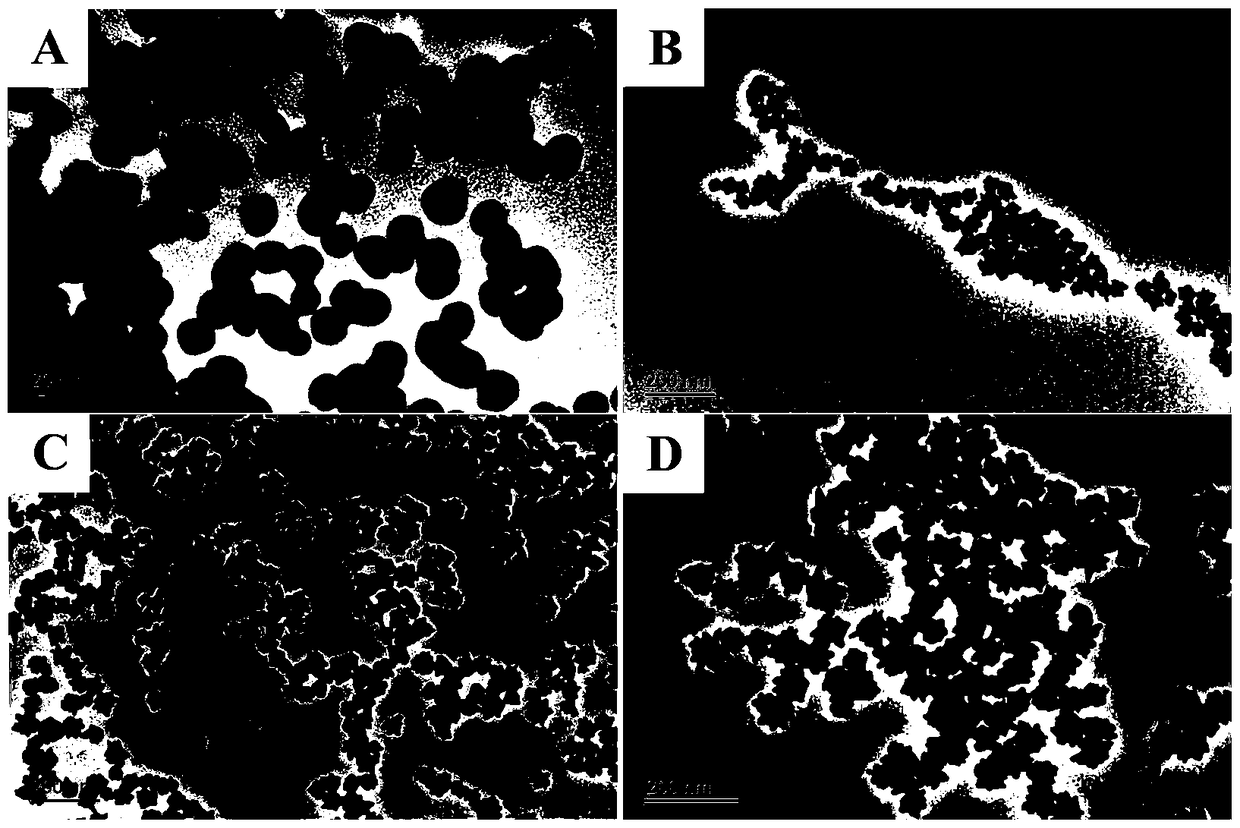
[0029] (1) Synthesis of spherical colloidal gold seed solution (spherical colloidal gold nanoparticles): using the classic trisodium citrate reduction method, accurately pipette 1mL of 1% HAuCl 4 Put the solution into a conical flask filled with 99mL ultrapure water, stir slowly on a magnetic stirrer and heat to boiling, then increase the speed and quickly add 2.7mL 1% Na at one time 3 C 6 h 5 o 7 Solution, continue to boil for 15min, until the color of the solution turns wine red and no longer changes, stop heating, stir at a constant speed and cool to room temperature, to obtain a spherical colloidal gold seed solution ( image 3 A). Such as figure 2 , the maximum surface plasmon resonance absorption wavelength was determined to be 520nm, the...
Embodiment 2
[0033] Example 2 Construction of Immunochromatographic Test Strips Based on High Absorbance Intensity and Low Absorbance Intensity Polydendrified Colloidal Gold Nanoparticles
[0034] Ochratoxin (OTA) was used as the analyte in a competitive inhibition mode. The test strip is composed of a sample pad, a binding pad, a nitrocellulose membrane, absorbent paper and a PVC bottom plate. The nitrocellulose membrane is coated with an ochratoxin antigen and a donkey anti-mouse secondary antibody as the detection line (T) and quality respectively. Control line (C):
[0035] (1) Particle size is 33 ± 3nm, high absorbing intensity polydendrite colloidal gold nanoparticle immunochromatographic test strip construction: be 33 ± 3nm with particle diameter, high absorbing intensity polydendric colloidal gold nanoparticle (take implementation The polydendritic colloidal gold solution with high absorbing intensity obtained in Example 1, without concentration treatment) is used as a labeling ma...
Embodiment 3
[0040] Example 3 The particle size is 68 ± 2nm, and the preparation of high absorbing intensity multi-dendrite colloidal gold nanoparticles
[0041] Using spherical colloidal gold nanoparticles with a particle size of 18±2nm as seeds:
[0042] (1) Synthesis of spherical colloidal gold seed solution (spherical colloidal gold nanoparticles): using the classic trisodium citrate reduction method, accurately pipette 1mL of 1% HAuCl 4 Put the solution into a conical flask filled with 99mL ultrapure water, stir slowly on a magnetic stirrer and heat to boiling, then increase the speed and quickly add 2.7mL 1% Na at one time3 C 6 h 5 o 7 Solution, continue to boil for 15min, until the color of the solution turns wine red and no longer changes, stop heating, stir at a constant speed and cool to room temperature, to obtain a spherical colloidal gold seed solution ( image 3 A). Such as figure 2 , the maximum surface plasmon resonance absorption wavelength was determined to be 520nm...
PUM
| Property | Measurement | Unit |
|---|---|---|
| particle diameter | aaaaa | aaaaa |
| particle diameter | aaaaa | aaaaa |
| particle diameter | aaaaa | aaaaa |
Abstract
Description
Claims
Application Information
 Login to View More