
Titanium silicate molecular sieve catalyst comprising organic functional group
A titanium-silicon molecular sieve, organic functional group technology, applied in the direction of molecular sieve catalyst, molecular sieve compound, molecular sieve characteristic silicate, etc., can solve the problem of uneven distribution of catalyst active centers, poor catalyst stability, poor surface hydrophobicity, etc., to achieve excellent selectivity and stability, solving mass transfer problems, reducing production costs and production cycle effects
- Summary
- Abstract
- Description
- Claims
- Application Information
AI Technical Summary
Problems solved by technology
Method used
Image

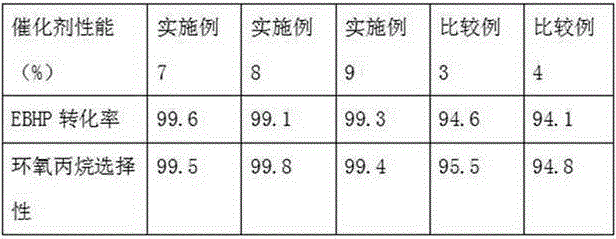
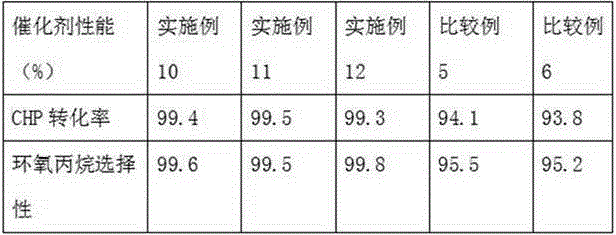
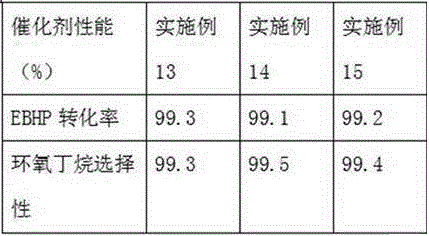
Examples
Embodiment 1
[0017] At room temperature and under stirring, add a mixed solution of silicon source tetraethyl orthosilicate, bis(triethoxysilyl)methane and trimethoxysilane, which accounts for 70% of the total amount to be added, to the template agent 16 Alkyltrimethylammonium bromide, mineralizer tetraethylammonium hydroxide and water mixed solution for hydrolysis to form a colorless and transparent solution I; the remaining 30% silicon source tetraethyl orthosilicate, di( Triethoxysilyl)methane and trimethoxysilane are mixed and then fully mixed with titanium source tetrabutyl titanate to form a mixed solution II; at -5°C and under rapid stirring, slowly add solution II to the solution In Ⅰ, a light yellow transparent solution was formed, and continued to stir for 1 hour, which was recorded as solution Ⅲ; solution Ⅲ was transferred to a stainless steel autoclave for crystallization treatment, the crystallization temperature was 140°C, and the crystallization time was 72 hours. Filter and...
Embodiment 2
[0021] Compared with Example 1, only in the molecular sieve preparation process, the amount of tetrabutyl titanate added was reduced. The composition relationship of the amount of each substance is [(CH 3 ) 3 CH 3 (CH 2 ) 15 N + ]Br - : [(CH 3 CH 2 ) 4 NH 4 ] + Oh - :Si(OC 2 h 5 ) 4 :(C 2 h 5 O) 3 Si-CH 2 -Si(OC 2 h 5 ) 3 : CH 3 Si(OCH 3 ) 3 :Ti(OC 4 h 9 ) 4 :H 2 O =0.3:0.4:1:0.3:0.1:0.03:10 (molar ratio).
[0022] The ultraviolet-visible (UV-Vis) spectrogram of the titanium-silicon molecular sieve catalyst containing organic functional groups has a strong absorption peak at about 215 nm, and no absorption peak exists at other wavelengths. Its infrared (FT-IR) spectrum is at 960cm -1 There is an obvious absorption peak. More than 95% of the pores have a pore size larger than 2 nm.
Embodiment 3
[0024] Compared with Example 1, only in the molecular sieve preparation process, reduce (C 2 h 5 O) 3 Si-CH 2 -Si(OC 2 h 5 ) 3 added amount. The composition relationship of the amount of each substance is [(CH 3 ) 3 CH 3 (CH 2 ) 15 N + ]Br - : [(CH 3 CH 2 ) 4 NH 4 ] + Oh - :Si(OC 2 h 5 ) 4 :(C 2 h 5 O) 3 Si-CH 2 -Si(OC 2 h 5 ) 3 : CH 3 Si(OCH 3 ) 3 :Ti(OC 4 h 9 ) 4 :H 2 O =0.3:0.4:1:0.2:0.1:0.04:10 (molar ratio).
[0025] The ultraviolet-visible (UV-Vis) spectrum of the titanium-silicon molecular sieve catalyst containing organic functional groups has a strong absorption peak at about 215 nm, and no absorption peak exists at other wavelengths. Its infrared spectrum (FT-IR) is at 960cm -1 There is an obvious absorption peak. More than 95% of the pores have a pore size greater than 2 nm.
PUM
 Login to View More
 Abstract
Description
Claims
Application Information
 Login to View More