Unlock instant, AI-driven research and patent intelligence for your innovation.

Method for separating non-metallic inclusion and carbide from steel inclusion

A technology for non-metallic inclusions and inclusions, applied in the field of steel cleanliness detection, can solve problems such as erosion, loss of small inclusions, and damage to the original characteristics of inclusions, and achieve high separation efficiency and accurate quantitative results.

Active Publication Date: 2017-11-07
UNIV OF SCI & TECH BEIJING
View PDF3 Cites 6 Cited by
  • Summary
  • Abstract
  • Description
  • Claims
  • Application Information

AI Technical Summary

Problems solved by technology

The Chinese patent has announced a method of measuring large non-metallic inclusions in steel by electrolysis (application publication number CN 102778377), in the elutriation process, the anode mud liquid obtained by electrolysis is poured into the elutriation tank, and the flow rate is 0.5-0.8L / min Nitrogen, wash with water for 20-30min, this process can remove the suspended solids and carbides with lighter density in the anode slime, but the washing by this method will lead to the loss of fine inclusions
There are also 4% HNO 3 +2%KMnO 4 and 20% NH 4 S 2 o 8 +2%KMnO 4 (Translated by Huang Shunhua, Analysis of Gas, Non-metallic Inclusions and Carbide in Steel, Volume 2, Metallurgical Industry Press, 1960) Chemical treatment dissolves carbides and finally obtains inclusions, but chemical methods also dissolve carbides It will cause erosion to the inclusions and destroy the original characteristics of the inclusions

Method used

the structure of the environmentally friendly knitted fabric provided by the present invention; figure 2 Flow chart of the yarn wrapping machine for environmentally friendly knitted fabrics and storage devices; image 3 Is the parameter map of the yarn covering machine
View more

Image

Smart Image Click on the blue labels to locate them in the text.
Viewing Examples
Smart Image
  • Method for separating non-metallic inclusion and carbide from steel inclusion
  • Method for separating non-metallic inclusion and carbide from steel inclusion
  • Method for separating non-metallic inclusion and carbide from steel inclusion

Examples

Experimental program
Comparison scheme
Effect test

Embodiment 1

[0033] The steel sample used in this embodiment is aluminum killed steel:

[0034] Step 1: Use a bucket sampler with an inner diameter of 50mm and a height of 150mm to take samples after aluminum deoxidation for 5 minutes in the RH refining process of aluminum killed steel, and cut the sample from the middle part between 40mm from the top of the bucket sample and 20mm from the bottom by wire cutting The rod-shaped sample is used, and the surface of the sample to be tested is polished to a smoothness of Ra 3.2 μm with sandpaper; the rod-shaped sample is used as the anode, and the stainless steel sheet is used as the cathode, (tetramethylammonium chloride 1%, triethanolamine 6%, glycerol 8%, the balance is anhydrous methanol) as the electrolyte, MS-30-10D DC stabilized power supply as the electrolysis power supply, electrolysis is carried out in a 500ml beaker, and the current density of the electrolysis process is controlled at 50-60mA / cm 2 , Electrolyte temperature is controll...

Embodiment 2

[0041] The steel sample used in this embodiment is silicon-aluminum composite deoxidized steel:

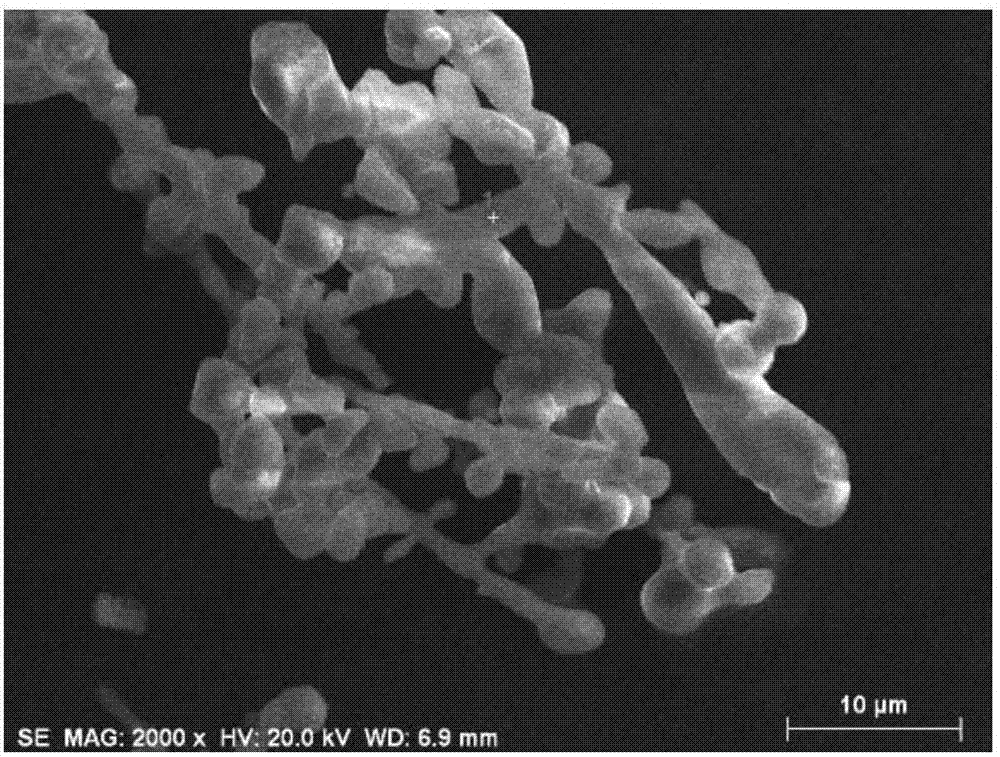
[0042] A bucket sampler with an inner diameter of 50mm and a height of 150mm is used to sample in the tundish process of the smelting process of silicon-aluminum composite deoxidized steel, as in the specific steps in Example 1, the morphology and composition of the inclusions in the separated silicon-aluminum composite deoxidized steel are as follows image 3 .

the structure of the environmentally friendly knitted fabric provided by the present invention; figure 2 Flow chart of the yarn wrapping machine for environmentally friendly knitted fabrics and storage devices; image 3 Is the parameter map of the yarn covering machine
Login to View More

PUM

No PUM Login to View More

Abstract

The invention belongs to the technical field of cleanliness detection of steel and provides a method for separating non-metallic inclusion and carbide from steel. The method comprises following implementation steps: (1), electrolysis of a steel sample; (2), extraction of precipitates obtained after electrolysis; (3), separation of free carbon from the precipitates; (4), separation of cementite and the non-metallic inclusion from the precipitates; (5), cleaning of the non-metallic inclusion; (6), observation of the non-metallic inclusion. Tribromethane, namely, bromoform, is taken as a flotation solution, HgI2 and AgNO3 are utilized for preparing a specific gravity liquid of fused salt, the inclusion and carbide in the electrolyzed precipitates are physically separated according to the principle of density difference, and damage to inclusion can be avoided to the greatest extent; the content of the non-metallic inclusion in steel can be accurately quantified with the method, and the method plays an important role in quantitative evaluation of molten steel cleanliness.

Description

technical field [0001] The invention mainly belongs to the technical field of steel cleanliness detection, and in particular relates to a method for separating non-metallic inclusions and carbides in steel. Background technique [0002] Non-metallic inclusions exist in the steel as an independent phase, which destroys the compactness and uniformity of the steel, and greatly reduces the strength, toughness, welding performance, corrosion resistance, fatigue resistance and various mechanical properties of the steel. performance. The quantity, distribution and type of inclusions have become an important indicator for evaluating the quality of steel. The properties of steel can be improved by studying non-metallic inclusions in steel and controlling their shape, size, distribution and structure. The existing common research methods for non-metallic inclusions are to directly observe and analyze the surface of the sample (such as metallographic microscopy) or to extract and sep...

Claims

the structure of the environmentally friendly knitted fabric provided by the present invention; figure 2 Flow chart of the yarn wrapping machine for environmentally friendly knitted fabrics and storage devices; image 3 Is the parameter map of the yarn covering machine
Login to View More

Application Information

Patent Timeline
no application Login to View More
IPC IPC(8): G01N1/28G01N33/20
CPCG01N1/28G01N33/20
Inventor 王敏包燕平赵立华郭建龙顾超王睿安航航王达志
Owner UNIV OF SCI & TECH BEIJING
Features
  • R&D
  • Intellectual Property
  • Life Sciences
  • Materials
  • Tech Scout
Why Patsnap Eureka
  • Unparalleled Data Quality
  • Higher Quality Content
  • 60% Fewer Hallucinations
Social media
Patsnap Eureka Blog
Learn More