Cyclic polycaprolactone-polyethylene glycol amphiphilic block copolymer and its preparation and application
A technology of amphiphilic block and polycaprolactone, which is applied in the direction of medical preparations and pharmaceutical formulations of non-active ingredients, can solve the problem of non-existence of amphiphilic block copolymers, and achieve low cytotoxicity, good The effect of drug loading capacity
- Summary
- Abstract
- Description
- Claims
- Application Information
AI Technical Summary
Problems solved by technology
Method used
Image

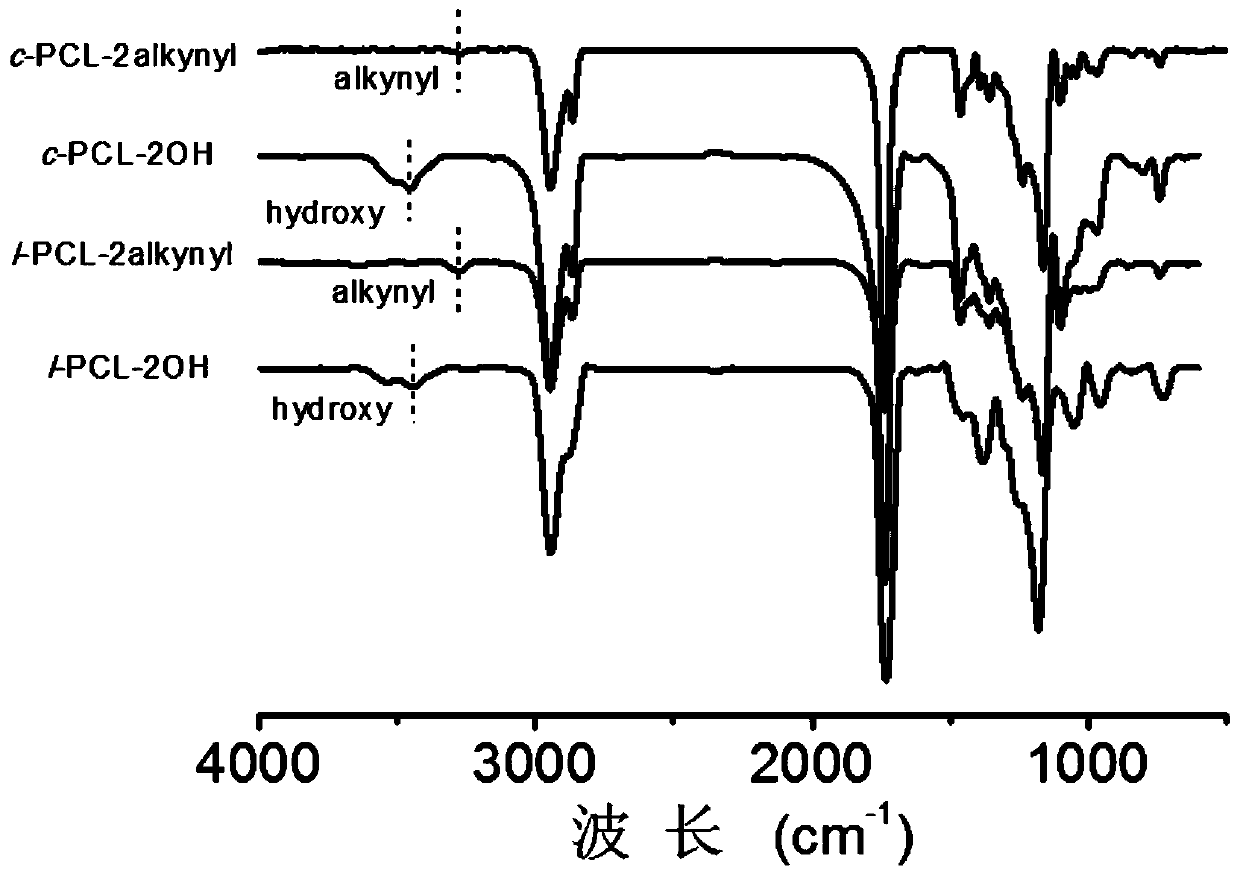
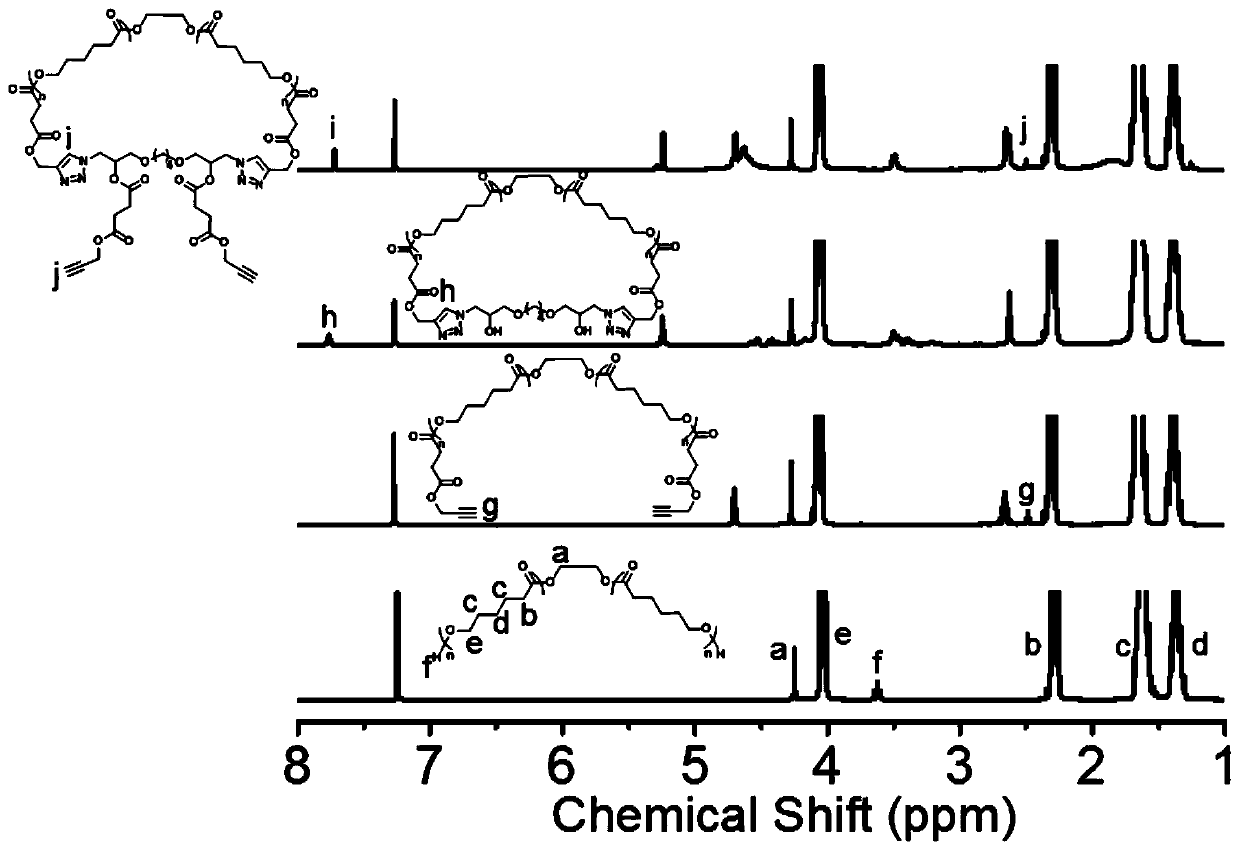

Examples
Embodiment 1
[0044] The preparation of embodiment 1 alkyne acid anhydride
[0045] In the following examples of the present invention, the synthetic route of the used alkynoic anhydride is as follows:
[0046]
[0047] The specific operation is as follows:
[0048]9.3 g (93.0 mmol) of succinic anhydride and 2.6 g (21.4 mmol) of 4-dimethylaminopyridine (DMAP) were dissolved in 20 mL of dry dichloromethane (DCM). 6.0 g (107.0 mmol) of propynyl alcohol was dissolved in 10 mL of dry DCM, which was slowly added dropwise to the above suspension solution, protected by argon, and stirred at 25°C for 36 h. After the reaction, add 50mL DCM to dilute, 10% NaHSO 4 Wash three times with aqueous solution (3×20 mL), 10% NaHCO 3 Wash three times with aqueous solution (3 x 20 mL). Take the organic phase with anhydrous Na 2 SO 4 Dry, filter with suction, and rotary evaporate to obtain a white solid powder (compound 1 in the figure above, 10.0 g, yield: 68.9%).
[0049] 8.0 g (51.3 mmol) of compoun...
Embodiment 2
[0050] Example 2 Preparation of Small Molecules Endcapped by Azide Groups at Both Ends (hereinafter referred to as Double Azide Capped Small Molecules)
[0051] In the following examples of the present invention, the synthesis route of the double-headed azide-terminated small molecule used is as follows:
[0052]
[0053] The specific operation is as follows:
[0054] 3.0g (14.8mmol) 1,4-butanediol diglycidyl ether, 4.8g (78.0mmol) NaN 3 and 4g (74.0mmol) NH 4 Cl was added to 30 mL of DMF solvent, and the reaction was stirred at 50° C. for 24 h. After the reaction was finished, cool to room temperature, add 300mL DCM to dilute, wash with water to remove DMF. Take the DCM phase with anhydrous Na 2 SO 4 Dry, filter with suction, and rotary evaporate to obtain a white waxy solid, which is a double-headed azide-terminated small molecule (compound 3 in the figure above, 3.7 g, yield: 86.4%). NMR characterization: 1 H NMR (300MHz, DMSO-d 6 ,δ,ppm):5.22(d,2H),3.77(m,2H),3....
Embodiment 3
[0055] The preparation of embodiment 3c-PCL-2alkynyl
[0056] The synthesis steps are as follows:
[0057] (1) Synthesis of l-PCL-2OH
[0058] Add a stirring bar to the 5mL ampoule, heat it under vacuum on the double row tube, fill it with argon to cool three times, and put it into the glove box. 4.0 mL (36.0 mmol) ε-CL (ε-caprolactone) and 40.0 μL (0.7 mmol) initiator ethylene glycol were added to the ampoule. Then add 80.0μL (0.8mol / L) catalyst Sn(Oct) 2 of toluene solution. Seal it with a rubber tube, and stir and react at 100°C for 2h. After the reaction, take it out from the glove box, cool it immediately, add THF to dissolve, precipitate with ice anhydrous ether, filter with suction, and dry the filter cake in a vacuum oven at 25°C overnight to obtain a white powder, which is l-PCL-2OH (2.9g , Yield: 70.4%). H NMR spectrum ( 1 H NMR) measurement result: M n,NMR =4900g / mol; Size exclusion chromatography (SEC) measurement result: M n,SEC = 8300g / mol,
[0059] (...
PUM
 Login to View More
 Abstract
Description
Claims
Application Information
 Login to View More
 - R&D
- Intellectual Property
- Life Sciences
- Materials
- Tech Scout
- Unparalleled Data Quality
- Higher Quality Content
- 60% Fewer Hallucinations
Browse by: Latest US Patents, China's latest patents, Technical Efficacy Thesaurus, Application Domain, Technology Topic, Popular Technical Reports.
© 2025 PatSnap. All rights reserved.Legal|Privacy policy|Modern Slavery Act Transparency Statement|Sitemap|About US| Contact US: help@patsnap.com