Dihydroquinoxalinone compound and preparation method thereof
What is AI technical title?
AI technical title is built by PatSnap AI team. It summarizes the technical point description of the patent document.
A technology for dihydroquinazolinones and compounds is applied in the field of dihydroquinazolinones and their preparation, and can solve the problems of complex post-treatment process, harsh reaction conditions, single reaction raw materials and the like
Active Publication Date: 2018-09-21
CHINA THREE GORGES UNIV
View PDF5 Cites 4 Cited by
Summary
Abstract
Description
Claims
Application Information
AI Technical Summary
This helps you quickly interpret patents by identifying the three key elements:
Problems solved by technology
Method used
Benefits of technology
Problems solved by technology
These methods not only have a single reaction raw material, but also have some obvious shortcomings. Most of the reaction conditions are relatively harsh, such as the need for dangerous organic solvents, higher temperatures, strong acids, expensive catalysts, and complicated post-treatment processes.
Method used
the structure of the environmentally friendly knitted fabric provided by the present invention; figure 2 Flow chart of the yarn wrapping machine for environmentally friendly knitted fabrics and storage devices; image 3 Is the parameter map of the yarn covering machine
View more
Image
Smart Image Click on the blue labels to locate them in the text.
Viewing Examples
Smart Image
Click on the blue label to locate the original text in one second.
Reading with bidirectional positioning of images and text.
Smart Image
Examples
Experimental program
Comparison scheme
Effect test
Embodiment 1
[0023]
[0024] 2-Nitrobenzonitrile (0.2mmol, 29.6mg), tetrahydroxydiboron (1mmol, 89.6mg), glacial acetic acid (0.24mmol, 14.5mg), cuprous chloride (0.04mmol, 4.0mg), benzeneFormaldehyde (0.24mmol, 25.4mg), methanol (1ml), and water (1ml) were sequentially added to the test tube, and reacted at 60°C for 3h. Analysis (petroleumether: ethyl acetate = 4:1) separation, yield: (40.8mg, 91%). m.p.225-226℃. 1 HNMR (400MHz, CDCl 3 )δ=7.99(dd,J 1 =8.0Hz,J 2 =1.6Hz,1H),7.65(m,2H),7.50(m,2H),7.39(dt,J 1 =7.6Hz,J 2 =1.6Hz,1H),6.95(dd,J 1 =7.6Hz,J 2 =0.8Hz,1H),6.72(d,J=8.0Hz,1H),5.95(s,1H),5.80(s,1H),4.44(s,1H). 13 C NMR (100MHz, CDCl 3 )δ=164.7, 147.2, 138.6, 134.0, 130.2, 129.2, 128.8, 127.4, 119.7, 115.7, 114.6, 69.2.
Embodiment 2
[0026]
[0027] Add 2-nitrobenzonitrile (0.2mmol, 29.6mg), tetrahydroxydiboron (1mmol, 89.6mg), benzaldehyde (0.24mmol, 25.4mg), methanol (1ml), water (1ml) into the test tube in turn , reacted at 60°C for 12h, after the end, the reaction solution was extracted 3 times with ethyl acetate, the combined organic phase was concentrated to dryness, and separated by column chromatography (petroleumether: ethyl acetate = 4:1), the yield: (6.7mg, 15%).
Embodiment 3
[0029]
[0030] 2-Nitrobenzonitrile (0.2mmol, 29.6mg), tetrahydroxydiboron (1mmol, 89.6mg), glacial acetic acid (0.24mmol, 14.5mg), cuprous chloride (0.04mmol, 4.0mg), benzene Add formaldehyde (0.24mmol, 25.4mg) and water (2ml) into the test tube in turn, and react at 60°C for 3h. Ethyl acetate=4:1) isolated, yield: (13.2 mg, 30%).
the structure of the environmentally friendly knitted fabric provided by the present invention; figure 2 Flow chart of the yarn wrapping machine for environmentally friendly knitted fabrics and storage devices; image 3 Is the parameter map of the yarn covering machine
Login to View More
PUM
Login to View More
Abstract
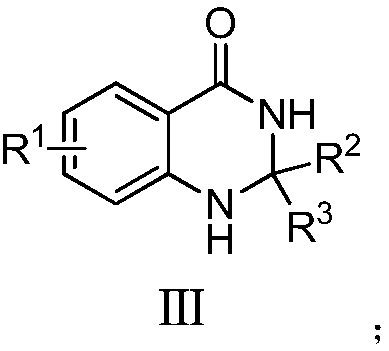
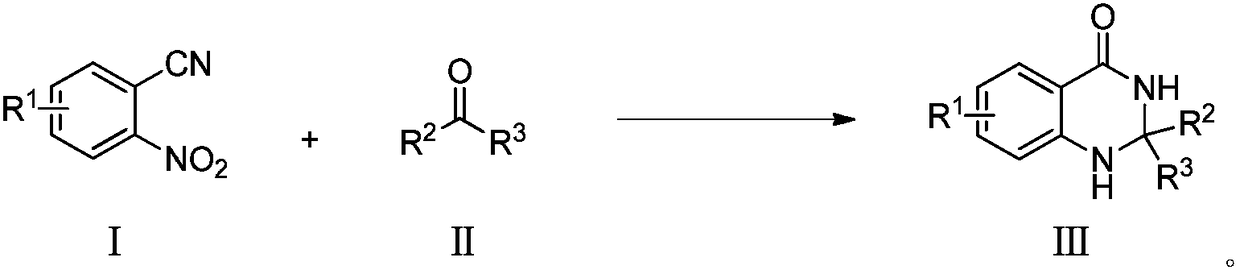
The invention relates to a dihydroquinoxalinone compound and a preparation method, and the specific structure is shown in III. The method uses cheap and readily available o-nitrobenzonitrile (I) and aldehyde or ketone (II) as raw materials, and alcohol and water as solvent. The target product (III) is obtained by a nitro reduction, a cyano hydrolysis, and a condensation reaction in a one-pot reaction system under the action of tetrahydroxydiboron, glacial acetic acid and catalytic amount of cuprous chloride. The preparation method uses 2-nitrobenzonitrile (I) as a raw material for the first time, which is easy to operate, easy to obtain raw materials, high in yield, and has the advantages of green synthesis such as step economy, atomic economy, mild reaction conditions and the like. The specific formula is shown in the description.
Description
technical field [0001] The invention belongs to the technical field of organic synthesis, and in particular relates to a dihydroquinazolone compound and a preparation method thereof. Background technique [0002] The skeleton structure of dihydroquinazolones widely exists in natural products and drug molecules, and has important biological activity and medicinal value. In the reported synthetic methods, 2-aminobenzamide, isatoic anhydride derivatives, 2-aminobenzonitrile, 2-nitroaniline, etc. are used as starting materials to condense with carbonyl compounds under certain conditions. reaction to obtain dihydroquinazolone compounds. These methods not only have a single reaction raw material, but also have some obvious shortcomings. Most of the reaction conditions are relatively harsh, such as the need for dangerous organic solvents, higher temperatures, strong acids, expensive catalysts, and complicated post-treatment processes. The innovation of the present invention is th...
Claims
the structure of the environmentally friendly knitted fabric provided by the present invention; figure 2 Flow chart of the yarn wrapping machine for environmentally friendly knitted fabrics and storage devices; image 3 Is the parameter map of the yarn covering machine
Login to View More
Application Information
Patent Timeline
Application Date:The date an application was filed.
Publication Date:The date a patent or application was officially published.
First Publication Date:The earliest publication date of a patent with the same application number.
Issue Date:Publication date of the patent grant document.
PCT Entry Date:The Entry date of PCT National Phase.
Estimated Expiry Date:The statutory expiry date of a patent right according to the Patent Law, and it is the longest term of protection that the patent right can achieve without the termination of the patent right due to other reasons(Term extension factor has been taken into account ).
Invalid Date:Actual expiry date is based on effective date or publication date of legal transaction data of invalid patent.




 Login to View More
  Login to View More