Check patentability & draft patents in minutes with Patsnap Eureka AI!

Thermally activated delayed fluorescence (tadf) nanoprobes and their preparation methods and applications in biological imaging

A fluorescent nano-probe, thermal activation delay technology, applied in the field of medicine, can solve the problems of surrounding cell tissue damage, high instrument precision, weak phosphorescence intensity, etc., to reduce self-absorption effect and inner filter effect, reduce background noise, The effect of reducing detection errors

Active Publication Date: 2022-03-04
HARBIN MEDICAL UNIVERSITY
View PDF6 Cites 0 Cited by
  • Summary
  • Abstract
  • Description
  • Claims
  • Application Information

AI Technical Summary

Problems solved by technology

[0004] Most long-lived probe compounds are mostly based on rare earth heavy metals, such as iridium and europium, which are potentially cytotoxic (Lv W, Yang T, Yu Q, Zhao Q, Zhang KY, Liang H, Liu S, Li F, HuangW. APhosphorescent Iridium (III) Complex-Modified Nanoprobe for Hypoxia Bioimaging Via Time-Resolved Luminescence Microscopy. Adv Sci (Weinh). 2015; 2 (10): 1500107.), although the lifetime of phosphorescence is long enough to achieve time-resolved detection, However, due to relatively weak phosphorescence intensity, high requirements for instrument precision, and potential damage to surrounding tissue, its application in bioimaging is limited (Li T, Yang D, Zhai L, Wang S, Zhao B, Fu N, Wang L, Tao Y, Huang W. Thermally Activated Delayed Fluorescence Organic Dots (TADF Odots) for Time-Resolved and Confocal Fluorescence Imaging in Living Cells and In Vivo. Adv Sci (Weinh). 2017; 4(4): 1600166.)

Method used

the structure of the environmentally friendly knitted fabric provided by the present invention; figure 2 Flow chart of the yarn wrapping machine for environmentally friendly knitted fabrics and storage devices; image 3 Is the parameter map of the yarn covering machine
View more

Image

Smart Image Click on the blue labels to locate them in the text.
Viewing Examples
Smart Image
  • Thermally activated delayed fluorescence (tadf) nanoprobes and their preparation methods and applications in biological imaging
  • Thermally activated delayed fluorescence (tadf) nanoprobes and their preparation methods and applications in biological imaging
  • Thermally activated delayed fluorescence (tadf) nanoprobes and their preparation methods and applications in biological imaging

Examples

Experimental program
Comparison scheme
Effect test

Embodiment 1

[0059] Synthesis of Example 1 Compound b

[0060]

[0061] Operation process:

[0062] Compound a (4,5-difluorophthalic anhydride) (300mg) and aniline (186mg) were fed in a mass ratio of 1:1.2, dissolved in 5ml of acetic acid, reacted at 120°C for 4h under the protection of argon, and cooled to room temperature , placed in the refrigerator overnight, crystallized and solids were precipitated, and a white solid was obtained by suction filtration, washed with water, and purified by column to obtain a white powder compound b, 204 mg, with a yield of 57.1%. 1H NMR (400MHz, CDCl3) δ7.79–7.75(t,J=8.0Hz,2H,-Ar),7.54–7.50(m,2H,-Ar),7.44–7.40(m,3H,-Ar). 13C NMR (100MHz, CDCl3) δ165.25, 156.06, 155.91, 153.46, 153.31, 131.32, 129.25, 128.60, 128.45, 126.41, 113.74, 113.67, 113.59, 113.52.

Embodiment 2

[0063] Example 2 Synthesis of Compound DF-1

[0064]

[0065] Operation process:

[0066] Carbazole (130 mg) and NaH (34 mg) were dissolved in THF and stirred at room temperature for 30 min, compound b (100 mg) was added, and the reaction was continued to stir for 2 h, purified by column, and evaporated to dryness to obtain yellow powder compound DF-1, 51 mg, yield 16.3%. 1HNMR (400MHz, Methanol-d4) δ8.25 (d, J = 6.4Hz, 2H, -Ar), 8.17–8.15 (m, 4H, -Ar), 7.97 (d, J = 8.0Hz, 2H, -Ar ),7.57–7.53(m,4H,-Ar),7.49–7.48(m,4H,-Ar),7.47–7.43(m,8H,-Ar),7.39–7.35(m,4H,-Ar), 7.28–7.27(m,3H,-Ar).13C NMR(100MHz,Methanol-d4)δ165.91,139.47,138.85,131.57,131.00,129.34,128.50,126.59,125.97,125.89,124.06,1209.023,12

Embodiment 3

[0067] Synthesis of Example 3 Compound c

[0068]

[0069] Operation process:

[0070]Add compound a (4,5-difluorophthalic anhydride) (1g) and p-aminophenylacetic acid (1.12g) into acetic acid (30mL) and mix and stir, and reflux for 4h. Cool the solution to 4°C overnight, extract and filter 1.32 g of solid compound c was obtained, and the yield was 80%. 1H NMR (400MHz, (CD3)2SO) δ13.14 (s, 1H, -COOH), 8.22 (t, J = 7.6Hz, 2H, -Ar), 8.11–8.08 (m, 2H, -Ar), 7.61 –7.59(m,2H,-Ar).13C NMR(100MHz,(CD3)2SO)δ167.11,165.33,155.04,154.94,153.33,153.23,135.98,130.33,129.40,127.35,114.34,114.30,114.20.1

the structure of the environmentally friendly knitted fabric provided by the present invention; figure 2 Flow chart of the yarn wrapping machine for environmentally friendly knitted fabrics and storage devices; image 3 Is the parameter map of the yarn covering machine
Login to View More

PUM

PropertyMeasurementUnit
particle sizeaaaaaaaaaa
Login to View More

Abstract

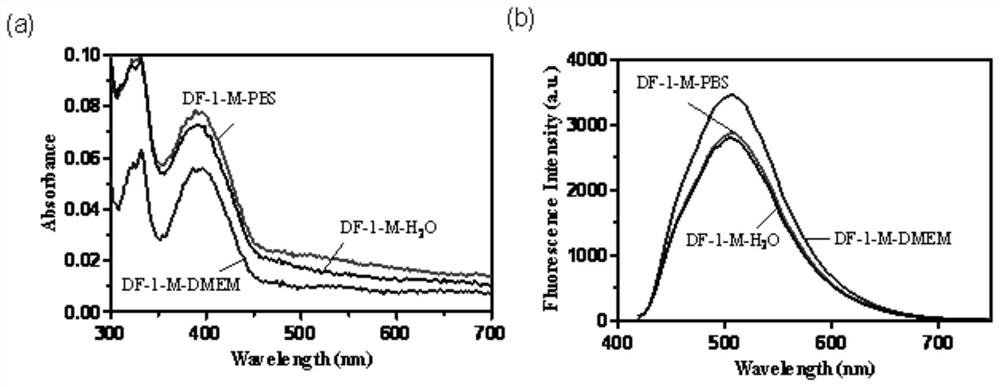
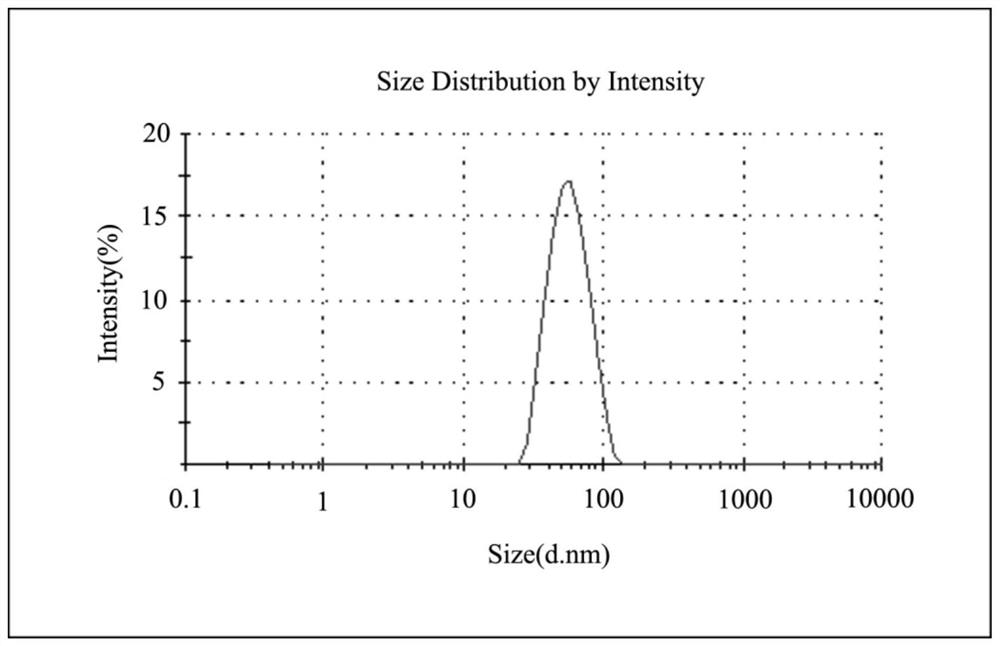
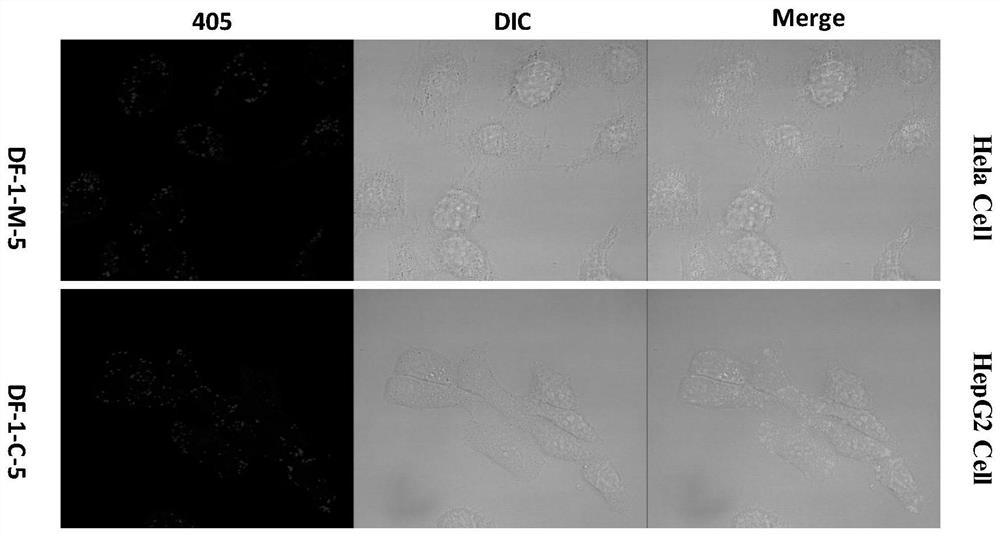
The invention discloses a series of thermally activated delayed fluorescence (TADF) nanometer probes, a preparation method thereof and an application in biological imaging. The thermally activated delayed fluorescence (TADF) nano-probe molecule has the structure shown in formula I. Compared with the reported imaging probe molecules, the thermally activated delayed fluorescent nanoprobes prepared by the present invention have better fluorescence intensity and fluorescence efficiency, which greatly improves the imaging sensitivity of such molecules and improves the fluorescence of the probes It has good water solubility, strong brightness and stability, oxygen barrier, and also has the characteristics of potential long-life fluorescence. It can show clear and stable imaging effects with strong fluorescence signals in cell imaging, and the fluorescence lifetime can reach 271.20 microns. Seconds and above, it is beneficial to reduce the self-absorption effect and inner filter effect, reduce the detection error between emitted light and scattered light, reduce the background noise of fluorescence imaging, improve the imaging signal-to-noise ratio, and can be used for ultra-high resolution fluorescence Imaging experiments.

Description

technical field [0001] The invention relates to a thermally activated delayed fluorescence (TADF) nanoprobe, and also relates to a preparation method of the nanoprobe and its application in biological imaging. The invention belongs to the technical field of medicine. Background technique [0002] TADF (thermally activated delayed fluorescence) thermally activated delayed fluorescence materials can simultaneously use singlet excitons and triplet excitons to emit light without noble metals. It is called the third generation of organic optoelectronics after fluorescent materials and phosphorescent materials. The material was first synthesized in 2012 by Adachi et al. (Uoyama H, Goushi K, ShizuK, Nomura H, Adachi C. Highly efficient organic light-emitting diodes from delayed fluorescence. Nature. 2012; 492(2012): 234-238.) . However, due to the small energy level difference between the singlet state and triplet state in TADF materials, the triplet excitons can return to the si...

Claims

the structure of the environmentally friendly knitted fabric provided by the present invention; figure 2 Flow chart of the yarn wrapping machine for environmentally friendly knitted fabrics and storage devices; image 3 Is the parameter map of the yarn covering machine
Login to View More

Application Information

Patent Timeline
no application Login to View More
Patent Type & Authority Patents(China)
IPC IPC(8): C07D209/48C07F9/6558C09K11/02C09K11/06G01N21/64A61K49/00
CPCA61K49/0021A61K49/0082G01N21/6428C09K11/025C09K11/06C07D209/48C07F9/65583C09K2211/1033C09K2211/1007C09K2211/1014C09K2211/1029
Inventor 彭海生胡海宇张青扬杜智敏张长梅王庆华许胜男陈重李明慧刘肖莹
Owner HARBIN MEDICAL UNIVERSITY
Features
  • R&D
  • Intellectual Property
  • Life Sciences
  • Materials
  • Tech Scout
Why Patsnap Eureka
  • Unparalleled Data Quality
  • Higher Quality Content
  • 60% Fewer Hallucinations
Social media
Patsnap Eureka Blog
Learn More