Supercharge Your Innovation With Domain-Expert AI Agents!

A method for additive manufacturing of composite materials

A composite material and additive manufacturing technology, applied in the field of additive manufacturing, can solve problems such as cracks, pores, and poor surface quality of parts, and achieve the effects of improving machining accuracy, good surface quality, and improving mechanical properties

Active Publication Date: 2022-06-24
WUHAN POLYTECHNIC UNIVERSITY
View PDF7 Cites 0 Cited by
  • Summary
  • Abstract
  • Description
  • Claims
  • Application Information

AI Technical Summary

Problems solved by technology

[0004] The main purpose of the present invention is to propose a method for additive manufacturing of composite materials, which aims to solve the problems of poor surface quality, internal pores and cracks of parts manufactured by the prior art

Method used

the structure of the environmentally friendly knitted fabric provided by the present invention; figure 2 Flow chart of the yarn wrapping machine for environmentally friendly knitted fabrics and storage devices; image 3 Is the parameter map of the yarn covering machine
View more

Image

Smart Image Click on the blue labels to locate them in the text.
Viewing Examples
Smart Image
  • A method for additive manufacturing of composite materials
  • A method for additive manufacturing of composite materials
  • A method for additive manufacturing of composite materials

Examples

Experimental program
Comparison scheme
Effect test

Embodiment 1

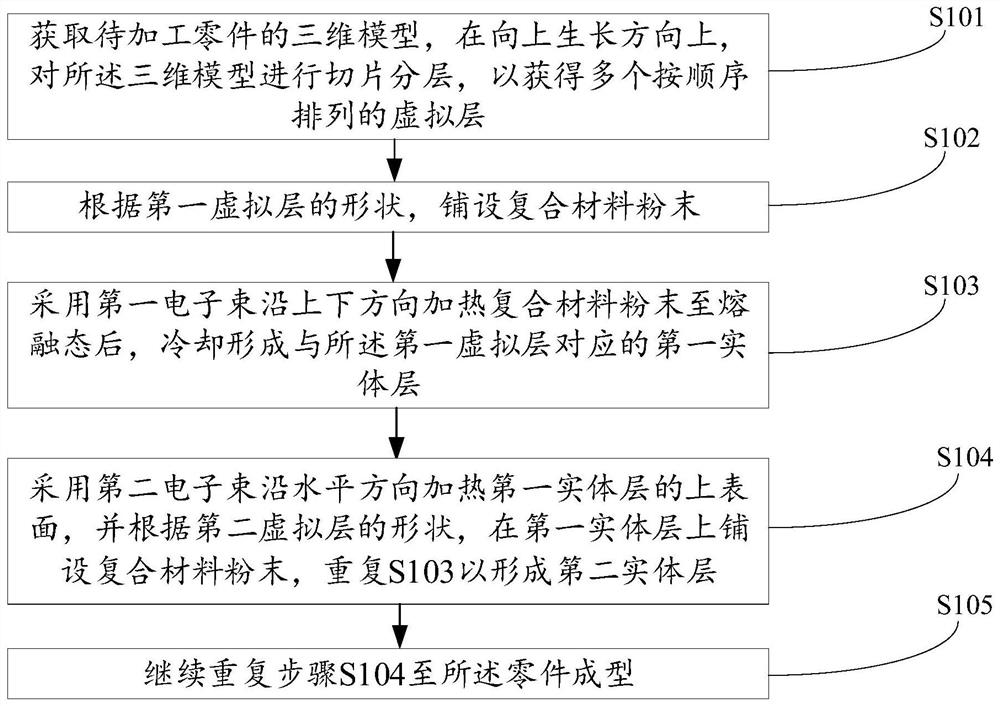
[0051] see figure 2 , design the three-dimensional model of the part, slice and stratify in the upward growth direction, set the thickness of each virtual layer to 0.8mm, and divide the part model into multiple virtual layers. And import the data of each virtual layer into the operating system of the processing equipment.

[0052] According to the shape of the first dummy layer, the composite material powder is laid. Among them, the composite material powder is made by mixing aluminum-copper alloy and carbon fiber in a weight ratio of 9:1, and both aluminum-copper alloy and carbon fiber are pulverized into powder with a particle size of 50 μm.

[0053] After the composite material powder is heated in the up-down direction by the first electron beam to a molten state, the low-temperature nitrogen gas circulation device is connected, and the first solid layer corresponding to the first virtual layer is formed by cooling. The acceleration voltage of the first electron beam was...

Embodiment 2

[0057] see figure 2 , design the three-dimensional model of the part, slice and stratify in the upward growth direction, set the thickness of each virtual layer to 0.6mm, and divide the part model into multiple virtual layers. And import the data of each virtual layer into the operating system of the processing equipment.

[0058] According to the shape of the first dummy layer, the composite material powder is laid. Among them, the metal materials in the composite powder are copper and gallium, and the polymer materials are carbon fiber and acrylonitrile-butadiene-styrene copolymer. The metal materials and polymer materials are mixed in a weight ratio of 6:1, and copper, gallium and Carbon fibers and acrylonitrile-butadiene-styrene copolymers were all pulverized into powders with a particle size of 60 μm.

[0059] After the composite material powder is heated in the up-down direction by the first electron beam to a molten state, the low-temperature nitrogen gas circulation...

Embodiment 3

[0063] see figure 2 , design the three-dimensional model of the part, slice and stratify in the upward growth direction, set the thickness of each virtual layer to 0.8mm, and divide the part model into multiple virtual layers. And import the data of each virtual layer into the operating system of the processing equipment.

[0064] According to the shape of the first dummy layer, the composite material powder is laid. Among them, the composite material powder is a mixture of vanadium and polycarbonate in a weight ratio of 3:1, and both vanadium and polycarbonate are pulverized into powders with a particle size of 70 μm.

[0065] After the composite material powder is heated in the up-down direction by the first electron beam to a molten state, the low-temperature nitrogen gas circulation device is connected, and the first solid layer corresponding to the first virtual layer is formed by cooling. The acceleration voltage of the first electron beam was set to 120kV; the scan r...

the structure of the environmentally friendly knitted fabric provided by the present invention; figure 2 Flow chart of the yarn wrapping machine for environmentally friendly knitted fabrics and storage devices; image 3 Is the parameter map of the yarn covering machine
Login to View More

PUM

PropertyMeasurementUnit
particle diameteraaaaaaaaaa
thicknessaaaaaaaaaa
particle diameteraaaaaaaaaa
Login to View More

Abstract

The invention discloses a method for additive manufacturing of composite materials. The method for additive manufacturing of composite materials includes the following steps: obtaining a three-dimensional model of the part to be processed, sliced ​​and layered in the upward growth direction, and obtained multiple virtual layers; laying composite material powder according to the shape of the first virtual layer; using The first electron beam heats the composite material powder in the vertical direction and cools to form the first solid layer; the second electron beam is used to heat the upper surface of the first solid layer in the horizontal direction, and according to the shape of the second virtual layer, the first solid layer is formed Lay composite material powder on top, then heat and cool with the first electron beam; continue to repeat the previous step until the part is formed. The present invention uses the first electron beam and the second electron beam to fully heat the inside of the powder layer, wherein in the horizontal direction, by heating the upper surface of the solid layer, the composite material powder and the solid layer are completely melted, so that the finished part Surface cracks are few and good quality.

Description

technical field [0001] The invention relates to the technical field of additive manufacturing, in particular to a method for additive manufacturing of composite materials. Background technique [0002] The development of modern high technology is inseparable from composite materials, and composite materials play a very important role in the development of modern science and technology. The research depth and application breadth of composite materials, as well as the speed and scale of production and development, have become one of the important indicators to measure the advanced level of a country's science and technology. The additive manufacturing technology based on composite materials is a hot spot of modern scientific research. [0003] Additive manufacturing technology is an advanced manufacturing technology that integrates computer science, optics, materials science and other disciplines, and accumulates three-dimensional models of parts into parts with certain struc...

Claims

the structure of the environmentally friendly knitted fabric provided by the present invention; figure 2 Flow chart of the yarn wrapping machine for environmentally friendly knitted fabrics and storage devices; image 3 Is the parameter map of the yarn covering machine
Login to View More

Application Information

Patent Timeline
no application Login to View More
Patent Type & Authority Patents(China)
IPC IPC(8): B22F3/105B22F10/28B22F10/36B29C64/153B29C64/295B29C64/393B29C64/371B29C64/30B33Y10/00B33Y30/00B33Y40/00
CPCB29C64/153B29C64/295B29C64/393B29C64/371B29C64/30B33Y10/00B33Y30/00B33Y40/00B22F10/00B22F10/36B22F12/45B22F10/50B22F10/28Y02P10/25
Inventor 陈继兵张国靖杨军胜
Owner WUHAN POLYTECHNIC UNIVERSITY
Features
  • R&D
  • Intellectual Property
  • Life Sciences
  • Materials
  • Tech Scout
Why Patsnap Eureka
  • Unparalleled Data Quality
  • Higher Quality Content
  • 60% Fewer Hallucinations
Social media
Patsnap Eureka Blog
Learn More