

A kind of compound and its preparation method and application
A compound and basic substance technology, applied in the field of compound and its preparation, can solve problems such as poor prognosis of surgery, late clinical symptoms, and difficulties in early diagnosis
- Summary
- Abstract
- Description
- Claims
- Application Information
AI Technical Summary
Problems solved by technology
Method used
Image

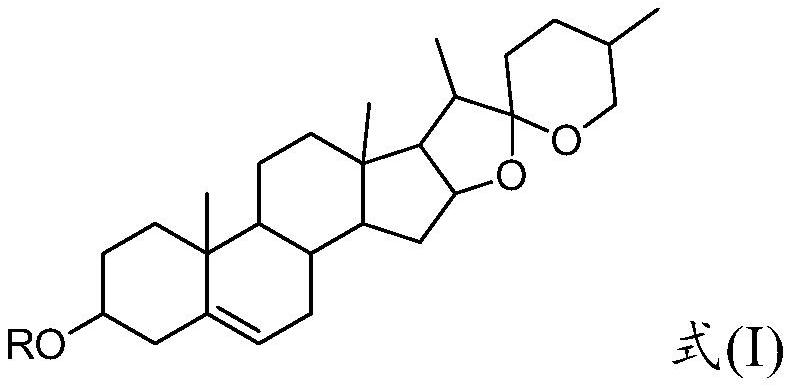
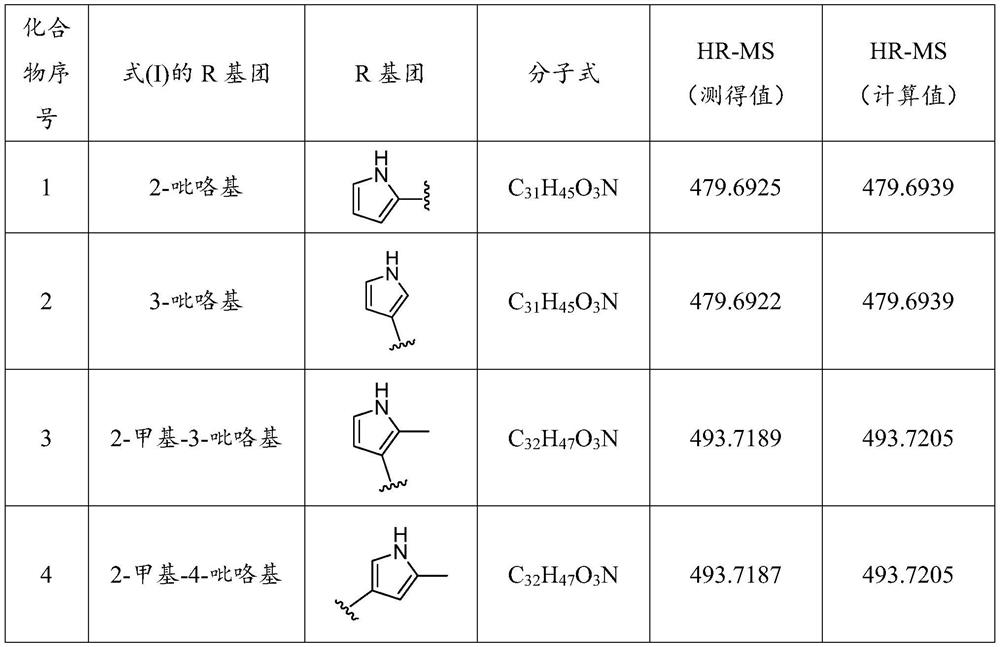
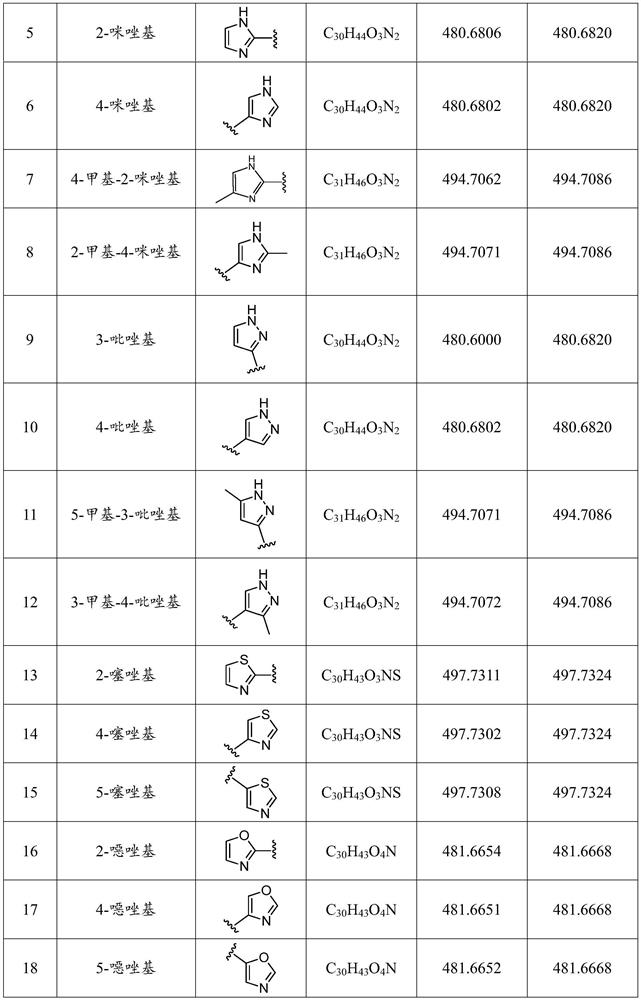
Examples
Embodiment 1
[0050]Weigh 4.2 g of diosgenin and 0.5 g of sodium hydride, dissolve in 500 mL of 100 mL of absolute ethanol in a three-necked flask, then add 1.5 g of 2-chloropyrrole, stir and freeze to -20°C, and heat and stir to react for 72 hours. TLC : Petroleum ether-ethyl acetate (1:1), color developer: 5% phosphomolybdic acid ethanol solution) Detect all diosgenin reactions, distill the ethanol, cool to room temperature, add 50mL water, and extract 3 times with dichloromethane (60mL×3), the dichloromethane was recovered from the extract, and TLC followed the separation and purification process of the reaction and the product. The solid was dried at 60°C for 4h to obtain 3.2g of a pale yellow powder. The melting point of the target product: 192.5-194.5°C,13C NMR(CDCl3,100MHz)δ143.56,140.83,121.85,119.64,118.34,108.61,107.92,82.95,82.33,66.94,62.82,56.64,50.81,42.15,40.71,40.13,39.24,37.73,37.52,32.86,32.26,32.05,31.31, ,29.14,28.86,21.13,19.37,17.56,15.50,14.82. TOF-HRMS: M / e(479.6925), mole...
Embodiment 2
[0053]Weigh 4.2g diosgenin and 1.0g potassium hydride dissolved in 100mL methanol 500mL in a three-necked flask, then add 1.5g 2-methyl-3-chloro-pyrrole, stir and heat at 25°C, and keep stirring for 36h. TLC( Developing agent: petroleum ether-ethyl acetate (1:1), developer: 5% phosphomolybdic acid ethanol solution) to detect all the diosgenin reactions, distilling out methanol, cooling to room temperature, adding 50 mL of water, and extracting with dichloromethane Three times (60 mL×3), the extract was recovered with dichloromethane, TLC followed the separation and purification process of the reaction and the product, and the solid was dried at 60° C. for 4 hours to obtain 3.4 g of a light yellow powder. The melting point of the target product: 191.7-193.9°C,13C NMR(CDCl3,100MHz)δ140.80,129.86,121.82,119.61,118.05,108.21,107.83,82.92,82.50,66.91,62.79,56.61,50.78,42.12,40.68,40.10,39.21,37.70,37.49,32.83,32.20,32.02,31.28 ,29.11,28.83,21.10,19.34,17.53,15.47,14.79,11.95. TOF-HRMS: M...
Embodiment 3
[0056]Weigh 4.2g diosgenin and 0.8g sodium ethoxide, dissolve 100mL n-propanol in a 500mL three-necked flask, then add 1.5g 2-chloroimidazole, stir and heat at 75°C, and keep stirring for 48h, TLC (developer: petroleum Ether-ethyl acetate (1:1), developer: 5% phosphomolybdic acid ethanol solution) to detect all diosgenin reactions, distill out n-propanol, cool to room temperature, separate with silica gel chromatography, ethyl acetate -Ethanol (such as 10:1) eluent, collect the product fractions, and spin off the solvent to obtain a solid. TLC follows the reaction and the separation and purification process of the product. Drying at 60°C for 4 hours, the product is a pale yellow powder 3.5g. The melting point of the target product: 195.1-196.8°C,13C NMR(CDCl3,100MHz) δ150.11,140.81,127.84,127.81,121.83,119.62,82.93,81.28,66.92,62.80,56.62,50.79,42.13,40.69,40.11,39.22,37.71,37.50,32.84,32.21,32.03,31.29,30.33 ,28.84,21.11,19.35,17.54,15.48,14.80. TOF-HRMS: M / e(480.6806), molecular f...
PUM
 Login to View More
 Abstract
Description
Claims
Application Information
 Login to View More