Unlock instant, AI-driven research and patent intelligence for your innovation.

Recombinant escherichia coli and application thereof in synthesis of p-hydroxybenzaldehyde

A technology for recombining Escherichia coli and Escherichia coli, applied in the field of genetic engineering, can solve the problems of complex fermentation product composition, environmental pollution safety, high purification difficulty, etc., and achieve the effects of being beneficial to environmental protection, easy to popularize and apply, and easy to control.

Inactive Publication Date: 2020-09-11
JIANGNAN UNIV
View PDF2 Cites 3 Cited by
  • Summary
  • Abstract
  • Description
  • Claims
  • Application Information

AI Technical Summary

Problems solved by technology

[0004] However, the above methods are all chemical synthesis methods, and there are problems such as environmental pollution and safety.
At present, there are also bacterial strains that can directly ferment p-hydroxybenzaldehyde to produce p-hydroxybenzaldehyde, but the fermentation products obtained by direct fermentation of microorganisms to produce p-hydroxybenzaldehyde have complex components and are difficult to purify
Therefore, the use of biocatalytic methods to produce p-hydroxybenzaldehyde meets the requirements of green chemistry and has bright application prospects in industrial production, but the current related technologies are few and immature

Method used

the structure of the environmentally friendly knitted fabric provided by the present invention; figure 2 Flow chart of the yarn wrapping machine for environmentally friendly knitted fabrics and storage devices; image 3 Is the parameter map of the yarn covering machine
View more

Image

Smart Image Click on the blue labels to locate them in the text.
Viewing Examples
Smart Image
  • Recombinant escherichia coli and application thereof in synthesis of p-hydroxybenzaldehyde
  • Recombinant escherichia coli and application thereof in synthesis of p-hydroxybenzaldehyde

Examples

Experimental program
Comparison scheme
Effect test

Embodiment 1

[0028] Example 1: Plasmid construction

[0029] Codon optimization is performed on the gene sequences encoding CYP199A4, HaPuR and HaPux, and after codon optimization, sequences such as cytochrome monooxygenase encoded by SEQ ID NO.1, SEQ ID NO.2, and SEQ ID NO.3, The ferredoxin and ferredoxin reductase genes. The recombinant plasmids pRSFduet-1-CYP199A4-HaPux and pETduet-1-HaPuR-HaPux were obtained by one-step cloning. The CYP199A4 (primers P1, P2) and HaPux (primers P3, P4) genes were inserted into the restriction sites BamHI / SacI and NdeI / XhoI on the pRSFduet-1 plasmid, respectively, and the HaPuR (primers P5, P6) and HaPux (primers P7 , P8) genes were inserted into the restriction sites NdeI / XhoI and XbaI / EcoRI on the pETduet-1 plasmid, respectively. The PCR reaction conditions were: 95°C for 5min; 98°C for 10s, 55°C for 5s, and 72°C for 5s / kb (30 cycles); 72°C for 10min, and then verified and recovered the PCR amplification product by 1% agarose gel electrophoresis. Th...

Embodiment 2

[0038] Embodiment 2: Recombinant bacteria construction

[0039]Transform recombinant plasmids pRSFduet-1-CYP199A4-HaPux and pETduet-1-HaPuR-HaPux into Escherichia coli E.coli BL21 by heat shock method to obtain recombinant E.coli BL21 / pRSFduet-1-CYP199A4-HaPux / pETduet -1-HaPuR-HaPux.

[0040] Basic operation of heat shock method:

[0041] (1) Melt the Escherichia coli competent cells stored at -80°C in ice for 10 minutes;

[0042] (2) Add 0.1ng-10ng of the corresponding plasmid to E. coli competent cells, mix gently and place in ice for 30min;

[0043] (3) Heat shock in a water bath at 42°C for 45-90 seconds, and immediately place it in ice for 1-2 minutes;

[0044] (4) Add 890 μl of LB medium;

[0045] (5) Put it into a shaker at 37°C, 180rmp-300rmp, and incubate for 1h;

[0046] (6) Take an appropriate amount of bacterial liquid to coat a resistant plate containing 50ug / mL kanamycin and 100ug / mL ampicillin, and place the plate upside down in a 37°C incubator overnight; ...

Embodiment 3

[0051] Example 3: Recombinant Escherichia coli protein expression conditions

[0052] (1) Influence of the concentration of inducer IPTG on the conversion rate

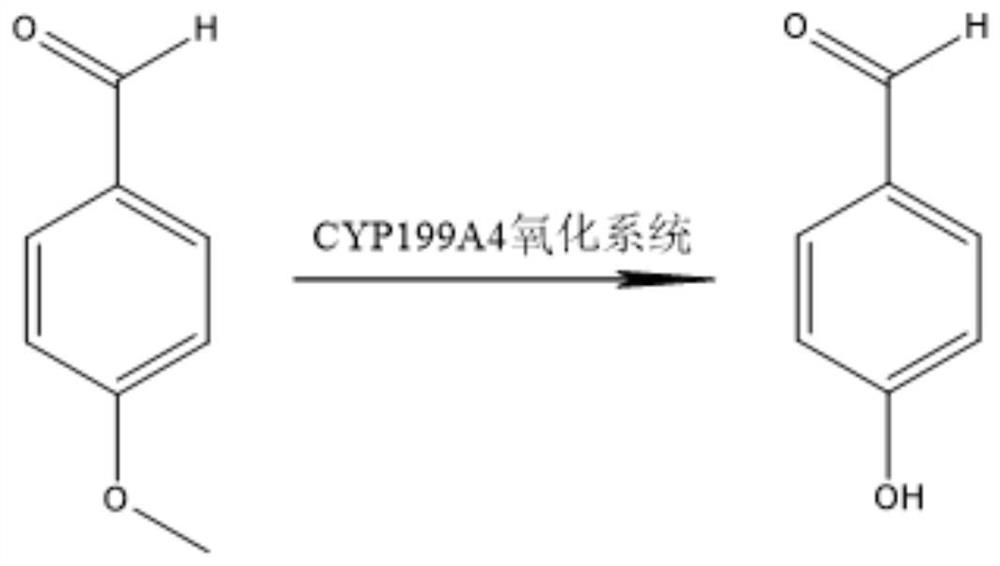
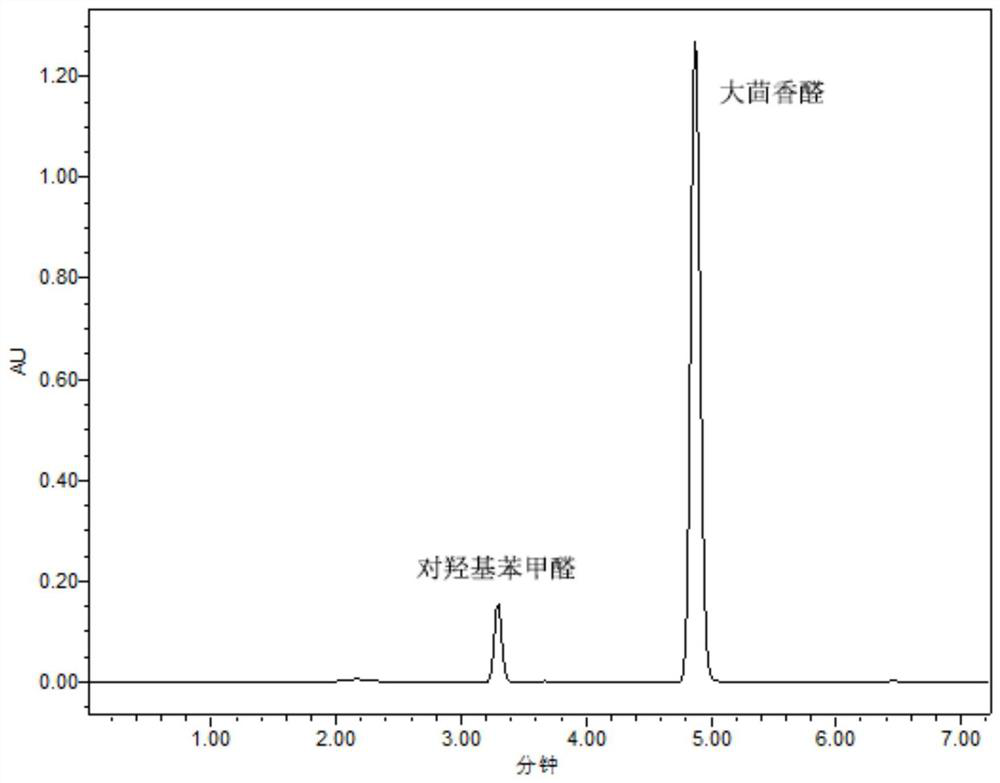
[0053] The recombinant Escherichia coli E. coli BL21 / pRSFduet-1-CYP199A4-HaPux / pETduet-1-HaPuR-HaPux constructed in Example 2 was inoculated as a single colony in 30 mL of LB medium and cultured for 12 hours. Inoculate 10% of the inoculum into a 250mL container containing 30mL LB medium, cultivate at 37°C, 220r, and in the cell OD 600 When it reaches 0.6, add 0, 0.2, 0.4, 0.6, 0.8, 1.0mmol / L IPTG respectively, culture at 25°C for 20h, collect the bacteria by centrifugation, and resuspend the recombinant Escherichia coli with 15mL of LB medium. The transformation system was 15 mL, the temperature was 30° C., the pH was 7, and the substrate concentration was 1 g / L. After 3 hours of whole-cell transformation, HPLC detection of anisaldehyde and p-hydroxybenzaldehyde in the whole-cell transformation solution of recombina...

the structure of the environmentally friendly knitted fabric provided by the present invention; figure 2 Flow chart of the yarn wrapping machine for environmentally friendly knitted fabrics and storage devices; image 3 Is the parameter map of the yarn covering machine
Login to View More

PUM

No PUM Login to View More

Abstract

The invention discloses recombinant escherichia coli and application thereof in synthesis of p-hydroxybenzaldehyde. Cytochrome monooxygenase (CYP199A4), ferredoxin (HaPuR) and ferredoxin reductase (HaPux), which are derived from Rhodopseudomonas palustris, are taken as target genes, rPSFduet-1 and pETduet-1 are taken as carriers, and escherichia coli E.coli BL21 is taken as a host to successfullyconstruct a genetically engineered bacterium which generates the p-hydroxybenzaldehyde by taking anisaldehyde as a substrate. The recombinant escherichia coli disclosed by the invention is taken as acatalyst, and 1 g / L of anisaldehyde can be converted into 250 mg / L of p-hydroxybenzaldehyde in 12 h. The method capable of carrying out microorganism whole-cell transformation to obtain the p-hydroxybenzaldehyde has the advantages of a moderate reaction condition, a simple technology and the like, and the method is easily controlled. Meanwhile, the method is favorable for environment protectionand can be easily promoted and applied.

Description

technical field [0001] The invention relates to a recombinant Escherichia coli and its application in synthesizing p-hydroxybenzaldehyde, belonging to the technical field of genetic engineering. Background technique [0002] p-Hydroxybenzaldehyde is an important organic intermediate for the synthesis of fragrances and medicines, and has a wide range of uses in the fields of chemical industry, agriculture, liquid crystal, electroplating and food additives. In the field of pesticides, p-Hydroxybenzaldehyde is mainly used for the synthesis of herbicides bromoxynil and hydroxychloronil; in the field of medicine, p-Hydroxybenzaldehyde can be used to synthesize amoxicillin, antibacterial synergist trimethoprim, 3 , 4,5-trimethoxybenzaldehyde, p-hydroxyglycine, amoxicillin cephalosporin, artificial Gastrodia elata, Rhododendron, Esmolol, etc.; in the fragrance industry, p-hydroxybenzaldehyde is mainly used for the synthesis of vanillin, ethyl Fragrances such as vanillin, jasminal,...

Claims

the structure of the environmentally friendly knitted fabric provided by the present invention; figure 2 Flow chart of the yarn wrapping machine for environmentally friendly knitted fabrics and storage devices; image 3 Is the parameter map of the yarn covering machine
Login to View More

Application Information

Patent Timeline
no application Login to View More
Patent Type & Authority Applications(China)
IPC IPC(8): C12N1/21C12N15/53C12N15/31C12N15/70C12P7/24C12R1/19
CPCC12N9/0079C12N9/0095C12N15/70C07K14/195C12P7/24C12Y114/15004C12Y118/01002C12N2800/22
Inventor 郑璞郑义培吴丹陈鹏程
Owner JIANGNAN UNIV