Unlock instant, AI-driven research and patent intelligence for your innovation.

Composite artificial skin material for repairing skin injury

A technology of artificial skin and keratin, applied in the field of skin repair, can solve the problems of skin defects, high price of composite membrane products, insufficient source of autologous skin, etc., to repair wound damage, have good antibacterial and repair effects, and maintain no infection Effect

Inactive Publication Date: 2020-09-18
JIANGNAN UNIV
View PDF10 Cites 3 Cited by
  • Summary
  • Abstract
  • Description
  • Claims
  • Application Information

AI Technical Summary

Problems solved by technology

[0004] In order to solve the problem of insufficient source of autologous skin for large-area skin defects, avoid secondary damage caused by bacterial infection and other problems during the repair process, and overcome the problems of expensive composite membrane products, the invention provides a composite antibacterial membrane, composite antibacterial Starting from the mechanism of in situ regenerative medical technology, the film is applied clinically to make thin film material and suture it on the wound surface, and graft nisin and other antibacterial agents, various growth factors and multidirectional Stem cells with differentiation potential, while avoiding bacterial infection, promote skin re-growth with shorter time and tighter structure, and finally achieve the purpose of promoting rapid repair of full-thickness skin wounds

Method used

the structure of the environmentally friendly knitted fabric provided by the present invention; figure 2 Flow chart of the yarn wrapping machine for environmentally friendly knitted fabrics and storage devices; image 3 Is the parameter map of the yarn covering machine
View more

Image

Smart Image Click on the blue labels to locate them in the text.
Viewing Examples
Smart Image
  • Composite artificial skin material for repairing skin injury
  • Composite artificial skin material for repairing skin injury
  • Composite artificial skin material for repairing skin injury

Examples

Experimental program
Comparison scheme
Effect test

Embodiment 1

[0042] Embodiment 1: antibacterial film preparation

[0043] 1. Preparation of genipin cross-linked nisin / CS / fibrin antibacterial film

[0044] Prepare 5g / 100mL fibrinogen aqueous solution and 5g / 100mL CS (chitosan) solution respectively, inject 5mL fibrinogen aqueous solution into 6-well culture plate, then add 0.5mL CS solution and mix well, after a few seconds It can be seen that the milky white flocs are evenly distributed and stop immediately. 200 μl of thrombin (50 u / mL) was added dropwise, and after 5 minutes, 200 μl of 10 mg / mL genipin solution was evenly added dropwise, and 400 μl of 10 mg / mL nisin (nisin) was added. Put the culture plate in a 37°C drying oven for 12 hours, and the liquid gradually solidified into a light blue gel. Pressurize the gel with a weight (diameter 3.2 cm, mass 200 g) coated with glycerin on the bottom surface, and continue to solidify the gel until the gel is solidified. Before taking out the weight, add glycerol dropwise in the 6-well cu...

Embodiment 2

[0050] Embodiment 2: Observation of the morphology and structure of the antibacterial film

[0051] Structural observation is carried out to the antibacterial film prepared in embodiment 1:

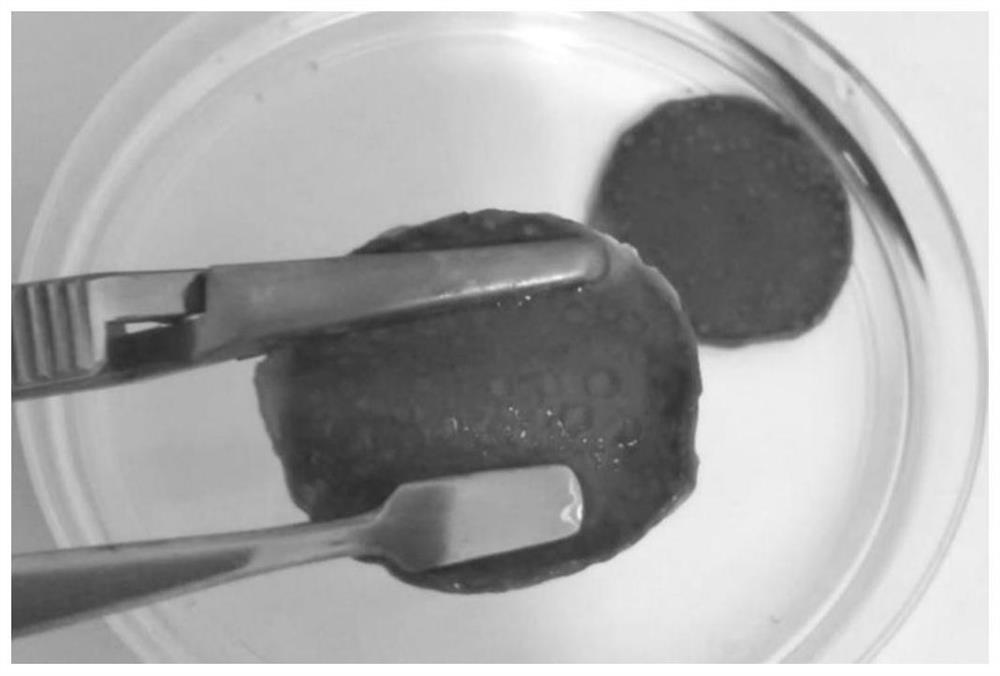
[0052] Such as figure 1 As shown, using nisin, CS and fibrin as raw materials, the composite antibacterial film prepared by the cross-linking of genipin was dark blue in appearance and had strong elasticity and toughness. The blending of protein materials in the preparation of CS membranes can significantly improve the mechanical properties of the membranes, making the composite membranes meet the needs of practical applications.

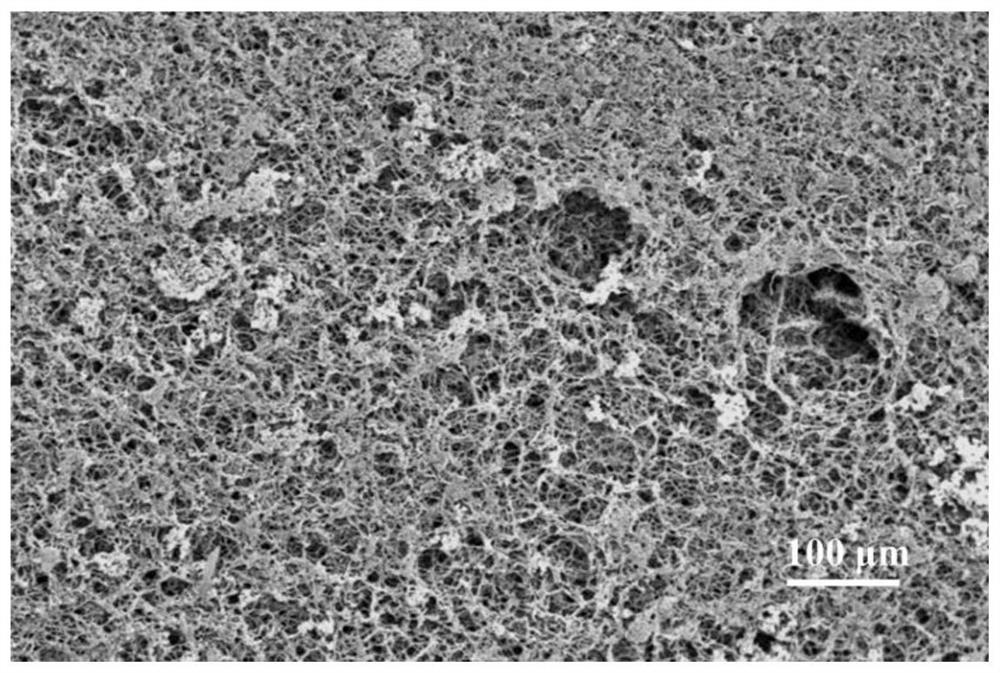
[0053] from figure 2 It can be seen that the composite antibacterial membrane has a porous network structure with a large number of pores, uniform distribution of pores, small pore size, and high mechanical strength.

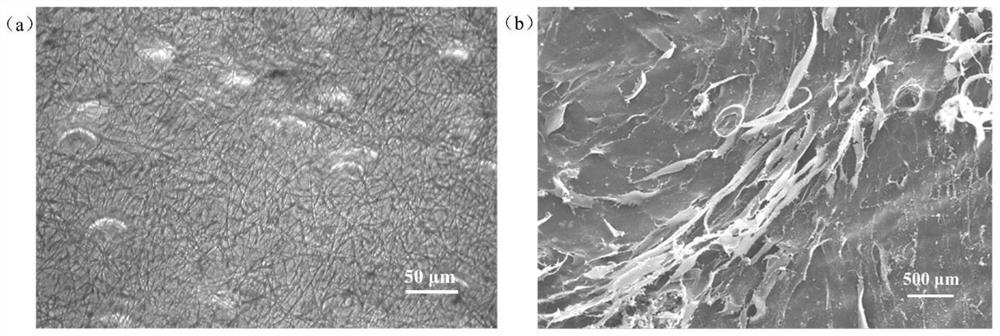
[0054] On the basis of the above antibacterial film, growth factors and EMSCs were implanted to prepare a composite antibacterial film. im...

Embodiment 3

[0055] Example 3: Establishment of animal full-thickness skin defect model and skin transplantation

[0056] Experimental rats aged 4-5 weeks were divided into 5 groups, 10 rats in each group, weighing about 250 g, marked with ear marks, and anesthetized by intraperitoneal injection.

[0057] Animal models of 2cm×2cm full-thickness skin defects were made on the back of rats, respectively, the non-implanted membrane material control group (group No. 1), the wound surface was only covered with vaseline oil gauze, and healed naturally; the ordinary membrane material group (group No. 2), Ordinary membrane materials without nisin, growth factors and EMSCs for wound transplantation; composite antibacterial membrane group (group 3), composite antibacterial membranes with nisin, growth factors and EMSCs for wound transplantation. The transplanted membrane material was sutured with 3-0 silk thread, fixed on the wound surface, and long thread was left. Rats in the three groups were rais...

the structure of the environmentally friendly knitted fabric provided by the present invention; figure 2 Flow chart of the yarn wrapping machine for environmentally friendly knitted fabrics and storage devices; image 3 Is the parameter map of the yarn covering machine
Login to View More

PUM

PropertyMeasurementUnit
concentrationaaaaaaaaaa
Login to View More

Abstract

The invention relates to a composite artificial skin material for repairing skin injury, and belongs to the field of skin repair. The composite artificial skin material prepared by the invention can be used for rapidly repairing small-area skin injury, the heal time is shortened by a half compared with that of a wound without a membrane material and shortened by 33% as compared a wound with a common membrane bacterial, and the repair efficiency is significantly improved. When applied to large-area skin injury, invasion of external bacteria in the wound can be blocked, the wound is kept dry andfree from infection, and the wound injury can be rapidly repaired. The composite artificial skin material is simple to use, good in antibacterial and repair effects and applicable to repair of skin injury on various scenes, and has broad application prospects.

Description

technical field [0001] The invention relates to a composite artificial skin material for repairing skin damage, belonging to the field of skin repair. Background technique [0002] Large-area skin defect is a serious and fatal trauma, and unreasonable treatment usually leads to bacterial infection, tissue dehydration and severe secondary trauma, which endangers human health. Traditional treatment methods include autologous skin transplantation, allogeneic skin transplantation and xenograft skin transplantation and other skin transplantation treatments. Among these methods, autologous skin transplantation has positive curative effect and no rejection reaction, so it is the first choice for the treatment of large area skin defects. However, autologous skin transplantation has problems such as insufficient source of autologous skin, formation of scars on the wound surface of the donor site, and pigmentation of the wound surface. [0003] In recent years, the rapid development...

Claims

the structure of the environmentally friendly knitted fabric provided by the present invention; figure 2 Flow chart of the yarn wrapping machine for environmentally friendly knitted fabrics and storage devices; image 3 Is the parameter map of the yarn covering machine
Login to View More

Application Information

Patent Timeline
no application Login to View More
Patent Type & Authority Applications(China)
IPC IPC(8): A61L27/20A61L27/22A61L27/38A61L27/50A61L27/54A61L27/60
CPCA61L27/20A61L27/225A61L27/227A61L27/3834A61L27/50A61L27/54A61L27/60A61L2300/252A61L2300/404A61L2300/414C08L5/08C08L89/00
Inventor 陆乃彦张轩翁雨燕杨国锋余雪健
Owner JIANGNAN UNIV