Check patentability & draft patents in minutes with Patsnap Eureka AI!

Method for producing L-phenylglycine through biological catalysis of genetic engineering strain

A technology of genetically engineered bacteria and phenylglycine, which is applied in the field of biocatalytic production of L-phenylglycine by genetically engineered strains, and can solve the problems of low catalytic activity of sulfuric acid and the like

Pending Publication Date: 2021-08-27
XIAMEN UNIV
View PDF5 Cites 0 Cited by
  • Summary
  • Abstract
  • Description
  • Claims
  • Application Information

AI Technical Summary

Problems solved by technology

However, they still have certain defects, such as the need for sulfuric acid assistance, low catalytic activity or the need for additional coenzyme circulation systems, etc.

Method used

the structure of the environmentally friendly knitted fabric provided by the present invention; figure 2 Flow chart of the yarn wrapping machine for environmentally friendly knitted fabrics and storage devices; image 3 Is the parameter map of the yarn covering machine
View more

Image

Smart Image Click on the blue labels to locate them in the text.
Viewing Examples
Smart Image
  • Method for producing L-phenylglycine through biological catalysis of genetic engineering strain
  • Method for producing L-phenylglycine through biological catalysis of genetic engineering strain
  • Method for producing L-phenylglycine through biological catalysis of genetic engineering strain

Examples

Experimental program
Comparison scheme
Effect test

Embodiment 1

[0030] Embodiment 1 constructs recombinant escherichia coli

[0031] 1. Construction of pET-LAAD-HmaS plasmid

[0032] With the sequences shown in SEQ ID NO: 5 and SEQ ID NO: 6 as the upstream and downstream primers (Table 1), PCR amplifies the L-α-amino acid deaminase gene LAAD (SEQ ID NO: 1), and the gel recovery object band; wherein, PCR amplification conditions: 98°C for 2min, 98°C for 10s, 56°C for 30s, 72°C for 1min, 30 cycles; 72°C for 2min.

[0033] The hydroxymandelic acid synthase gene HmaS (SEQ ID NO: 2) was amplified by PCR with primers SEQ ID NO: 7 and SEQ ID NO: 8, and the target band was recovered from the gel; wherein, PCR amplification conditions: 98°C for 2min, 98°C 10s, 56°C for 30s, 72°C for 1min, cycle 30 times; 72°C for 2min.

[0034] The L-α-amino acid deaminase gene LAAD and the hydroxymandelic acid synthase gene HmaS were respectively digested with BsaI at 37°C for 2 hours, and the digested fragments were recovered by PCR purification; the enzyme dig...

Embodiment 2

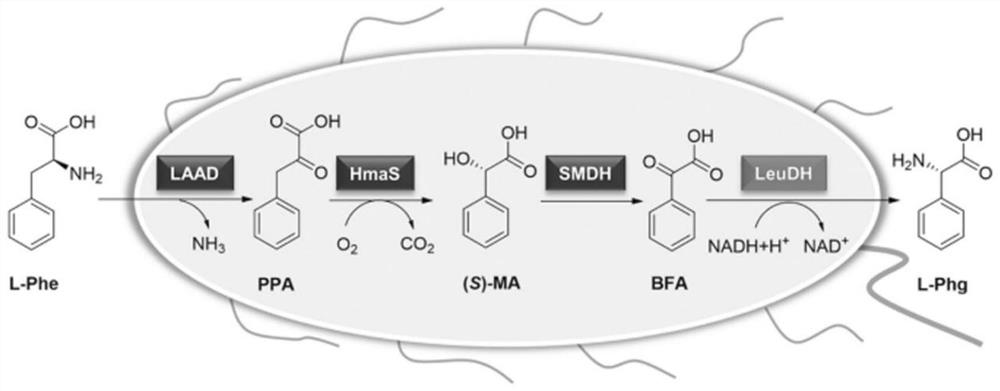
[0047] Example 2 Whole Cell Biotransformation Recombinant Strain

[0048] The Escherichia coli engineering bacteria prepared in Example 1 were inoculated in 2mL LB culture solution, then inserted into 100mL TB culture solution at a ratio of 1:100 to expand the culture for 2 to 3 hours, OD 600 After reaching 0.6, add 0.5mM IPTG, induce protein expression at 22°C for 20h, and obtain bacteria by centrifugation.

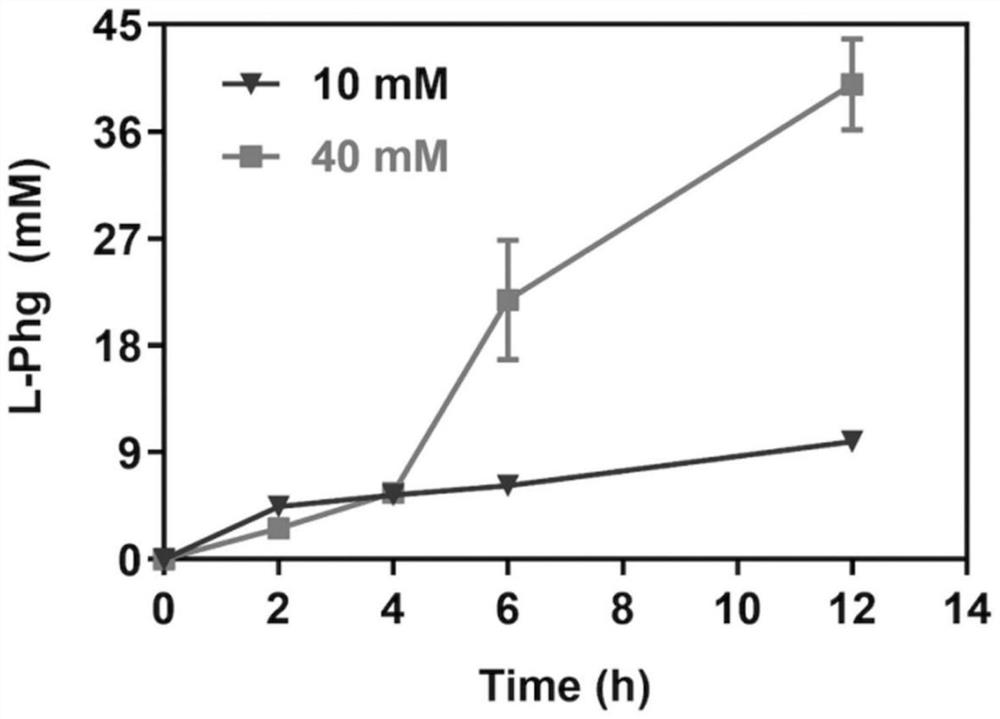
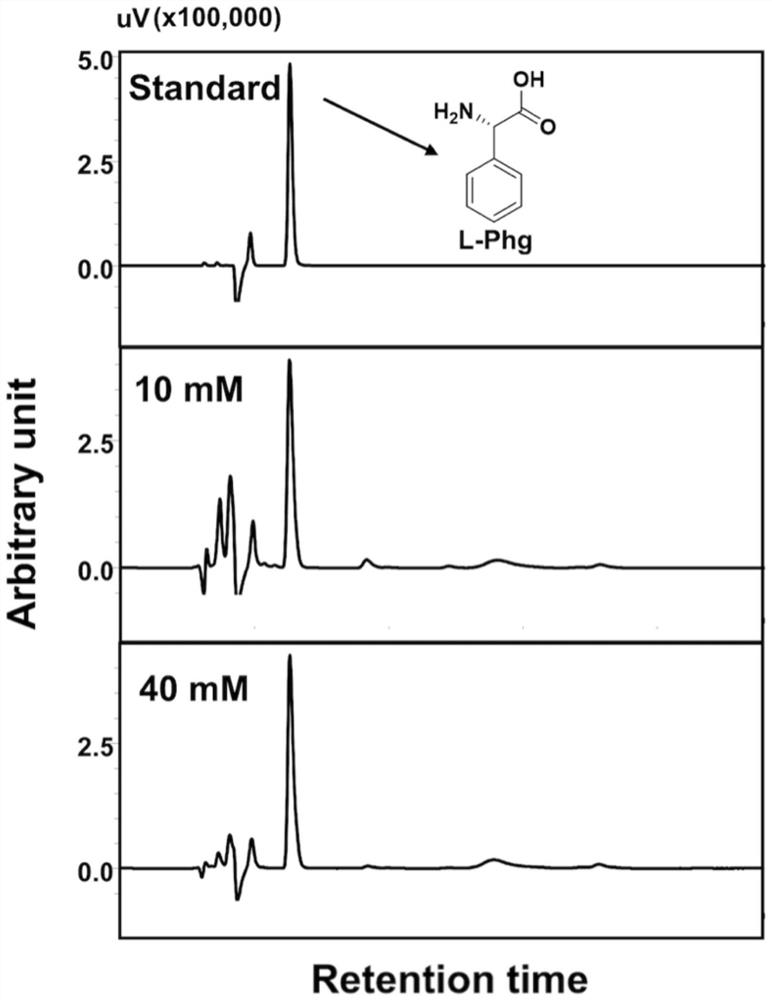
[0049] Whole cell transformation system (2mL): 10g / L dry weight of cells, L-phenylalanine (10mM or 40mM), and finally add phosphate buffer (200mM, pH=8.0) to make up. The system was reacted at 30° C. and 250 rpm for 1 to 12 hours. Then, the sample was centrifuged, the supernatant was taken, and the output of L-phenylglycine was detected by liquid chromatography.

[0050] Quantitative analysis of the product: the conversion solution was detected and analyzed by Shimadzu high performance liquid chromatography, using photodiode array detector (working wavelength 210nm), S...

the structure of the environmentally friendly knitted fabric provided by the present invention; figure 2 Flow chart of the yarn wrapping machine for environmentally friendly knitted fabrics and storage devices; image 3 Is the parameter map of the yarn covering machine
Login to View More

PUM

No PUM Login to View More

Abstract

The invention relates to a method for producing L-phenylglycine through biological catalysis of a genetic engineering strain, which comprises the following steps: connecting a gene for coding L-alpha-amino acid deaminase, a gene for coding hydroxymandelic acid synthetase and a carrier through enzyme digestion to obtain a first recombinant plasmid; connecting the gene for coding mandelate dehydrogenase, the gene for coding leucine dehydrogenase and the vector through enzyme digestion to obtain a second recombinant plasmid; and transferring the first recombinant plasmid and the second recombinant plasmid into a host cell together to obtain the genetically engineered bacterium. According to the embodiment of the invention, the genetically engineered bacterium obtained by the method is used for biologically catalyzing the L-phenylalanine, so that the maximum yield of the L-phenylglycine can be achieved, and the genetically engineered bacterium has a wide industrial application prospect.

Description

technical field [0001] The invention relates to the technical field of bioengineering, in particular to a method for biocatalyzing the production of L-phenylglycine by genetic engineering strains. Background technique [0002] L-phenylglycine is a kind of chiral unnatural amino acid, as an important raw material compound and drug intermediate, it can be used to synthesize β-lactam antibiotics such as penicillin, virgemycin, prunamycin I, etc. It is used in the synthesis of anti-tumor drug paclitaxel and has broad market prospects in the field of medicine. L-phenylglycine is mainly synthesized by chemical methods, but the chemical synthesis reaction conditions are severe, the process is complicated, there are many by-products, and the optical purity of the product is low, so further optical resolution is required; and a large amount of organic solvents and toxic substances are required in the synthesis process. Material, industrial pollution is serious. [0003] Compared wi...

Claims

the structure of the environmentally friendly knitted fabric provided by the present invention; figure 2 Flow chart of the yarn wrapping machine for environmentally friendly knitted fabrics and storage devices; image 3 Is the parameter map of the yarn covering machine
Login to View More

Application Information

Patent Timeline
no application Login to View More
IPC IPC(8): C12N15/70C12N15/53C12N1/21C12P13/04C12R1/19
CPCC12N15/70C12N15/52C12N9/0069C12N9/0016C12N9/0006C12N9/0022C12P13/04C12Y113/11046C12Y104/01009C12Y101/99031C12Y104/03002
Inventor 袁吉锋
Owner XIAMEN UNIV
Features
  • R&D
  • Intellectual Property
  • Life Sciences
  • Materials
  • Tech Scout
Why Patsnap Eureka
  • Unparalleled Data Quality
  • Higher Quality Content
  • 60% Fewer Hallucinations
Social media
Patsnap Eureka Blog
Learn More