
Synthesis method of 3, 3, 5-trimethyl cyclohexanol
A technology of trimethylcyclohexanol and its synthesis method, which is applied in the field of synthesis of 3,3,5-trimethylcyclohexanol, can solve the problems of product cost increase, waste lye environmental pollution, etc., and avoid post-processing , Improve the hydrogenation activity and simplify the preparation process
- Summary
- Abstract
- Description
- Claims
- Application Information
AI Technical Summary
Problems solved by technology
Method used
Image

Examples
Embodiment approach 1
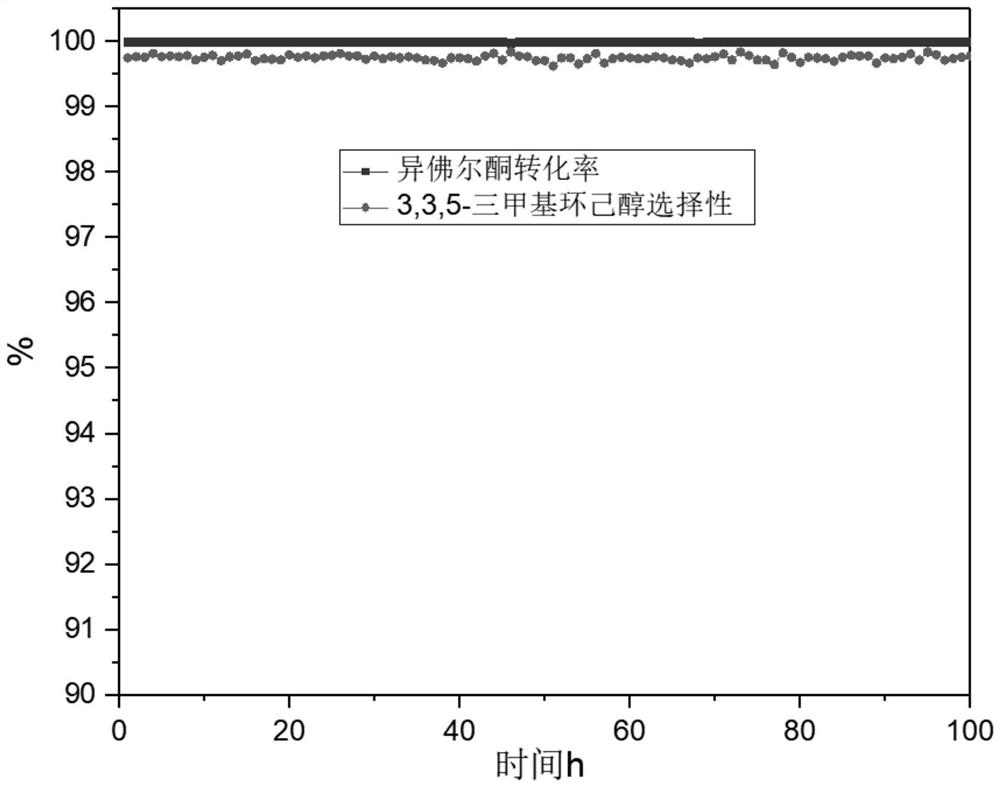
[0035] In a 10ml fixed bed reactor, the deep hydrogenation of isophorone to 3,3,5-trimethylcyclohexanol was carried out using a Zn-promoted Ni-Mo unsupported catalyst. The reaction temperature was 140 °C and the reaction pressure was 1.5 MPa. , the raw material liquid phase space velocity is 0.5h -1 , under the condition of hydrogen oil volume ratio of 240, through gas chromatography analysis, the conversion rate of raw material isophorone is 99.46%, the average selectivity of 3,3,5-trimethylcyclohexanol is 99.78%, and the ratio of cis-trans isophorol is 99.78%. 5.8.
[0036] The used Zn-promoted Ni-Mo unsupported catalyst preparation steps:
[0037] (1) At 30°C, add 0.5 g of ethanolamine to 60 ml of deionized water, and stir evenly.
[0038] (2) Continue to add 15.0g basic nickel carbonate, 10.8g ammonium heptamolybdate and 1.6g zinc nitrate into the above solution, and stir for 1h.
[0039] (3) Pour the above mixture into the reaction kettle, crystallize at 150°C for 6h, co...
Embodiment approach 2
[0044] In a 10ml fixed bed reactor, the deep hydrogenation of isophorone to 3,3,5-trimethylcyclohexanol was carried out using a Zn-promoted Ni-Mo unsupported catalyst, the reaction temperature was 160 °C, and the reaction pressure was 2.0 MPa , the raw material liquid phase volume space velocity is 1.5h -1 , under the condition of hydrogen oil volume ratio of 240, through gas chromatography analysis, the conversion rate of raw material isophorone is 99.52%, the average selectivity of 3,3,5-trimethylcyclohexanol is 99.09%, and the ratio of cis-trans isophorol is 99.09%. 6.1.
[0045] The used Zn-promoted Ni-Mo unsupported catalyst preparation steps:
[0046] (1) Add 1.5 g of ethanolamine to 60 ml of deionized water under the condition of 45°C, and stir evenly.
[0047] (2) Continue to add 33.6 g of nickel acetate, 7.9 g of ammonium heptamolybdate, and 2.4 g of zinc nitrate into the above solution, and stir for 1.0 h.
[0048] (3) Pour the above mixture into the reaction kett...
Embodiment approach 3
[0053] In a 10ml fixed bed reactor, the deep hydrogenation of isophorone to 3,3,5-trimethylcyclohexanol was carried out using a zinc-promoted Ni-Mo unsupported catalyst. The reaction temperature was 160 °C and the reaction pressure was 2.0 MPa. , the raw material liquid phase space velocity is 1.5h -1 , under the condition of hydrogen oil volume ratio of 480, through gas chromatography analysis, the conversion rate of raw material isophorone is 99.81%, the average selectivity of 3,3,5-trimethylcyclohexanol is 99.54%, and the ratio of cis-trans isophorol is 99.54%. 6.3.
[0054] The used Zn-promoted Ni-Mo unsupported catalyst preparation steps:
[0055] (1) Add 1.9 g of ethanolamine to 60 ml of deionized water under the condition of 60°C, and stir evenly.
[0056] (2) Continue to add 26.2g of nickel nitrate, 14.1g of ammonium tetramolybdate and 3.2g of zinc nitrate into the above solution, and stir for 1h.
[0057] (3) Pour the above mixture into the reaction kettle, crystal...
PUM
 Login to View More
 Abstract
Description
Claims
Application Information
 Login to View More