

Preparation method of CdSe nano-crystalline composite liposome microcapsule bubble used for fluorescence immunity detection
A technology of nanocrystal composite and fluorescent nanocrystal, which is applied in the fields of nanomaterials and biology, can solve problems affecting sensitivity, sedimentation, quantum dot leakage, etc., and achieve the effect of simple operation, good repeatability, and large amount of preparation
- Summary
- Abstract
- Description
- Claims
- Application Information
AI Technical Summary
Problems solved by technology
Method used
Image



Examples
Embodiment Construction
[0026] Select 99.9% CdO: 0.0128-0.0150g; Se powder: 0.079-0.158g; zinc fatty acid: 0.114-0.328g.
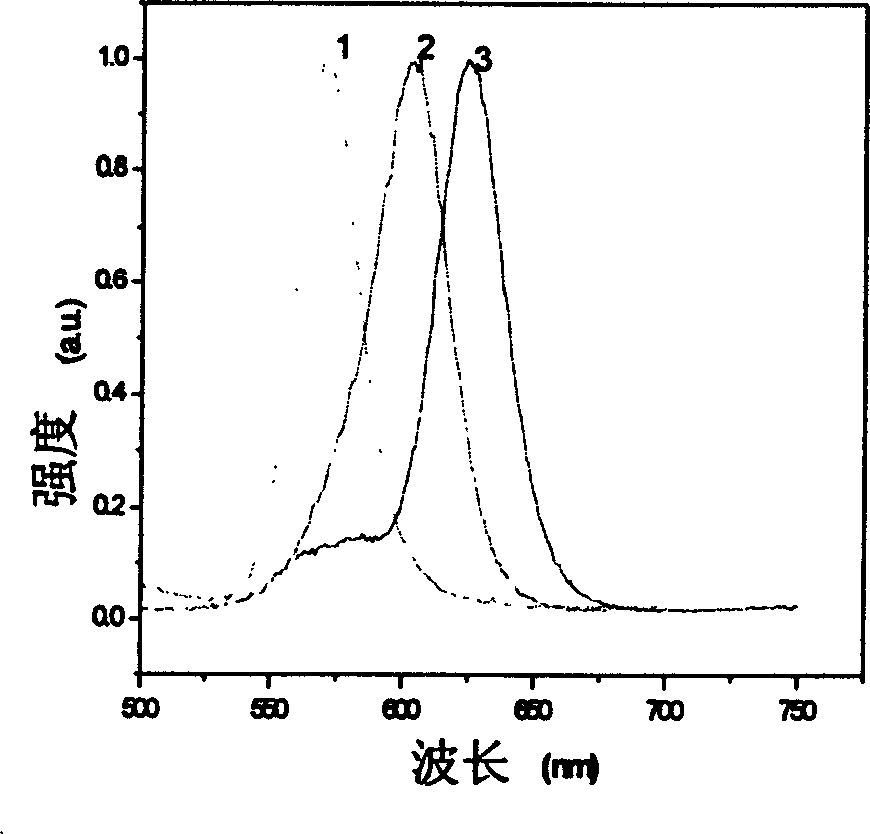
[0027] Between 140-150℃, CdO reacts with stearic acid to produce cadmium stearate, then the reaction vessel of the resultant is lowered to room temperature, and TOPO and HDA are added to the vessel at room temperature, and then the reactor The temperature rose to 300-320°C. TOPSe is injected into the system at this temperature, and the temperature is rapidly cooled after injection, and the cooling interval is 250-280°C. Nanocrystals of different sizes can be obtained with different cooling times, that is, nanocrystals with sizes ranging from 3-5nm are obtained. The fluorescent color of the crystal gradually red shifts with time, that is, it gradually changes from green to red. Figure 1 shows the fluorescence spectra of different sizes synthesized under the above conditions. Based on the synthesis of different CdSe nanocrystals, Zn was directly injected into the system, and Zn combine...
PUM
 Login to View More
 Abstract
Description
Claims
Application Information
 Login to View More