Amphiphilic tri-block copolymer taxol bonding medicament and synthesis method thereof

A copolymer and tri-block technology, which is applied in the field of paclitaxel-bonded drugs and its synthesis, can solve the problems of difficult synthesis of carrier polymers, large-scale production and clinical application.

A copolymer and tri-block technology, which is applied in the field of paclitaxel-bonded drugs and its synthesis, can solve the problems of difficult synthesis of carrier polymers, large-scale production and clinical application.

CN1961962AInactive Publication Date: 2007-05-16CHANGCHUN INST OF APPLIED CHEMISTRY - CHINESE ACAD OF SCI

Image

Smart Image Click on the blue labels to locate them in the text.
Viewing Examples
Smart Image
  • Amphiphilic tri-block copolymer taxol bonding medicament and synthesis method thereof
  • Amphiphilic tri-block copolymer taxol bonding medicament and synthesis method thereof
  • Amphiphilic tri-block copolymer taxol bonding medicament and synthesis method thereof

Examples

Experimental program
Comparison scheme
Effect test

Embodiment 1

[0034] Embodiment 1: the preparation of PLA-PEG-PLA triblock polymer

[0035] 1 g of lactide (LA) monomer recrystallized three times with ethyl acetate and 4 g of polyethylene glycol (PEG) with a molecular weight of 4600 were added to a water separator with a reflux condensing unit that was ventilated three times with high-purity argon. tube and a dry ampoule with a magnetic stirrer, add anhydrous toluene solvent with a total mass ratio of LA and PEG of 2:1 to azeotropically remove water, then distill off half of the toluene, add about 0.2ml molar concentration of 2× 10 -3 mol / l stannous octoate toluene solution. Stir and react at 110°C for 12h, then dissolve the product in an appropriate amount of dichloromethane, settle with ether to obtain a white product, dry it in vacuum at 40°C to obtain a PLA-PEG-PLA triblock polymer, and calculate by NMR The total molecular weight of the two PLA blocks is about 1100.

Embodiment 2

[0036] Embodiment 2: the preparation (solution method) of the PLA-PEG-PLA triblock polymer of terminal carboxyl group

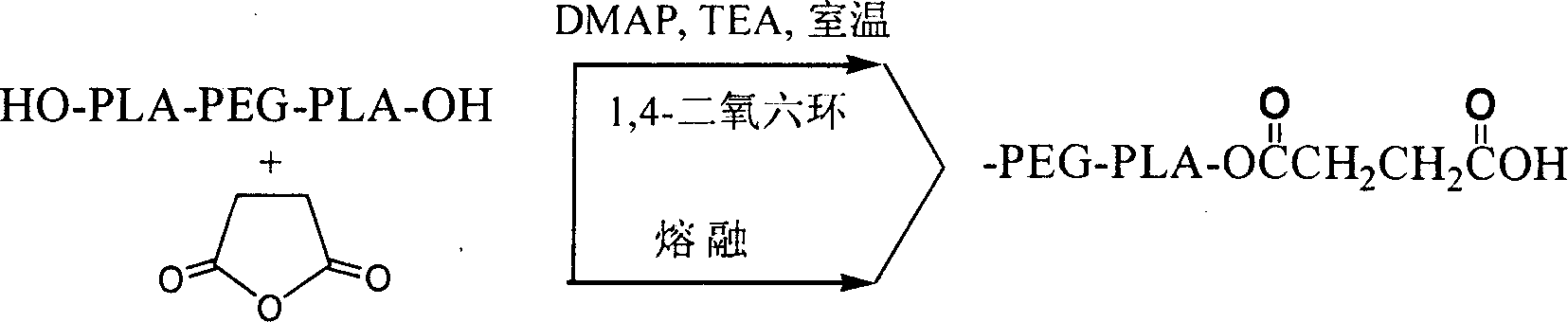
[0037] Dissolve 1.0g of hydroxyl-terminated PLA-PEG-PLA triblock polymer in 20ml of 1,4-dioxane, and then add 0.024g of succinic anhydride, 0.029g of DMAP and 0.03ml of TEA at 0°C. Stir the reaction for 24 hours. Filter out the resulting precipitate, concentrate the filtrate and settle it with a large amount of ether, filter, and vacuum-dry at 40°C to obtain a white product of PLA-PEG-PLA triblock polymer with carboxyl groups.

[0038] The nuclear magnetic spectrum of the obtained PLA-PEG-PLA triblock polymer whose end group is carboxyl group is shown in FIG. 3 .

Embodiment 3

[0039] Embodiment 3: the preparation (melt method) of the PLA-PEG-PLA triblock polymer of terminal carboxyl group

[0040] Put 0.5g of hydroxyl-terminated PLA-PEG-PLA triblock polymer and 0.012g of succinic anhydride into a one-necked bottle, heat to 130°C until the polymer melts, maintain a constant temperature, react for 8 hours, add 10ml of chloroform to dissolve, Settled with a large amount of ether, filtered, and dried under vacuum at 40°C to obtain a white product of carboxyl-terminated PLA-PEG-PLA triblock polymer.

the structure of the environmentally friendly knitted fabric provided by the present invention; figure 2 Flow chart of the yarn wrapping machine for environmentally friendly knitted fabrics and storage devices; image 3 Is the parameter map of the yarn covering machine
Login to View More

PUM

No PUM Login to View More

Abstract

The invention relates to an amphipathy block copolymer-Paclitaxel compound and relative preparation, wherein said invention is formed by bonded aliphatic polyester-carbowax-aliphatic polyester block copolymer and Paclitaxel; with hydroxyl carbowax (PEG), solvent and catalyst, it processes the ring-opening polymerization of aliphatic ester to obtain the liphatic polyester-carbowax-aliphatic polyester block copolymer, then converting the hydroxyl grouyp into end carboxyl; with condensating agent, processing genate reaction with Paclitaxel, to obtain the inventive drug. The invention has amphipathy property, to be made into liquid agent or freeze dried. And its block structure can improve the Paclitaxel content, adjusted between 10-40%.

Description

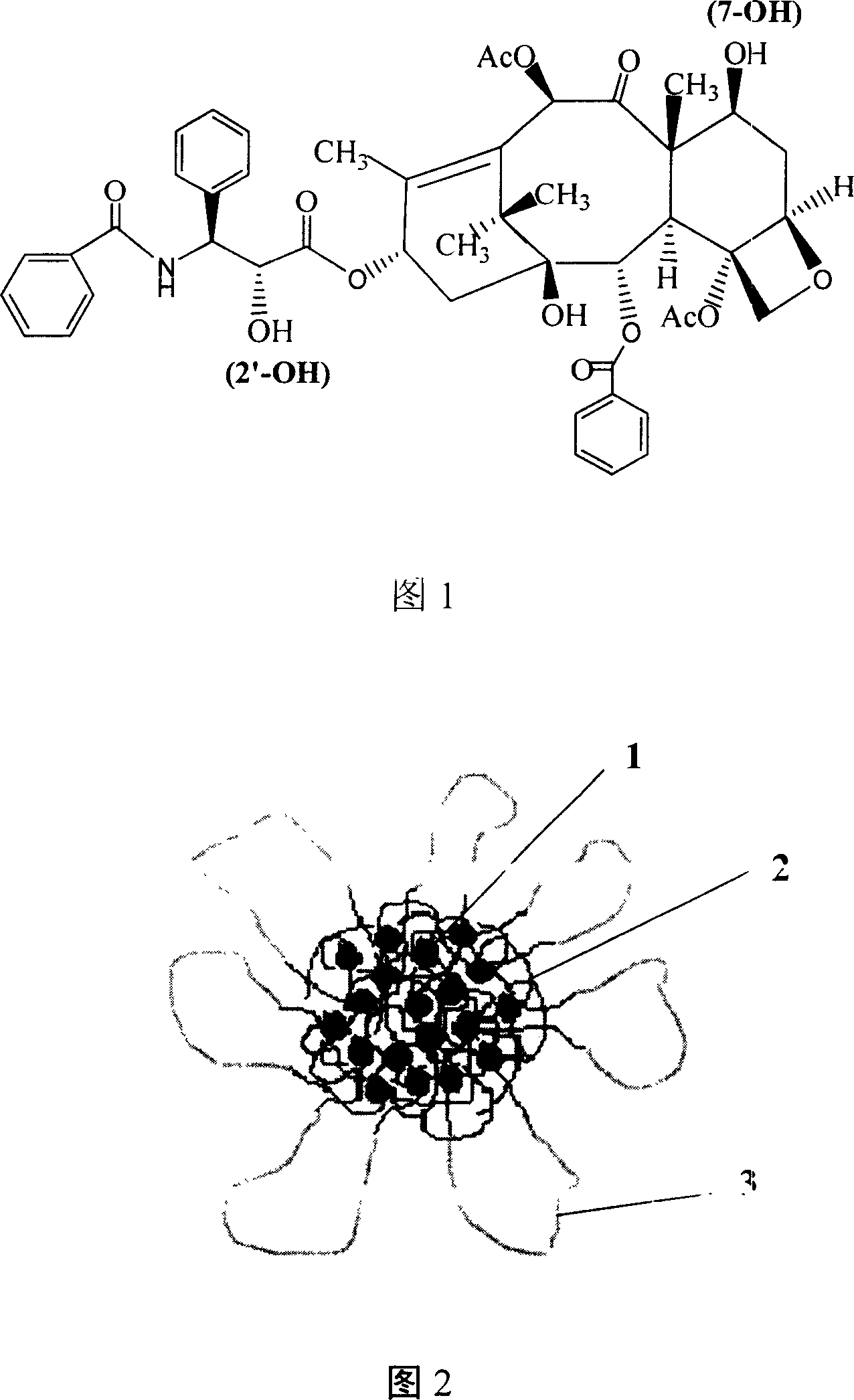
technical field [0001] The invention relates to a class of biodegradable polymer paclitaxel-bonded drugs and a synthesis method thereof, in particular to an amphiphilic triblock copolymer-paclitaxel-bonded drug and a synthesis method thereof. Background technique [0002] Paclitaxel is an anti-microtubule agent extracted from the needles and bark of Taxus brevifolia - Taxus brevifolia (see Figure 1 for the structure), since it was first isolated and crystallized by chemistry and X-rays in 1971 by Wani et al. Since the structure of paclitaxel was determined by scientific methods, Phase I clinical research and Phase II and Phase III clinical trials have shown that it has obvious antitumor effects on human cancer. This effect was originally discovered in advanced ovarian and breast tumors, and it has been reported in a large number of literatures to have a significant effect on small cell and non-small cell lung cancer, head and neck cancer, and metastatic melanoma. However, t...

Claims

the structure of the environmentally friendly knitted fabric provided by the present invention; figure 2 Flow chart of the yarn wrapping machine for environmentally friendly knitted fabrics and storage devices; image 3 Is the parameter map of the yarn covering machine
Login to View More

Application Information

Patent Timeline
16 May 2007
Publication
CN1961962A
IPC
A61K47/48; A61K31/337; A61K47/34; A61P35/00; A61K47/60
Inventors
景遐斌; 谢志刚