Polymer/filler/metal composite fiber and preparation method thereof
a composite fiber and metal technology, applied in the field of synthetic fibers, can solve the problems of reducing reducing the distance between metal particles, and reducing so as to reduce the probability of recombination of metal particles, and reduce the number of metal particles. , the viscosity of the blend system is greatly increased, the effect of reducing the distan
- Summary
- Abstract
- Description
- Claims
- Application Information
AI Technical Summary
Benefits of technology
Problems solved by technology
Method used
Image

Examples
example 1
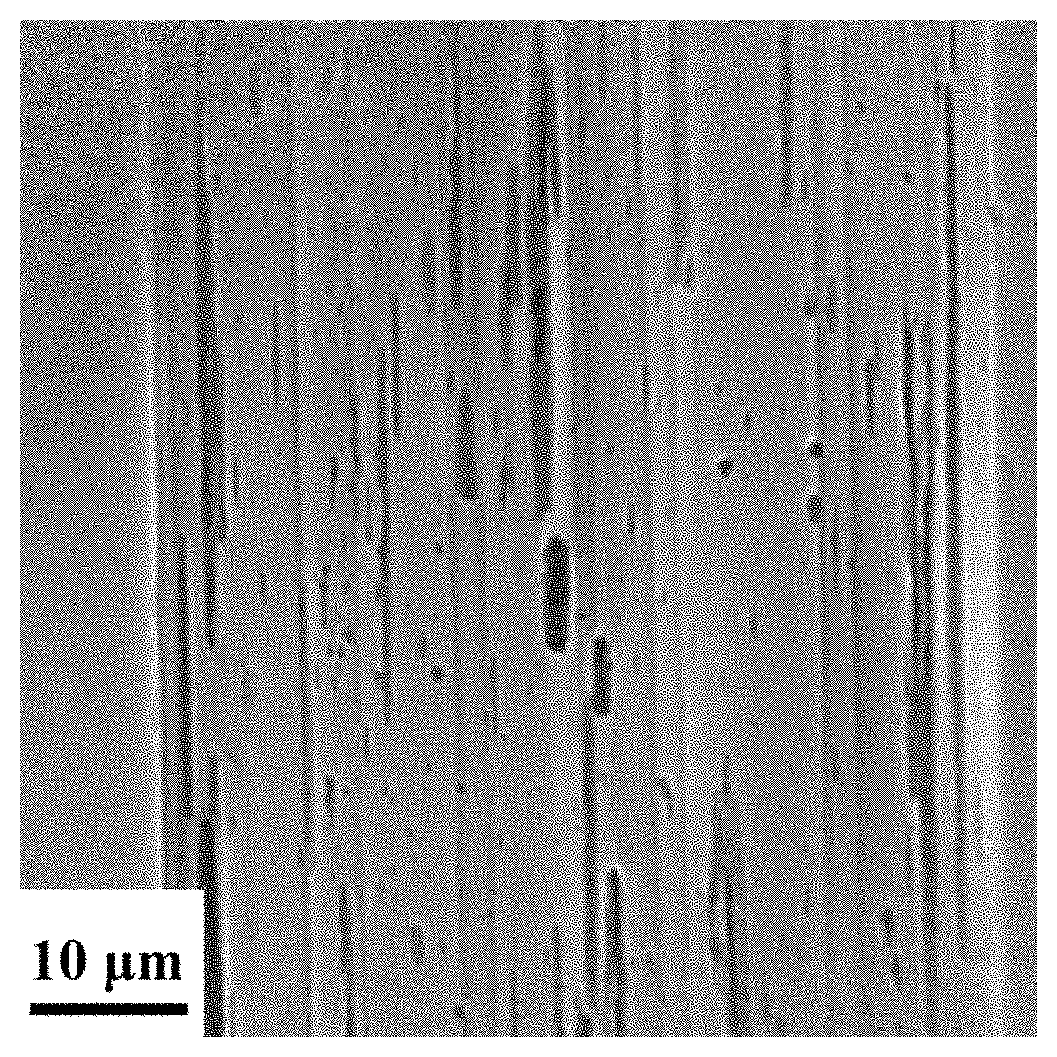
[0046]The present example used polypropylene (Sinopec Ningbo Zhenhai Refining & Chemicals, brand Z30S, melting point of 167° C.) as the polymer, tin-bismuth alloy (Beijing Sanhe Dingxin Hi-tech Development Co., Ltd., melting point of 138° C.) as the metal alloy, and carbon nanotubes (Beijing Cnano Technology, brand FT-9000, average diameter of 11 nm, average length of 10 μm, multi-walled carbon nanotubes). The volume ratio of tin-bismuth alloy to polypropylene was 0.5:100, and the weight ratio of carbon nanotubes to polypropylene was 2:100. Antioxidant 1010 (produced by Ciba-Geigy, Switzerland), antioxidant 168 (produced by Ciba-Geigy, Switzerland), and zinc stearate (commercially available) were added in appropriate amounts; wherein based on 100 parts by weight of the polypropylene, the amount of antioxidant 1010 was 0.5 part, the amount of antioxidant 168 was 0.5 part, and the amount of zinc stearate was 1 part.
[0047]The above raw materials of the polymer, the carbon nanotubes and...
example 2
[0049]This example was carried out as described in Example 1, except that the volume ratio of the metal alloy to the polymer was 1:100. The resultant polymer / carbon nanotube / metal composite fibers were subjected to various tests. The test results are listed in Table 1. As observed with the scanning electron microscope, the diameter of the metal short fibers in the composite fibers was below 2.15 μm. The length was greater than or equal to 7.6 μm. Broken fibers were rarely seen during spinning, and the fibers as obtained had smooth surface.
example 3
[0050]This example was carried out as described in Example 1, except that the volume ratio of the metal alloy to the polymer was 2:100. The resultant polymer / carbon nanotube / metal composite fibers were subjected to various tests. The test results are listed in Table 1 and Table 2. As observed with the scanning electron microscope, the diameter of the metal short fibers in the composite fibers was below 3.46 μm. The length was greater than or equal to 9 μm. Broken fibers were rarely seen during spinning, and the fibers as obtained had smooth surface.
PUM
| Property | Measurement | Unit |
|---|---|---|
| melting point | aaaaa | aaaaa |
| diameter | aaaaa | aaaaa |
| melting point | aaaaa | aaaaa |
Abstract
Description
Claims
Application Information
 Login to View More
 - R&D
- Intellectual Property
- Life Sciences
- Materials
- Tech Scout
- Unparalleled Data Quality
- Higher Quality Content
- 60% Fewer Hallucinations
Browse by: Latest US Patents, China's latest patents, Technical Efficacy Thesaurus, Application Domain, Technology Topic, Popular Technical Reports.
© 2025 PatSnap. All rights reserved.Legal|Privacy policy|Modern Slavery Act Transparency Statement|Sitemap|About US| Contact US: help@patsnap.com