
Donepezil formulations
a technology of donepezil and formulations, applied in the direction of drug compositions, biocides, dispersed delivery, etc., can solve the problems of reduced patient compliance, unpleasant taste of solution or suspension of donepezil, and patients may experience cholinergic adverse events
- Summary
- Abstract
- Description
- Claims
- Application Information
AI Technical Summary
Benefits of technology
Problems solved by technology
Method used
Image

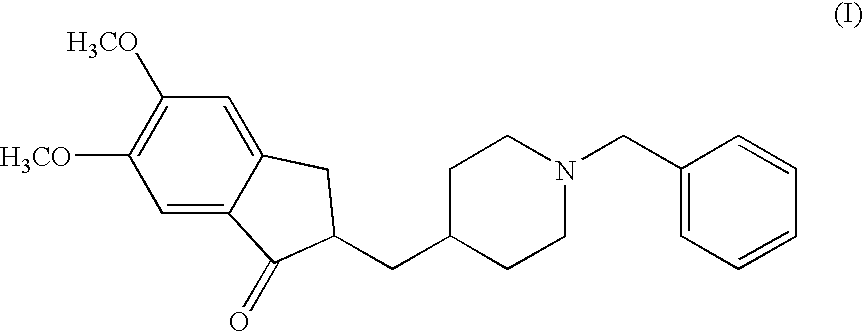
Examples
example 1
Polyvinylpyrrolidone (PVP) 29 / 32K / Donepezil hydrochloride, 2:1 wt Basis, Oven Drying
[0305] To a 125 mL Erlenmeyer flask is added PVP 29 / 32K (8.1210 g) having a molecular weight distribution corresponding to 29 / 32K available from International Specialty Chemicals under the tradename PLASDONE, donepezil free base (4.62 g) and hot purified water (60° C., 48 mL). The Erlenmeyer flask is immersed in a water bath heated to 60° C. Hot 1.0 N HCl (60° C., 13.6 mL) is added to the 125 mL Erlenmeyer flask and stirred for approximately 5 minutes. Approximately 5 mL of the hot solution is transferred using a pipette to a pre-heated crystallization dish (60° C.) and allowed to dry in a tray oven at 60° C. for 71 hours. The solid product is tested by FTIR and x-ray powder diffraction to indicate the lack of crystalline peaks in the x-ray powder diffraction to indicate an absence of crystalline donepezil and that donepezil is present in amorphous form only.
example 2
PVP 29 / 32K / Donepezil hydrochloride, 2:1 wt Basis, Vacuum Drying.
[0306] Approximately 5 mL of the hot solution prepared in Example 1 is transferred using a pipette to a pre-heated 50 mL round bottom flask (60° C.). The sample is dried under static vacuum at 60° C. for 29 hours. The solid product is tested by FTIR and x-ray powder diffraction.
example 3
PVP 29 / 32K / Donepezil hydrochloride, 2:1 wt Basis, Fluid Bed Drying.
[0307] To a 250 mL flask (equipped with a magnetic stir bar) is added PVP 29 / 32K (14.0097 g), donepezil hydrochloride (7.0058 g) and purified water (85.366 g). The contents of the flask are stirred and heated to a temperature of approximately 60° C. with a stirring hotplate to obtain a clear solution. The hot solution is spray dried onto dibasic calcium phosphate dihydrate (100.0 g) using a bench top fluid bed dryer. The solid product is tested by FTIR and x-ray powder diffraction.
PUM
| Property | Measurement | Unit |
|---|---|---|
| Fraction | aaaaa | aaaaa |
| Fraction | aaaaa | aaaaa |
| Fraction | aaaaa | aaaaa |
Abstract
Description
Claims
Application Information
 Login to View More